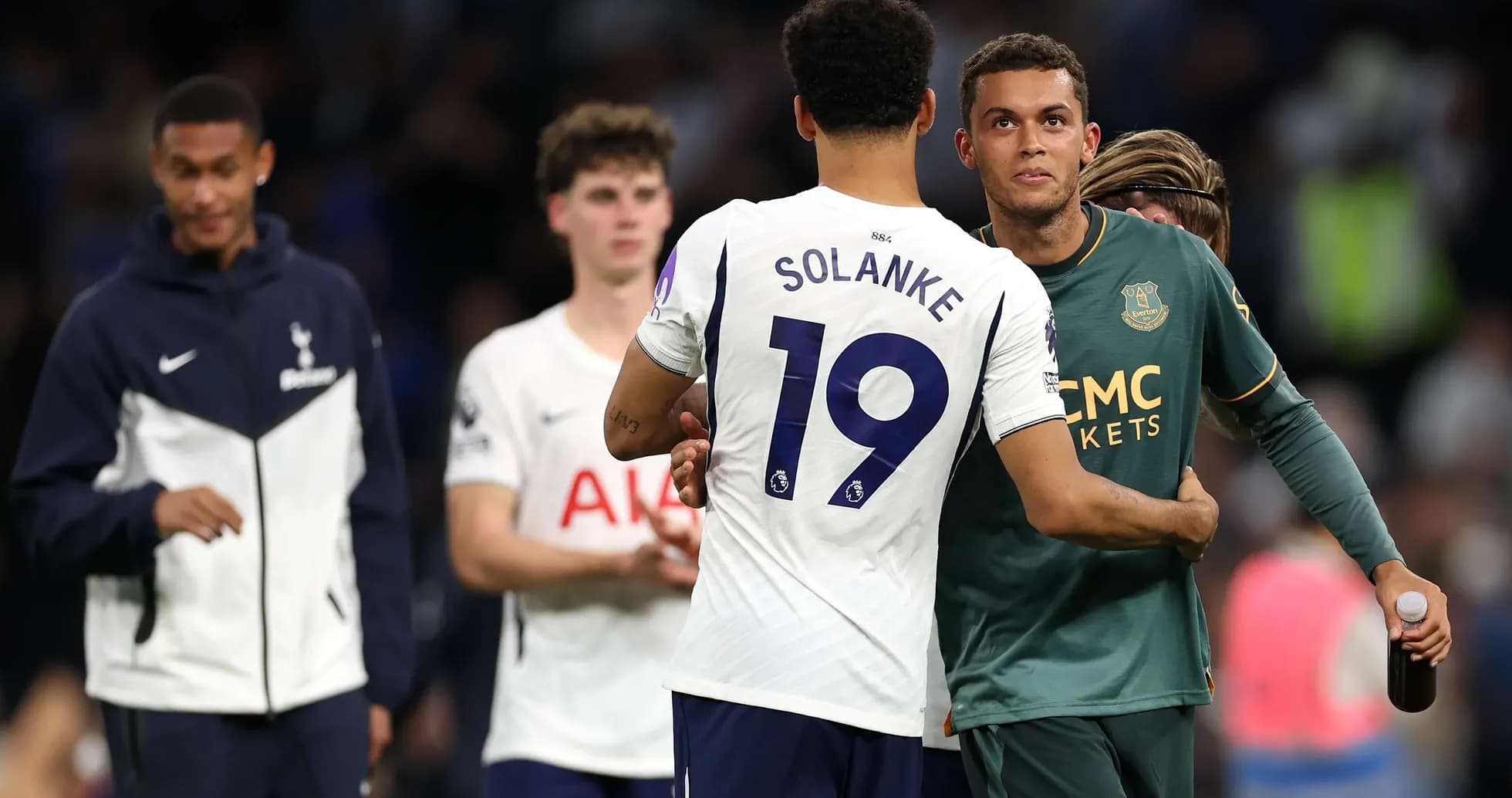
Tottenham vs Everton: A Tactical Stalemate Under De Zerbi
Under the grey north London sky, this had the feel of a crossroads rather than a routine early-season fixture. Tottenham, under Roberto De Zerbi, arrived in Round 4 marooned in 17th, with just 2 points from 4 matches and a goal difference of -5. Everton, steadier if unspectacular in 8th with 6 points and unbeaten, came to the Tottenham Hotspur Stadium as the side that already knew what it was this season. The goalless full-time scoreline reflected both the hosts’ attacking crisis and the visitors’ pragmatic resilience.
I. The Big Picture – Two 4-2-3-1s, two very different moods
Both managers set up in a 4-2-3-1, but the systems carried contrasting emotional weights. De Zerbi’s Tottenham are a possession-first project still hunting their first league goal of the campaign. Heading into this game, they had played 4 league matches in total, drawn 2 and lost 2, failing to score in all 4. Overall they averaged 0.0 goals for per game, and 1.3 goals against, with 0 goals for and 2 conceded at home.
Across the technical area, David Moyes had a clearer identity already embedded. Everton also lined up 4-2-3-1, but their season to date had been defined by control and compactness. Heading into this game, they had played 4 league matches in total, winning 1 and drawing 3, with 5 goals for and 3 against. At home they had averaged 2.0 goals for and 1.0 against; away they had been more conservative, with 0.5 goals for and 0.5 against on their travels. The league table framed this as a meeting between a side trying to remember how to win and another that had quietly forgotten how to lose.
The starting XIs underlined that contrast. For Tottenham, A. Kinský started in goal behind a back four of A. Robertson, M. van de Ven, J. van Hecke and A. Gray. In midfield, the double pivot of R. Bentancur and S. Tonali was tasked with knitting control to incision, while the advanced trio of Omar Marmoush, Mateus Fernandes and Sávio supported lone striker D. Solanke. It was an XI built for dominance of territory, but still unproven in the most important metric: goals.
Everton mirrored the shape but not the uncertainty. J. Pickford anchored a back line of V. Mykolenko, J. Branthwaite, J. Tarkowski and A. Maitland-Niles. In front, H. Armstrong and J. Garner formed a disciplined shield, freeing B. Johnson, K. Dewsbury-Hall and Tyrique George to float behind forward T. Barry. It was a structure that had already delivered balance: 5 goals scored overall, only 3 conceded, and clean sheets both at home and away.
II. Tactical Voids – The absences that shaped the narrative
The story of Tottenham’s season so far is as much about who is missing as who is playing. D. Kulusevski, M. Mudryk, W. Odobert and X. Simons were all ruled out, each with knee or ankle injuries, while Richarlison’s absence due to transfer negotiations removed another potential reference point in the final third. De Zerbi was effectively without four natural attacking difference-makers plus a proven Premier League forward, forcing him to lean heavily on Marmoush, Sávio and Solanke for creativity and penetration.
For Everton, the headline absentee was C. Norgaard, out injured. His profile as a screening midfielder and tempo-setter would have dovetailed neatly with Moyes’ compact 4-2-3-1. Without him, the responsibility for controlling central spaces fell even more on J. Garner and H. Armstrong.
Disciplinary trends added another layer. Tottenham’s yellow-card distribution this season has been heavily back-loaded: 40.00% of their bookings have arrived between 76-90 minutes, with 20.00% in each of the 0-15, 31-45 and 46-60 windows. That late-game spike hints at a side chasing matches, stretched and emotional. Everton’s cautions have been more evenly spread, but with a noticeable rise between 61-75 minutes at 28.57%, suggesting that their intensity phase often coincides with the third-quarter push of a match.
III. Key Matchups – Hunter vs Shield, Engine Room battles
The “Hunter vs Shield” duel here was more conceptual than individual, because Tottenham’s “hunter” is collective rather than a single prolific scorer. Solanke led the line, but the real threat was supposed to come from the rotations of Sávio, Marmoush and Mateus Fernandes between the lines. They were up against an Everton defence that, heading into this fixture, had conceded just 3 goals overall in 4 matches, with only 1 conceded on their travels. That away record – 0.5 goals against per game – made clear that breaking Moyes’ block would require precision rather than volume.
At the heart of that block stood J. Tarkowski and J. Branthwaite, protected by Garner and Armstrong. Their task was to absorb Tottenham’s positional play without allowing Solanke to pin them back or Marmoush to drift into the half-spaces unchecked. Everton’s comfort in narrow scorelines, combined with Pickford’s command of his area, meant that Spurs’ wide overloads through Robertson and Gray needed to be perfect to open real gaps.
The “Engine Room” clash was even more intriguing. Bentancur and Tonali versus Garner and Armstrong set up as a duel between two double pivots with very different mandates. Tottenham’s pair were asked to progress and probe, breaking Everton’s first line and feeding the three behind Solanke. Garner and Armstrong, by contrast, were tasked with compressing the central corridor, slowing Spurs’ tempo and springing counters through Dewsbury-Hall and Johnson.
Garner’s season profile underlines his importance. In 4 league appearances he has completed 128 passes with 3 key passes and a 90% accuracy rate, while making 11 tackles and winning 16 of 27 duels. He has already collected 2 yellow cards, and appears in both the yellow and red card leaderboards, underlining how close to the disciplinary edge he operates. His willingness to step into challenges is central to Everton’s ability to disrupt rhythm in midfield.
IV. Statistical Prognosis – A nil-nil that made sense
Following this result, the numbers still paint Tottenham as a side in search of an attacking identity. They have yet to score in the league, have failed to score in all 4 fixtures overall, and continue to average 0.0 goals for both at home and away. Their clean-sheet count of 2 overall, split evenly between home and away, hints at a defensive platform that is not entirely broken, but the goal difference of -5 (0 scored, 5 conceded overall) is a stark reminder of the imbalance.
Everton, by contrast, extend their unbeaten run and remain defined by controlled margins. With 5 goals for and 3 against overall, their goal difference of +2 reflects a side that rarely over-commits. Two clean sheets and only 1 match without scoring on their travels underline a team comfortable in tight, tactical contests such as this.
In xG terms, this had the feel of a low-margin game even before a ball was kicked: a home side with no goals and an away side conceding 0.5 per match on their travels was always likely to lean towards caution. The goalless draw fits the underlying data. Tottenham’s absences in the final third and Everton’s compact 4-2-3-1 combined to produce a match where the story was structure over chaos, control over risk.
For De Zerbi, the tactical puzzle remains unsolved: how to convert sterile control into cutting edge without his missing creators. For Moyes, this was another data point in a growing sample that says his Everton are hard to beat, structurally sound, and quietly building from a foundation of defensive solidity.