Tottenham's Struggles Continue Despite Clean Sheet Against Nottingham Forest
Tottenham finally stopped the rot on Saturday. They didn’t win, they still haven’t scored this Premier League season, but they did walk out of the City Ground with something to show for it.
A point. A clean sheet. And a manager who, somehow, sounded encouraged.
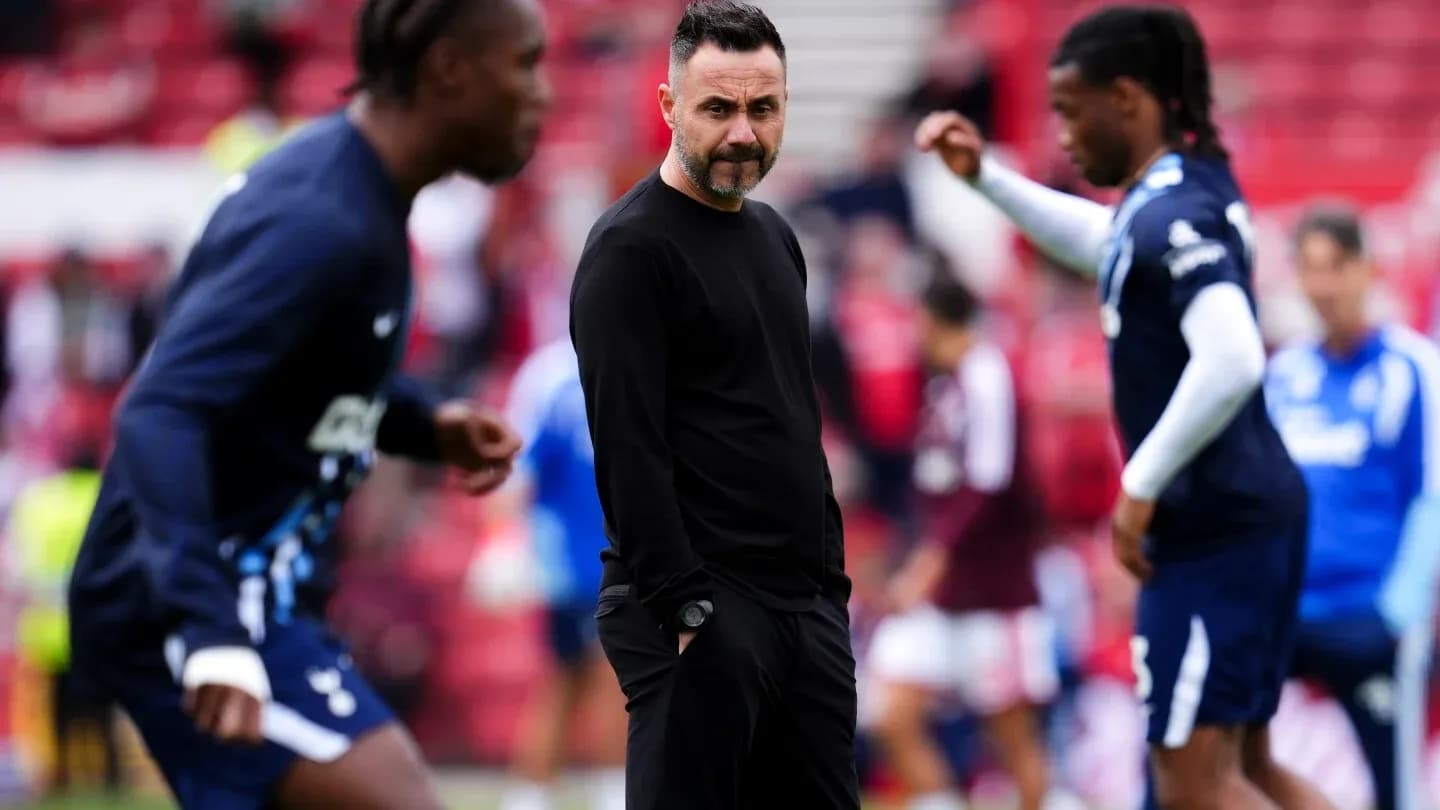
Roberto De Zerbi watched his new Tottenham side scrap their way to a 0-0 draw with Nottingham Forest in a bruising, bitty contest. It was not pretty. It was not fluid. It was, however, a fight, and Spurs showed they are willing to live in that kind of game.
De Zerbi: Proud of the display, frustrated with the scoreline
“Disappointing for the result, but for the performance, very happy,” De Zerbi said afterward. “Considering we started working together on Thursday for the first time, we played well.”
He went straight to the key issue.
“I think we can improve in the last pass. If we approve in the last third, I think we can score many, many goals because we have the players with big qualities. Now it’s a tough moment to accept this result, because I think we played well.”
The pattern of his analysis was clear. Between their own box and Forest’s, Spurs looked like a De Zerbi team. On the edge of the penalty area, they looked like a side still learning each other’s names.
“It’s not to unlock [the final third]. It’s the mistakes. We have to work in this part,” he said. “I think we played very well with the ball, we found the solutions because they press [our defenders] with three, but one of our full backs was always alone and we found him always in 90 minutes. So in build-up, we played very well. In the last third, I think we can be… better. Much better.”
The numbers back him up: possession, territory, control – Spurs had enough of all three. The problem is the bit that actually decides football matches.
Risk, reward and a back line under pressure
De Zerbi’s system is built on risk. He invites pressure onto his defenders to create space higher up the pitch. When it clicks, the trade-off is worth it; the attacking payoff dwarfs the danger at the back. When it doesn’t, you’re asking a lot from your centre-backs for very little return.
Right now, Tottenham are living that contradiction. The risk is there. The reward isn’t.
The safety net is Micky van de Ven. The Dutch defender looks at home in chaos, comfortable defending huge spaces, and he has started the season strongly alongside compatriot Jan Paul van Hecke. Even in last week’s defeat to Newcastle, it was set pieces that cost Spurs rather than open-play disarray.
Van de Ven, more than anyone else in this squad, raises Tottenham’s floor. He keeps them competitive on bad days, keeps them in games when the attacking structure misfires.
The ceiling, though? At the moment, he’d struggle to stand upright inside it. The final third is that cramped.
A broken attack with no true creator
De Zerbi didn’t hide from it. On paper, he knows he has talent. On grass, he knows it isn’t functioning.
The white rectangle that matters most – the penalty area – remains a dead zone for Spurs. They move the ball neatly until they reach it, then ideas run dry. The squad has been overhauled since last season, but the central problem is familiar: there is no natural no. 10 knitting everything together.
Without that central creator, Tottenham funnel attacks wide. The ball goes to the flanks, the tempo slows, and the opposition has time to retreat, reset and crowd the box. Forest read the script early. They pressed high to disrupt Spurs’ build-up, then sank back into a deep block, defending with nine or 10 players packed around their own area.
Tottenham, full of gifted dribblers but lacking a true playmaker between the lines, couldn’t pick the lock.
Substitutions, balance and a team still forming
De Zerbi also pointed to a key moment after the break.
“The second half, I’m sorry because the medical stuff pushed to change Savio and Udogie after 60 minutes,” he said. “Kudus and Robertson played very well, but maybe two substitutions in that moment was not so good. But now we can’t take risk with injuries again. Savio is too important for us, the same Destiny. Maybe we lost some balance, some connection [when they came off].”
The rhythm Spurs had built began to fray. The structure that had carried them up the pitch with relative ease lost its edge, and the game drifted. De Zerbi accepted the medical call – he has already lost too many players to injury – but he knew the cost in real time.
Defensively, though, he saw something to cling to.
“I think today we defended very, very well,” he said. “We have to improve the physical condition [of some players], the connection between the players. We changed, I don’t know how many players in this transfer window. We brought very, very good players, but the team doesn’t adjust like the names on paper or Football Manager.”
That last line cut to the heart of Tottenham’s current state. The recruitment looks strong. The names excite. The chemistry, for now, is theoretical.
Maddison, goals and the shape of the season
The obvious hope is James Maddison. If he returns from injury and quickly rediscovers his sharpness after effectively missing a year, he could become the missing link between midfield and attack, the player who turns sterile dominance into chances and goals.
The more sober reading is that this may be what Spurs look like for a while. A side that can control games, press with energy, defend with growing authority – and still walk away with nothing more than a clean sheet and a shrug.
They have their first point. They still don’t have a goal. Until that changes, how high can De Zerbi really push this team?