Sunderland's Struggles Amid War Tensions at Roker Park
By late August 1939, Bill Murray was still feeling his way into the Sunderland job. He had only stepped up in March to replace Johnny Cochrane, the man under whom he had once played, and he understood exactly what Roker Park demanded. The brief was clear enough: drag the club back towards the levels of 1936 and 1937, when Sunderland were league champions and FA Cup winners, and erase the memory of the sharp decline that followed.
An opening-day win over Derby County in the 1939-40 campaign hinted that the old Sunderland might be stirring again. Hope flickered. Then Huddersfield Town came to Roker Park.
They left with both points and most of the credit.
Huddersfield were simply the better side, their shape and discipline exposing how far Murray’s team still had to travel before they could call themselves contenders again. Sunderland looked raw. Disjointed. A side in transition, and on this evidence, nowhere near the finished article.
At the back, uncertainty reigned. Marking was slack, decisions hesitant, and the visitors took full advantage. Up front, Sunderland never really clicked. Attacks broke down, passes went astray, and the crowd’s early optimism drained away with every wasted move.
Newspapers the next day did not spare the officials, accusing them of turning a blind eye to a string of borderline Huddersfield fouls that broke up Sunderland’s rhythm. But most of the criticism landed closer to home. Captain Raich Carter took a knock and, restricted in his movement, could not impose himself as usual. That was when his teammates needed to rise with him. They didn’t. Reporters noted the absence of anyone willing, or able, to fill the void.
Only goalkeeper Johnny Mapson emerged with much credit. Consensus was that he had no chance with either goal and, without him, the scoreline might have looked even harsher.
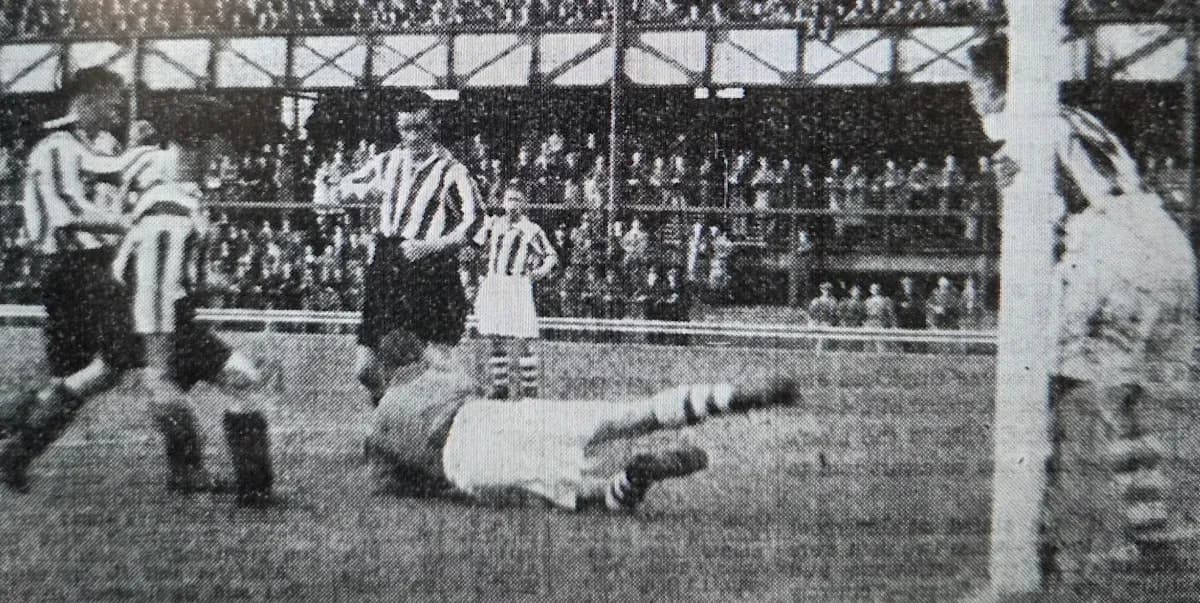
Huddersfield’s opener, inside the first few minutes, sparked debate that lasted long after the final whistle. Billy Price met a cross with a firm header that many in the ground were adamant had flown straight in. The referee thought otherwise, recording it as an own goal by Jimmy Gorman, who had challenged Price in the air. On the scoresheet it went down as Gorman’s mistake, but in the stands plenty were convinced it was Price’s goal.
Carter briefly changed the mood on 33 minutes. Even hampered, he found a way to level the match, and for a spell Sunderland threatened to turn the afternoon around. The noise rose, the old Roker energy returned, and there was a sense that Murray’s men might yet grind out a win.
Instead, the pressure told at the other end. Price struck again ten minutes from time, this time with no argument over the identity of the scorer. His late winner felt decisive, and the home support knew it. When the final whistle went, there were few serious complaints about the outcome. Huddersfield had been sharper, smarter, more cohesive. Sunderland had been shown exactly where they stood.
As fans drifted away from Roker Park, they were left to wonder what this team might become under Murray, and how long it would take. Yet another, darker question was already pushing its way into every conversation: would there even be football to watch in a few weeks’ time?
Anyone who had unfolded a newspaper before heading to the ground would have known why. Front pages were dominated by rising international tension and the looming threat of another war in Europe. The Sunderland Echo and Shipping Gazette carried reports of French radio being placed under military control and of frantic diplomatic talks across the continent. A stark photograph showed workmen stacking sandbags in front of the Royal Infirmary.
There was a chilling practicality to the local coverage. One piece detailed helmet and respirator arrangements for parents in Sunderland, listing the schools where children could be fitted out. Redby, Hudson Road, Cowan Terrace, Thomas Street, Commercial Road, Hylton Road, Diamond Hall, High Southwick, James William Street and Barnes were all named as collection points, with specially adapted equipment promised for infants.
It was sobering reading. Whatever escapism football usually offered, that kind of news could not help but seep into the mood at the match.
Among the 16,315 inside Roker Park that day were soldiers and sailors already called up under the emergency measures, uniforms visible in the stands. They were allowed in at half price, as long as they were prepared to use what was normally the boys’ gate. It was a small concession, a small ritual of normal life clung to at a time when normality was slipping away.
The performance on the pitch did little to lift the wider mood. Some in the crowd may have sensed it already: this might be their last visit to Roker for quite a while.
By the time Sunderland travelled to Arsenal the following weekend, that feeling had hardened into grim reality. German forces had invaded Poland. A larger war was no longer a possibility; it was on its way.
The game at Highbury went ahead, but even that carried the marks of a country bracing itself. Kick-off was pushed back to 17:00 so that emergency public transport timetables would be under less strain and an urgent evacuation of local children could be completed. Football, normally the heartbeat of a Saturday, had been relegated to a sideshow.
Soon, the results against Derby, Huddersfield and Arsenal were scrubbed from the official record. The season, in any meaningful sense, vanished. Murray’s plans to rebuild Sunderland were put on hold. Instead of plotting tactics and transfers, he found himself overseeing fitness work for troops stationed in County Durham. Roker Park, quickly earmarked as an evacuation zone, stood largely idle for the next two years.
On 30 August 1939, it was just another league defeat: Sunderland 1, Huddersfield Town 2. Carter on the scoresheet, Mapson defiant, Price decisive. A new manager learning hard lessons.
Within days, it became something else entirely – the last, uneasy glimpse of what English football looked like before the world changed.
Match Details
Saturday 30 August 1939
Football League Division One
Sunderland 1 (Carter 33')
Huddersfield Town 2 (Gorman o.g. 4', Price 80')
Sunderland: Mapson; Gorman, Hall; Housam, Lockie, Hastings; Duns, Carter, Robinson, Smeaton, Burbanks.
Venue: Roker Park
Attendance: 16,315