Sunderland vs Manchester United: A Tactical Showdown
The Stadium of Light had the feel of a crossroads fixture. Sunderland, 12th in the Premier League with 48 points and a goal difference of -9 (37 scored, 46 conceded overall), welcomed a Manchester United side chasing Champions League security in 3rd, on 65 points with a goal difference of 15 (63 for, 48 against overall). Heading into this game, it was a meeting of contrasting footballing identities: Sunderland’s pragmatic, shape-shifting survival project under Regis Le Bris against Michael Carrick’s increasingly expansive United, whose attacking numbers have outpaced their defensive control.
Over 36 league matches, Sunderland have been defined by balance more than brilliance: 12 wins, 12 draws, 12 defeats overall, with a solid home platform. At home they average 1.3 goals scored and 1.1 conceded, a profile of narrow margins and careful risk management. United, by contrast, have lived with volatility at the sharp end. Overall they average 1.8 goals scored and 1.3 conceded, with 2.0 for and 1.2 against at home, and 1.5 for, 1.4 against on their travels. On their travels, they still carry threat but concede enough to keep games open.
The team sheets reflected both ambition and necessity. Sunderland were without Daniel Ballard (suspended after a red card) and R. Mundle (hamstring injury), stripping Le Bris of a key aerial presence and a wide option. That absence pushed responsibility onto the starting back line of Lutsharel Geertruida, Nordi Mukiele, Omar Alderete and Reinildo Mandava in front of goalkeeper Robin Roefs. Reinildo arrives with a disciplinary edge – one red card this season and a readiness to step into duels – which shapes how Sunderland defend their box.
In midfield, Granit Xhaka and Noah Sadiki formed the double pivot, with Trai Hume, Enzo Le Fée and Chemsdine Talbi linking to lone forward Brian Brobbey. Xhaka’s season has been the anchor of Sunderland’s structure: 32 appearances, 2723 minutes, 6 assists, and 1684 passes at 83% accuracy. He is both metronome and shield, with 49 tackles and 20 successful blocks, and his presence is crucial in resisting United’s central overloads. Le Fée adds a more elastic, two-way profile: 4 goals, 5 assists, 48 key passes and 83 tackles, a creative engine who can both progress the ball and collapse back into a compact mid-block.
On the bench, Sunderland had forward options in Nilson Angulo, Eliezer Mayenda, Wilson Isidor and Jocelin Ta Bi, plus the versatility of Luke O’Nien and the youthful energy of Chris Rigg and Habib Diarra. Without Ballard, Dennis Cirkin’s defensive versatility also loomed as a potential in-game adjustment if Le Bris wanted to shift into a back three.
United’s absentees were equally significant. Benjamin Šeško, with 11 league goals and 51 shots this season, missed out through a leg injury, depriving Carrick of his most prolific penalty-box finisher. Matthijs de Ligt’s back injury removed a first-choice defender, increasing the burden on Harry Maguire and Lisandro Martínez. Maguire himself carries a red card in his season profile and is often walking the disciplinary tightrope in high-stress away fixtures.
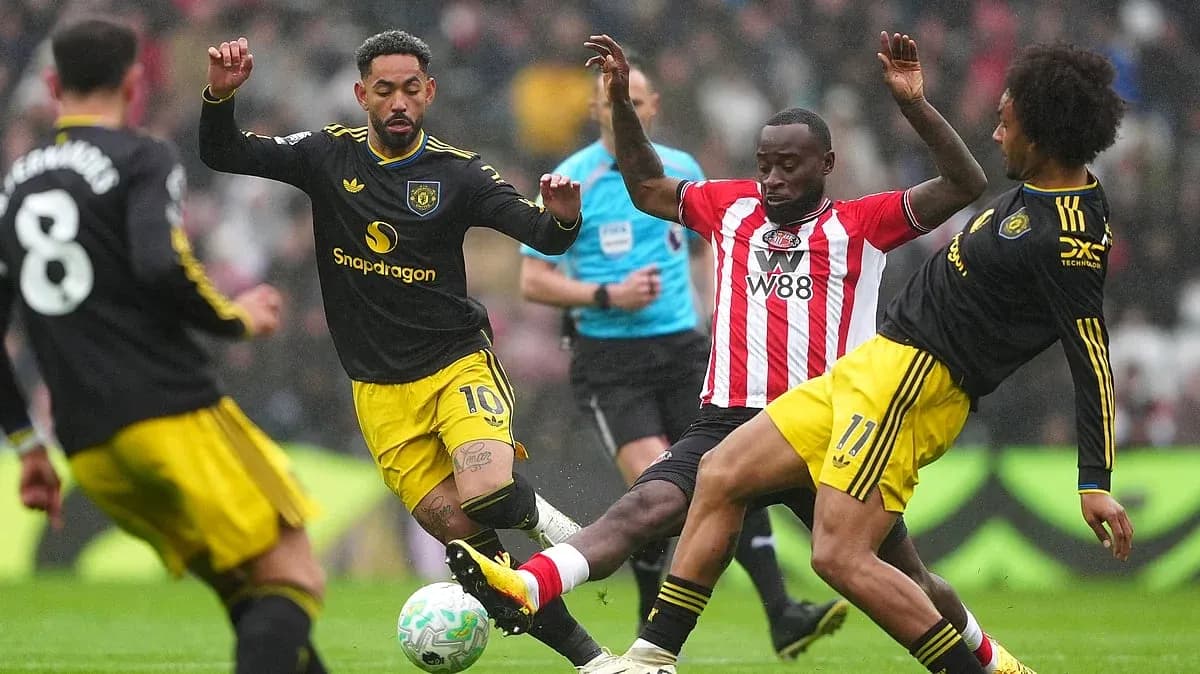
Carrick responded with a technically rich XI. Senne Lammens started in goal, behind a back four of Noussair Mazraoui, Maguire, Martínez and Luke Shaw. In midfield, Mason Mount and Kobbie Mainoo sat beneath a fluid trio of Amad Diallo, Bruno Fernandes and Matheus Cunha, with Joshua Zirkzee as the nominal striker. The tactical shape nodded towards United’s season-long preference for either 3-4-2-1 or 4-2-3-1; here, without a third centre-back, the onus was on Martínez to step into build-up and on Shaw to provide width and underlaps.
The Hunter vs Shield duel was embodied not by Šeško but by United’s spread of secondary scorers. Cunha arrives with 9 league goals and 2 assists, 57 shots and 34 on target, plus 88 dribble attempts with 41 successful – a relentless ball-carrier who can unbalance Sunderland between the lines. He attacks into a defence that, overall, concedes 1.3 goals per match, but at home only 1.1, and has kept 7 clean sheets at the Stadium of Light.
Sunderland’s Shield is collective rather than individual. Mukiele and Alderete bring physicality; Reinildo has 34 tackles, 14 successful blocks and 30 interceptions in his campaign, and is willing to defend aggressively in the channels where Cunha and Amad like to drift. Hume, who has 64 tackles and 12 blocks, is also one of the league’s more combative full-backs, but his 9 yellow cards underline the risk: he walks into this kind of game knowing that one mistimed challenge can tilt the balance.
The Engine Room battle, though, is where this match truly breathes. Bruno Fernandes stands as the league’s top creator: 19 assists, 8 goals, 125 key passes and 1881 total passes at 82% accuracy. He is the system, not just a part of it. Around him, Mainoo offers vertical carries and link play, while Mount adds pressing intensity and late box arrivals. Opposite them, Xhaka and Le Fée must compress space between the lines, deny Bruno his favourite half-spaces and still find time to launch counters.
Xhaka’s 34 key passes and Le Fée’s 48 show Sunderland are not purely reactive; they can play through pressure if the first line is broken. The question is whether they can do that often enough against a United side whose away profile – 1.5 goals scored and 1.4 conceded – suggests a willingness to trade blows.
Discipline and timing loom large. Sunderland’s yellow-card distribution shows a clear surge between 46-60 minutes (23.38%) and a persistent edge late on (16.88% between 76-90’), while United’s bookings also spike after half-time, with 21.31% between 46-60’ and 19.67% between 76-90’. In other words, the match is primed to become increasingly ragged as legs tire and spaces open. Reinildo’s red this season and Maguire’s own dismissal hint at volatility if either side is forced to chase.
From a statistical prognosis, United carry the heavier attacking artillery. Their overall 63 goals to Sunderland’s 37, plus 7 clean sheets against Sunderland’s 11, suggest a side built more to outscore than to suffocate. Sunderland, with 13 matches failed to score overall and only 1.0 goals per game in total, must be ruthlessly efficient when transitions fall to Brobbey and the supporting midfield line.
Expected Goals data is not provided, but the structural clues are clear. United’s shot volume, creative hubs in Bruno and Cunha, and their away scoring average point to them generating the higher xG on the day. Sunderland’s home resilience, defensive organisation and disciplined double pivot point to a lower, more compressed xG profile, built on limiting big chances rather than chasing them.
In narrative terms, this fixture always felt like United’s fire against Sunderland’s firewall. The final 0-0 scoreline underlines that, for once, the Shield held: Sunderland’s structure, discipline and midfield industry succeeded in dragging United’s high-powered attack into a stalemate, a result that fits the underlying tension between a top-four hunter and a mid-table side expertly versed in survival football.