
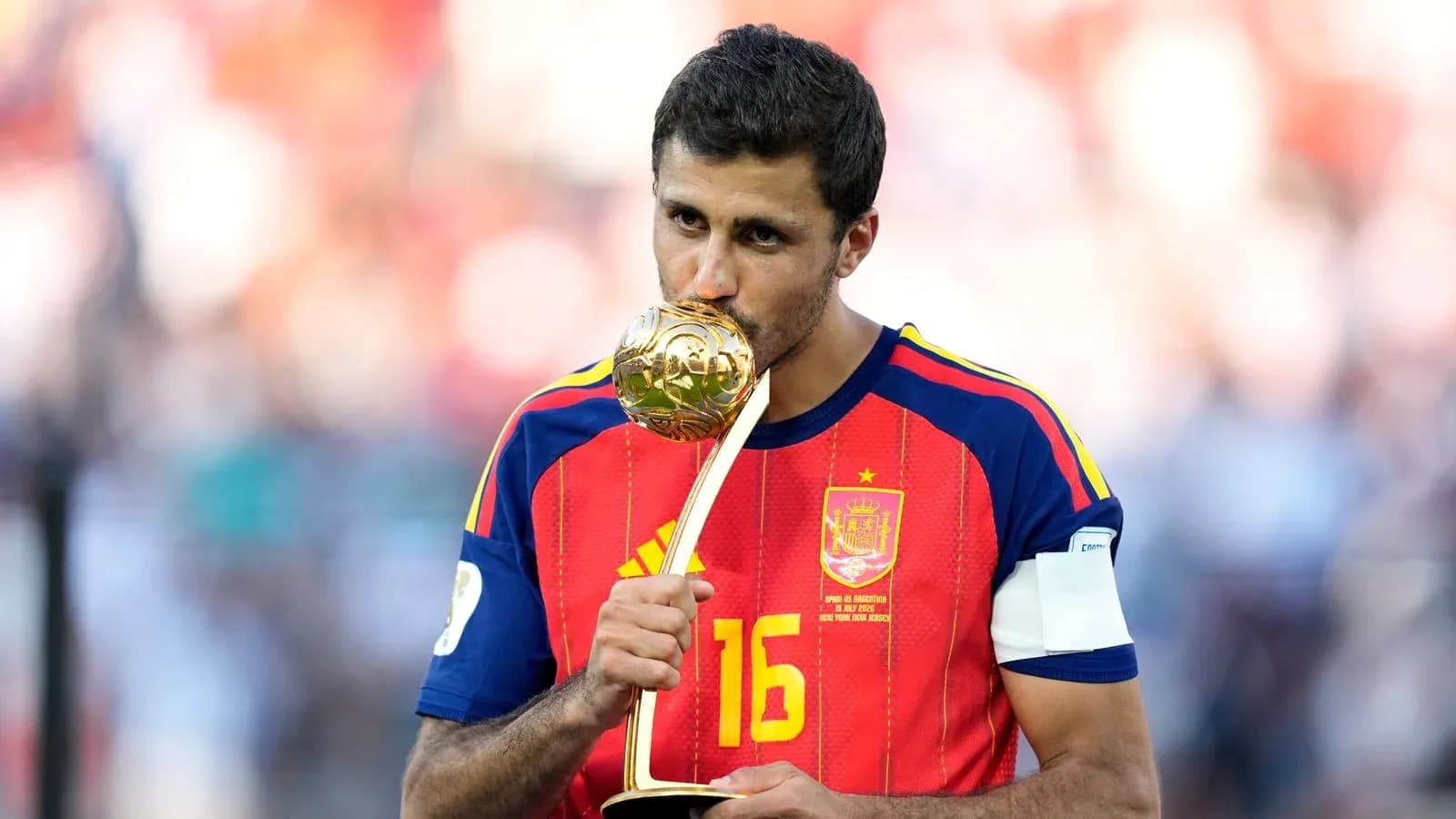
Rodri at the Center of Barcelona and Real Madrid Transfer Battle
Barcelona and Real Madrid are circling. Manchester City are digging in. And at the centre of it all stands Rodri – Spain’s captain, a World Cup winner, and the fulcrum of one of the great modern club sides.
This is no routine transfer story. It’s a tug of war over the most influential midfielder in the Premier League era’s recent history.
Barcelona move onto the front foot
Barcelona are preparing a formal approach to Manchester City for Rodri and believe they have real encouragement that a deal could be possible if the midfielder decides to move in this window. Their interest has accelerated in the last 24 hours, and they are hopeful they can beat Real Madrid to his signature.
Rodri has entered the final year of his contract at the Etihad. That single detail has changed the temperature of the whole situation. It gives rival clubs a sliver of leverage they have never previously enjoyed with City’s midfield general.
Real Madrid have already been at the table. Talks with City began last week, with the European champions indicating they would be willing to pay around £50m. For a player of Rodri’s stature, that figure reflects his contract situation more than his footballing value.
Barcelona sense an opening. If Rodri is to move now, they believe they have a strong chance of being the destination.
City’s stance: keep the cornerstone
Inside City, the message is blunt: they do not want to sell.
Rodri is central to Enzo Maresca’s plans as he steps into the job of reshaping a side that has just lost Bernardo Silva to Real Madrid and is already adapting to a new era post-Pep Guardiola. City want Rodri not just as a player, but as the on‑pitch reference point for Maresca’s next team, and are hoping he will sign a new long-term deal.
The complication? Timing. Rodri is recovering from successful back surgery following the World Cup. He is expected to miss the Community Shield against Arsenal and City’s opening Premier League fixture. The club must plan the start of the season without him, while simultaneously trying to convince him he remains the heartbeat of their future.
Letting that heartbeat walk out now, for a reduced fee, is not part of City’s ideal script.
Madrid’s Spanish question
For Real Madrid, Rodri is about more than just improving an already star-studded midfield. He is part of a wider political and cultural push.
When Florentino Pérez was re‑elected as club president, he faced criticism that Madrid had too few Spain internationals at this summer’s World Cup. The response has been swift. Marc Cucurella arrived from Chelsea as the tournament began, and there is broad internal support at the Bernabéu for making Rodri the next Spanish pillar of the project.
Madrid are weighing their next move: whether to raise their offer, how hard to push, and how far to go for a player who would instantly reshape their midfield dynamic and their national identity narrative.
“What’s the point in selling?”
From a football perspective, the idea of City cashing in now has been met with disbelief in some quarters.
Jamie Carragher, speaking on Sky Sports, did not mince his words. A £40‑50m sale? “What’s the point in selling them?” he asked of City’s hierarchy. “You might as well just keep them for the extra year.”
Carragher called Rodri “arguably the best midfield player in world football” and highlighted how, in the second half of last season, he and Bernardo Silva “were fantastic and almost took Manchester City to the title.”
His argument is simple: City paid around £60m for Rodri. Recovering roughly £40m with a year left, only to lose the most complete midfielder in the division, makes little sporting sense. Better, in his view, to keep him, accept the risk of a free transfer next summer, and preserve City’s title chances now.
He also pointed to history. When Liverpool won the title under Arne Slot, an early-season injury to Rodri hurt City badly and tilted the balance. For Carragher, that alone underlines his importance: remove Rodri, and City’s margin for error shrinks dramatically.
Irreplaceable, or close to it
Inside the club and across the league, the assessment of Rodri’s influence is strikingly similar.
Laura Hunter of Sky Sports described the loss of Rodri as “massive”. Pep Guardiola has long maintained he is “the best midfielder in the world by far”. Under Guardiola, City’s entire in‑play structure was built around him – his positioning, his bravery in receiving the ball under pressure, his calm in tight spaces, his ability to set the rhythm.
He did the same for Spain this summer, dictating games, controlling tempo, bending matches to his will.
There is a clear pattern: in the seasons where Rodri’s availability has been compromised by injury, City have failed to retain their Premier League crown. That is no coincidence. There is no other player in their squad, or in the wider market, who can condition a game in quite the same way.
Which leads to the uncomfortable question for City: how do you replace the irreplaceable?
The honest answer is that you don’t. Not like-for-like.
Elliot Anderson offers a partial solution. The England international, signed this summer, brings energy, range and box‑to‑box qualities. At 23, he has time to grow into a more authoritative role. His numbers already hint at a player who can become comparable in impact, if not in exact style. Inside City, he is seen more as a long-term heir to Bernardo Silva’s hybrid role than a pure Rodri clone.
He can be a surrogate of sorts. He cannot yet be the dictator.
A decision that will shape three giants
So the landscape is clear.
Barcelona, emboldened, are ready to test City’s resolve. Real Madrid, armed with prestige and a revived commitment to Spanish stars, are considering whether to push harder. City, still building around a new manager and without their midfield anchor for the start of the season, are trying to hold their line.
Rodri, recovering from surgery and approaching the final year of his deal, sits at the crossroads.
Who bends first – the player, the club, or the suitors – will not just decide one transfer. It will help decide the balance of power in Spain, and perhaps the destination of the Premier League title.




