
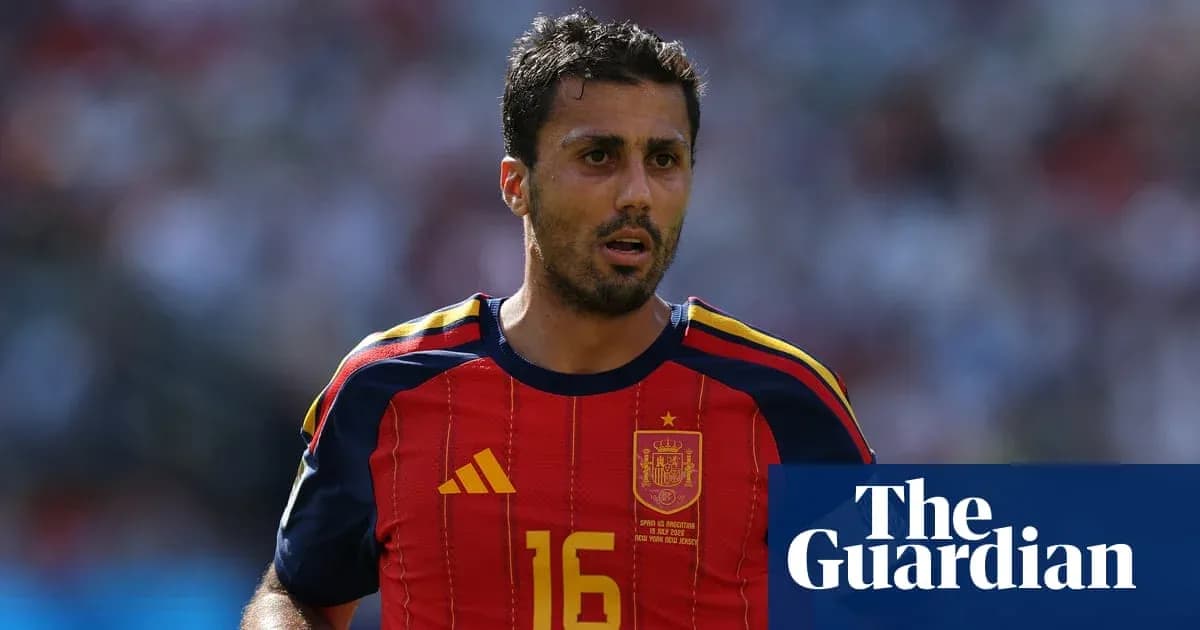
Rodri Faces Surgery After World Cup Triumph: Manchester City’s Dilemma
Rodri’s World Cup summer was supposed to close one chapter and open another. Instead, it has left Manchester City staring at a familiar, unwelcome storyline: life without their midfield metronome.
Fresh from lifting the World Cup with Spain and being named the tournament’s best player, the 30-year-old now faces the prospect of back surgery that could sideline him for the start of the new season. The same player who bossed the final in New Jersey, captaining Spain to a 1-0 win over Argentina and collecting the Golden Ball, may now swap the centre circle for the treatment room once again.
For City, it is a brutal twist. For Rodri, it is another punch in a two-year run that has tested his resilience as much as his talent.
From Golden Ball to operating table?
Rodri arrived at the World Cup looking like a man determined to remind everyone what he looks like at full tilt. He did exactly that. Dictating tempo, shutting down counters, threading passes through the lines – this was the version of Rodri that once felt indestructible in Pep Guardiola’s midfield.
But the glow of that triumph has been dimmed by the looming back operation. The issue is serious enough that it is expected to rule him out at the start of the club season, just as a new era begins under Enzo Maresca.
For a player whose game is built on control, his body has offered anything but.
Two seasons of pain
The spiral began in September 2024. In a 2–2 draw with Arsenal at the Etihad Stadium, Rodri ruptured his anterior cruciate ligament, an injury that ripped the spine out of City’s midfield and his season. He missed most of the campaign, a rare long-term absentee in a squad used to his constant presence.
When he returned, the setbacks kept coming. At the Club World Cup last July, another injury struck. Last season turned into a patchwork of comebacks and breakdowns: hamstring problems, groin issues, the constant stop-start rhythm that robs players of sharpness and confidence. He managed only 17 Premier League starts, a startling number for someone once considered undroppable.
The World Cup felt like a defiant answer to all of that. Now the back problem threatens to drag him back into the same cycle.
City’s dilemma, Madrid’s shadow
The timing could hardly be more delicate. Rodri’s contract runs out next June. His future, already a simmering question in Manchester, now sits at the crossroads of form, fitness and ambition.
He has long spoken of a desire to play again in Spain, and Real Madrid sit at the top of that wish list. They have yet to make a concrete move, but the attraction is obvious: a Spanish international in his prime years, schooled in the demands of elite European football, capable of anchoring a midfield for seasons.
City, under Maresca, cannot afford to treat him as anything other than central to their plans. The new manager wants to keep him, to build around the intelligence and authority that few in world football can replicate. Yet he must now plan pre-season, and perhaps the opening weeks of the campaign, without him – and do so while the clock on Rodri’s contract ticks loudly in the background.
“When you go down, you can rise again”
Rodri did not hide from the strain when he spoke after Spain’s World Cup win.
“For me, it’s been a very tough time,” he said, reflecting on the injuries that have carved up his recent years. “I just want the new generations to see my example as an opportunity. When you go down, you can rise again. This is my philosophy for my entire life. Of course, sometimes things go well, things go wrong, but always the positiveness.”
Those words sounded like a personal manifesto on the podium in New Jersey. They may now become his guide for another long rehabilitation.
City know the numbers. Without him, their midfield loses its compass. With him, they gain not just a passer and protector, but a leader who has just captained his country to the biggest prize of all.
The question is no longer whether Rodri can still reach those heights. He has just proved that. The question is how many more times his body will let him – and whether his next great act unfolds in Manchester, Madrid, or somewhere else entirely.




