
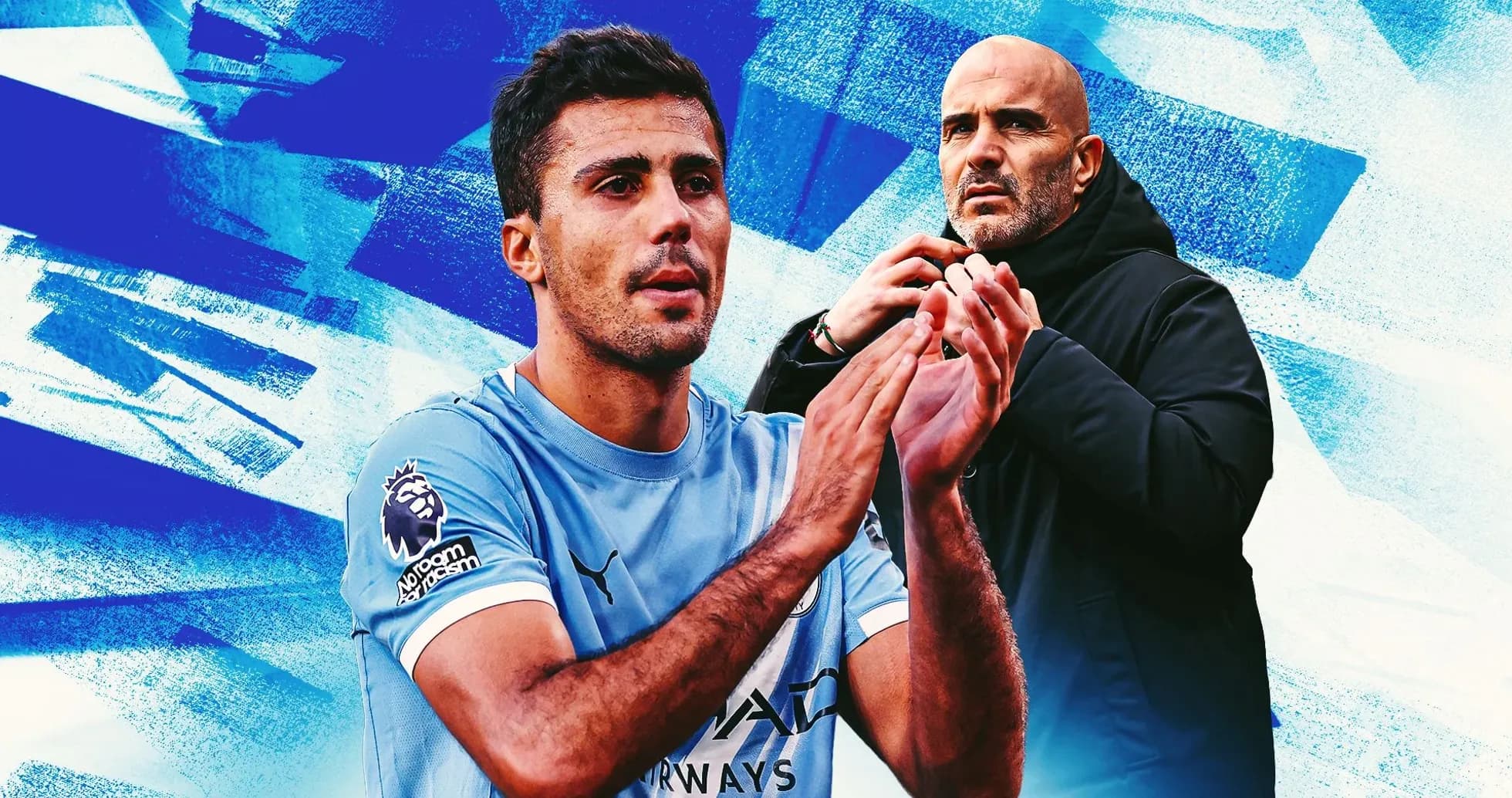
Rodri's Impact on Manchester City After Injury
Rodri’s torn ACL in September 2024 didn’t just halt a season. It ripped through a dynasty.
A month later he was in Paris, lifting the Ballon d’Or, the best midfielder on the planet with a brace on his knee and a grimace behind the smile. Since then, his story at Manchester City has been a stop-start reel of rehab sessions, managed minutes and the nagging sense that the machine no longer runs quite the same without its metronome.
Before that injury, Rodri had missed only seven games for City. Seven. In an era of relentless schedules and rotating XIs, he was the constant. After it, City’s iron grip on the Premier League slipped. They have not reclaimed the title since the 2023-24 campaign, and inside the club they point, again and again, to one simple truth: when Rodri doesn’t play, everything looks more fragile.
Guardiola saw what was coming. Back in October last year, as the midfielder inched his way back, he said: “In the World Cup, he will be the best Rodri, and next season he will be the best Rodri.” It sounded ambitious. It turned out to be prophetic.
The best Rodri, on the biggest stage
In North America this summer, Rodri took the World Cup and bent it to his rhythm. From the base of Spain’s midfield, he dictated games with that familiar, unhurried authority, snapping into tackles, hoovering up loose balls, and then sliding his team into gear with the simplest, smartest pass available.
Luis de la Fuente’s side had stars across the pitch, but Rodri was the one who set the terms. He broke up attacks, killed counters, and turned chaos into order. Spain lifted the trophy; their captain in midfield looked every inch the Ballon d’Or winner he had become.
For City, it was both a reassurance and a warning. This is what they have when Rodri is fit and free. This is also what they stand to lose.
With just one year left on his contract and Guardiola’s glittering era now over, the prospect of Rodri sensing that his own cycle in Manchester is coming to an end is real. For City, it would be the departure that changes everything.
Maresca walks in, and straight into a storm
Enzo Maresca knows all this. The new head coach, back at City after his spell at Chelsea, understands exactly what Rodri represents.
“First of all I have to say, that around big players there are always speculations so I am not worried about that,” he said at his first press conference at the City Football Academy. “I think it is normal, also because they won the World Cup, because he is one of the best players.
“I think every manager wants to have Rodri because he is a top player. But now, surgery on Monday [on his back]. He needs a holiday, he needs to rest and recover and then he will be back with us.”
On the surface, it was calm. Behind the scenes, it has to be a nagging concern. Maresca’s entire footballing blueprint is built on a controlling No.6, a player who can slide between roles, drop into the back line, step into midfield, and launch attacks from deep. Rodri is that system, embodied. He is also a World Cup-winning captain, a voice in the dressing room at a time when City are losing leaders at a worrying rate.
Bernardo Silva, last season’s captain, has gone to Real Madrid. John Stones has joined Inter at the end of his deal. Guardiola, the architect of everything, has walked away. Strip Rodri out of that picture and Maresca is not just tweaking a team; he is trying to rebuild an identity from scratch.
A midfield with more questions than answers
Look beyond Rodri and Elliot Anderson and the picture in midfield becomes stark.
Anderson has arrived for £116 million, a statement fee for a 23-year-old whose rise at Nottingham Forest has been nothing short of explosive. Under Thomas Tuchel with England, he has become a key cog, a combative, deep-lying playmaker who relishes the dirty work as much as the delicate pass.
The numbers back up the eye test. Last season in the Premier League, Anderson won possession more times than any other player (306) and came out on top in the most duels (297). He still led Forest for chances created, 54 in total, nine of them classed as big chances, despite the presence of Morgan Gibbs-White. At the 2026 World Cup, he made the joint-most tackles (18) – sharing that honour with Rodri himself.
He can press, pass, tackle, create. He looks ready. If Rodri does head to Madrid, Anderson will see not just a gap, but a throne.
Yet City cannot simply anoint him and hope. The supporting cast has not convinced. Nico Gonzalez, brought in partly to cover Rodri’s ACL absence, has been one of the clear disappointments of the club’s heavy January 2025 spending. He struggled to make any real impression on Guardiola and spent most of the second half of last season watching from the bench. A sale has been openly floated.
Tijjani Reijnders told a different story at first. A £46m signing from AC Milan, he started brightly, then faded. Consistency deserted him, and by the turn of the year he, too, was reduced to a bit-part role. City will hope that a full season of adaptation to English football allows him to step up, but hope is not a plan.
Behind them, the picture is even more brutal. Mateo Kovacic, Rico Lewis and Kalvin Phillips have all reportedly been deemed surplus to requirements. Clear those names out and then remove Rodri from the equation, and Maresca is left staring at a midfield rebuild of enormous scale in a single summer.
The next wave – and the risk of rushing it
There is a potential safety net. Ayyoub Bouaddi, the 18-year-old who lit up Morocco’s World Cup run, is high on City’s list as a defensive midfield target. The original idea was simple: sign him, then send him straight back to Lille on loan to continue his development.
That plan may not survive the Rodri question. If the Spaniard pushes for a move and Madrid come calling, City might have no choice but to accelerate Bouaddi’s arrival and throw him into the mix far earlier than intended. For a teenager, even one with his talent and temperament, that is a very different proposition from another year in Ligue 1.
Maresca could end up with Anderson as his new No.6, Bouaddi learning on the job, Reijnders trying to prove he belongs, and Nico Gonzalez potentially out of the door. It is a bold, youthful core. It is also a huge gamble for a club determined to avoid the turbulence that swallowed Manchester United and Arsenal when Sir Alex Ferguson and Arsène Wenger stepped away.
City’s hierarchy are desperate not to repeat that pattern of drift and misjudgement. They want continuity, clarity, and a structure that outlives any one man – even Guardiola. That is why Rodri matters so much. He is the bridge between eras.
Maresca’s tightrope
Maresca is not shying away from the scale of the task.
“I want to say it is a privilege because the reason why the club decided to go for me, that is a privilege,” he said when asked about following Guardiola. “I have said many times, I consider Pep the best coach in the world in the last 20-25 years. It is a challenge.
“Also the history of the manager with many years in the same club, they struggle a bit. Sir Alex, Arsene. But it is also a challenge to do the right things.”
He leans heavily on the idea of time and structure.
“I know the organisation quite well and the people inside the club from years ago. I just said before that when a club has three [sic] managers in almost 20 years, it shows how serious [they are]. The structure understands to give time for everything.
The organisation is the main thing. This club and organisation has had three [sic] managers in 17 years. That is not normal and has not happened often. I am confident that we can continue to do a great job and continue to do the job that has been done in the last 14, 15 years since Roberto Mancini was here.”
The message is clear: City are stable, City are patient, City will back their man. Yet stability has its limits when the spine of the dressing room walks out of the door.
Guardiola is gone. Bernardo is gone. Stones is gone. Rodri could be next. Maresca insists he is calm, but he knows what it would mean to start his biggest job without the one player who, more than any other, makes City look like City.
The new era at the Etihad will be bumpy regardless. Whether Rodri is still there when the dust settles will say everything about how rough the ride becomes.




