Real Sociedad vs Real Betis: A Tactical Draw in La Liga
The Reale Arena under lights, La Liga’s Regular Season - 35, and two sides whose seasons have been defined by fine margins. Real Sociedad, 8th with 44 points and a goal difference of -1 (54 scored, 55 conceded overall), hosted 5th‑placed Real Betis, sitting on 54 points with a goal difference of 11 (54 for, 43 against overall). The 2-2 draw that followed felt like a snapshot of their entire campaigns: Sociedad’s volatility and Betis’ controlled chaos colliding in 90 tense minutes.
I. The Big Picture – Systems and Seasonal DNA
Pellegrino Matarazzo doubled down on Real Sociedad’s most-used structure, rolling out a 4-4-2 that mirrors their season identity. Heading into this game, they had used that shape 12 times in La Liga, leaning on it to squeeze value from an attack that averages 1.9 goals at home and 1.5 in total. The selection was bold and front‑footed: Mikel Oyarzabal and O. Oskarsson as a striking pair, flanked by A. Barrenetxea and T. Kubo, with C. Soler and J. Gorrotxategi knitting the central lane.
Behind them, a back four of S. Gomez, D. Caleta-Car, J. Martin and A. Elustondo protected A. Remiro. It is a line that reflects Sociedad’s season-long paradox: at home they score freely (34 goals at home) but still concede 27, their overall goals-against average at 1.6. This is not a side that locks games down; it leans into risk.
Manuel Pellegrini answered with Real Betis’ signature 4-2-3-1, the platform they have used 25 times in the league. A. Valles in goal, shielded by A. Ruibal, D. Llorente, V. Gomez and R. Rodriguez, with S. Altimira and M. Roca as the double pivot. Ahead of them, a creative trio of Antony, Pablo Fornals and A. Ezzalzouli supported Cucho Hernandez as the lone striker.
This structure encapsulates Betis’ balance. Heading into this game, they averaged 1.8 goals at home, 1.3 on their travels and 1.5 overall, while conceding just 1.2 in total. They are not as explosive as their flair might suggest, but they are efficient, with 10 clean sheets overall and only 7 defeats in 35 league matches.
II. Tactical Voids – Absences and Discipline
Both squads arrived compromised in key areas. Real Sociedad were stripped of depth and versatility: J. Aramburu (suspended for yellow cards) removed a tenacious right‑back option whose 10 yellows this season and 96 tackles define their aggressive edge. His absence forced a more conservative back line and removed one of their most combative duelists (340 duels, 193 won).
In attack and wide zones, G. Guedes (toe injury) and J. Karrikaburu (ankle injury) reduced Matarazzo’s ability to change the front line from the bench. At full-back and defensive cover, A. Odriozola and I. Ruperez (both knee injuries), plus I. Zubeldia (muscle injury), narrowed the options for in‑game tactical shifts, especially if the back four came under sustained pressure.
Betis had structural absences of their own. M. Bartra (heel injury) and A. Ortiz (hamstring injury) weakened the depth at centre-back and in defensive rotations. With Betis’ away goals‑against total at 26, and their away average 1.4 conceded, missing an experienced organiser like Bartra increased the load on D. Llorente and V. Gomez to manage Sociedad’s dual‑striker threat.
Disciplinary profiles also framed the contest. Real Sociedad’s season yellow-card curve shows a notable spike between 46-60 minutes (21.62%) and 76-90 minutes (17.57%), while Betis’ bookings surge even more dramatically late, with 24.64% of their yellows arriving between 76-90 minutes and 17.39% between 91-105. In a match that finished level, those patterns underlined the frantic, stretched nature of the second half, where both sides habitually live on the edge.
III. Key Matchups – Hunter vs Shield, Engine Room Battles
The headline duel was “Hunter vs Shield”: Mikel Oyarzabal against a Betis defence that, overall, had conceded 43 goals. Oyarzabal came into this fixture as one of La Liga’s most effective forwards: 15 goals and 3 assists in 31 appearances, with 61 shots (36 on target) and 7 penalties scored from 7 attempts. His reliability from the spot, combined with his 40 key passes and 731 total passes at 76% accuracy, makes him both finisher and facilitator.
Betis’ back four and double pivot were tasked with compressing his operating space between the lines. Yet their away record – 24 goals conceded on their travels – suggested that if Sociedad could generate enough volume, Oyarzabal would find moments. The 2-2 scoreline suggests exactly that: Betis’ structure held in phases, but their shield could not fully mute Sociedad’s talisman.
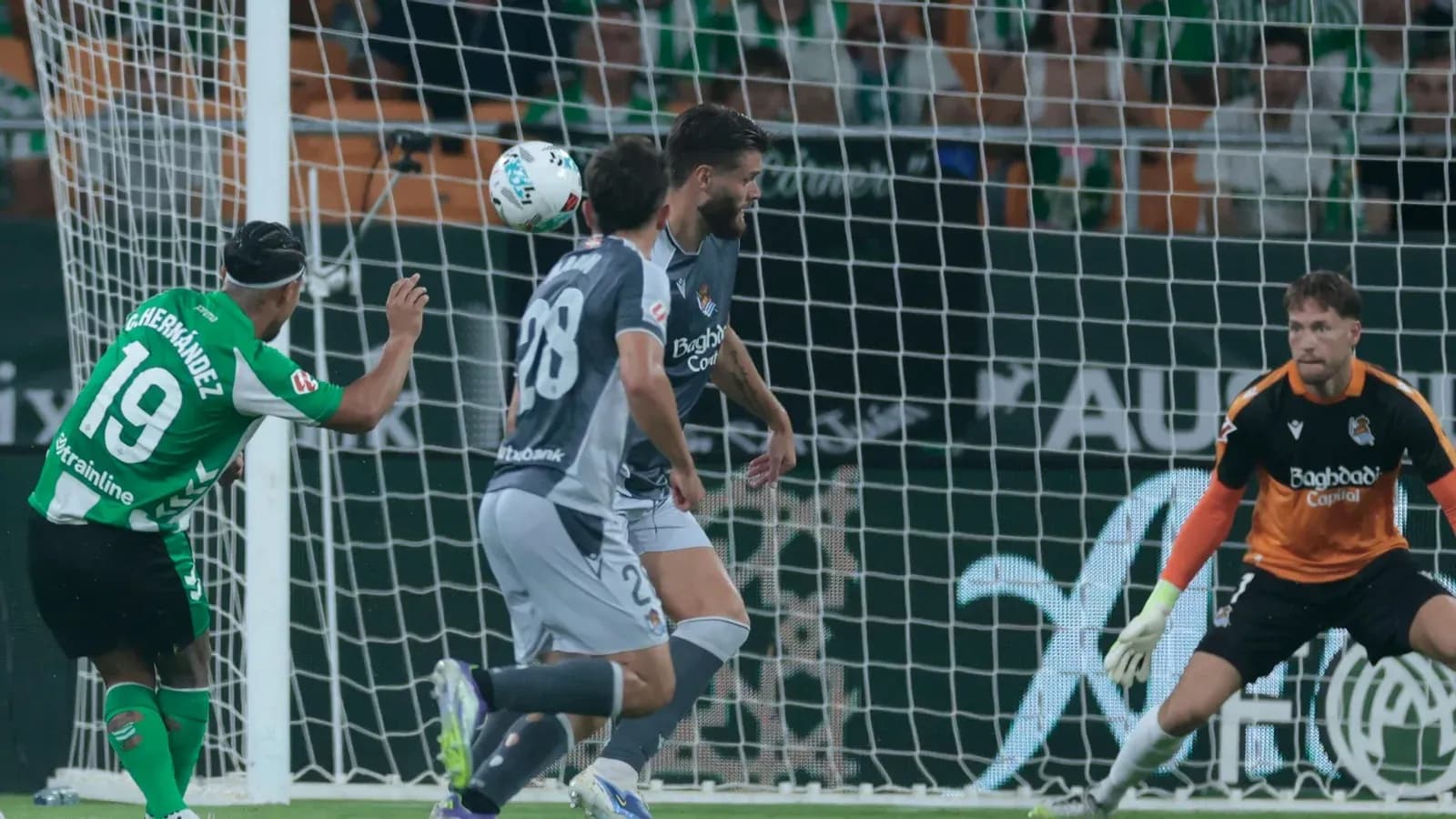
On the other side, Cucho Hernandez embodied Betis’ own “Hunter” role: 10 goals and 3 assists in 30 appearances, with 58 shots and 22 on target. Against a Real Sociedad defence that had conceded 27 at home and 55 overall, his movement across the front line was always likely to expose the gaps between Caleta-Car and J. Martin, especially when Sociedad’s full-backs pushed high.
In the “Engine Room”, Pablo Fornals and M. Roca squared up against C. Soler and J. Gorrotxategi. Fornals’ season numbers – 7 goals, 5 assists, 1,675 passes with 82 key passes and 86% accuracy – mark him as Betis’ metronome and primary zone 14 architect. His ability to receive under pressure and slip angled passes into Ezzalzouli or Cucho was central to Betis’ first-half control.
Ezzalzouli, meanwhile, blurred the line between creator and destroyer of defensive schemes. With 9 goals, 8 assists and 80 dribbles attempted (38 successful), plus 345 duels (179 won), he repeatedly tests full-backs physically and positionally. His presence on the left against A. Elustondo and Kubo’s flank work demanded constant support from Gorrotxategi, stretching Sociedad’s midfield horizontally.
IV. Statistical Prognosis – What the Numbers Say About a 2-2
Following this result, both teams remained faithful to their statistical identities. Real Sociedad’s overall goals-for average of 1.5 and goals-against average of 1.6 point to high-variance, open contests; a 2-2 draw sits comfortably within that volatility band, especially at home where they had already scored 34 and conceded 27.
Real Betis, with 1.5 goals scored and 1.2 conceded in total, are usually slightly more controlled, but their away defensive average of 1.4 conceded and 24 goals scored on their travels hinted at a game where they would both threaten and be threatened. The lack of any penalties missed for either side this season (Sociedad 8 scored from 8; Betis 2 from 2) meant that any spot-kick would likely tilt the xG ledger decisively, but the open‑play exchanges instead carried the narrative.
Without explicit xG values, the shot and goal profiles of their leading men are instructive: Oyarzabal’s 36 shots on target from 61 attempts and Cucho’s 22 on target from 58 suggest forwards who regularly generate quality looks. Combine that with Ezzalzouli’s dual role as dribbler and creator and Fornals’ high-volume chance creation, and a multi‑goal draw emerges as the most statistically coherent outcome.
In tactical terms, Sociedad’s 4-4-2 brought numbers into the box but left spaces in transition; Betis’ 4-2-3-1 offered superior control between the lines but occasionally struggled to protect the half‑spaces when full-backs advanced. The 2-2 at the Reale Arena felt less like an upset and more like a logical convergence of two season arcs: one side chasing Europe from below, the other defending a Champions League berth, both too ambitious to settle for safety and too flawed to shut the door.