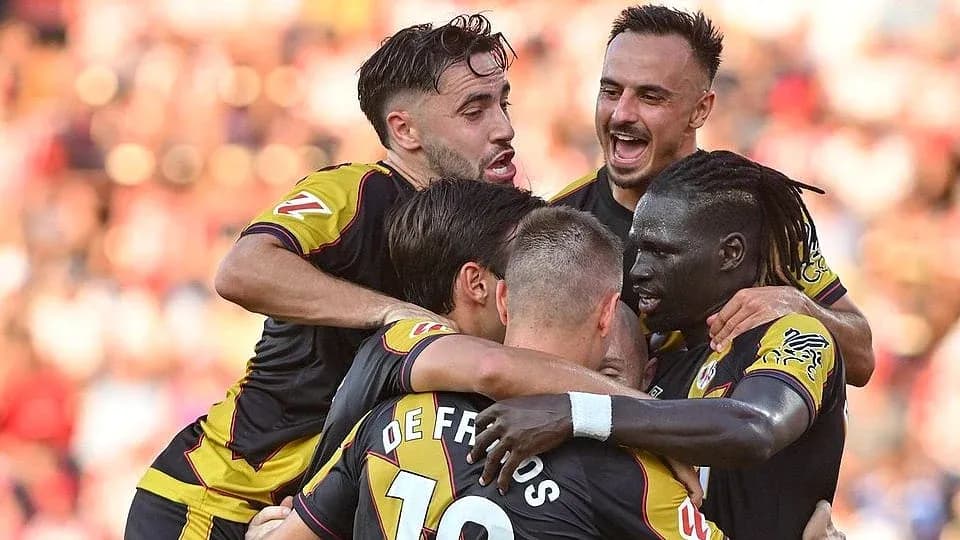
Rayo Vallecano vs Girona: A Clash of Two Seasons
The Vallecas night ended level on the scoreboard, but the 1–1 between Rayo Vallecano and Girona felt like two different seasons colliding. One, Rayo’s steady march towards mid‑table safety; the other, Girona’s nervous fight to escape the relegation zone. Following this result in La Liga’s Regular Season – 35, the draw broadly reflected their seasonal DNA: Rayo controlled risk, Girona lived on the edge.
I. The Big Picture – Structure and Identities
At Campo de Futbol de Vallecas, Inigo Perez set Rayo up in a 4‑3‑3, a departure from the 4‑2‑3‑1 that has been their most-used shape this season (21 matches). The tweak was subtle but telling: instead of a classic double pivot, he trusted a three‑man midfield to compress space and support an aggressive front line.
Rayo came into the round ranked 10th with 43 points, built on a cautious but efficient profile. Overall this campaign they have scored 36 and conceded 42, giving a goal difference of -6. At home they have been far harder to break: across 18 home fixtures they have 6 wins, 10 draws and only 2 defeats, scoring 22 and conceding just 15. The averages at Vallecas – 1.2 goals for and 0.8 against – underline why Perez could afford to be bolder in structure: the defensive base is reliable.
Girona, by contrast, arrived in Madrid under Michel with a 4‑2‑3‑1 that has been their default (19 matches). But the context is far more fragile. Heading into this game they were 18th with 39 points and a goal difference of -15 (37 scored, 52 conceded overall). On their travels they had 3 wins, 8 draws and 7 defeats from 18 matches, with 18 goals scored and 27 conceded; their away averages of 1.0 for and 1.5 against tell the story of a side that can score but almost always gives you a chance.
II. Tactical Voids – Absences and Discipline
The absences on the team sheet shaped the narrative before a ball was kicked. Rayo were stripped of creativity and set‑piece threat with Isi Palazón suspended after a red card, while I. Akhomach, Luiz Felipe and D. Mendez were all out injured. Losing Palazón removed a player who has 3 goals, 3 assists and 10 yellow cards this season – a high‑usage, high‑risk conduit who draws 51 fouls and commits 36. Without him, Rayo’s right side lost some chaos and delivery, but also a disciplinary liability: his 1 missed penalty this campaign is a reminder that his high influence comes with volatility.
On Girona’s side, the list was even more disruptive. B. Gil was suspended through yellow card accumulation, and Juan Carlos, Portu and V. Vanat were all sidelined with injuries, alongside D. van de Beek and the anomalous listing of M. ter Stegen. For Michel, this stripped depth from both flanks and the bench. Portu’s absence in particular reduced Girona’s capacity to attack space in transition and to press from the front.
Disciplinary patterns across the season also framed the tone. Rayo’s yellow cards are relatively evenly spread, but there is a noticeable rise between 46–75 minutes, where 18 (18.37%) come in the 46–60’ window and 19 (19.39%) in 61–75’. Their reds spike late: 33.33% between 91–105’. Girona are even more combustible late on: a huge 39.19% of their yellows arrive between 76–90’, with another 17.57% in 91–105’. For a relegation‑threatened side, that late‑game ill‑discipline is a tactical fault line.
III. Key Matchups – Hunter vs Shield, Engine Room
With Isi Palazón out, the “Hunter vs Shield” axis shifted to Jorge de Frutos. As Rayo’s leading scorer with 10 goals and 1 assist, he is the primary end product in a side that otherwise spreads its goals. His profile – 47 shots, 26 on target, 27 key passes – makes him both finisher and secondary creator from wide or half‑spaces.
Against him stood a Girona defence whose overall record this season is fragile: 52 goals conceded in 35 matches, 1.5 per game both at home and away. Their best defensive piece, Vitor Reis, was central to resisting De Frutos. Across the season, Vitor Reis has blocked 38 shots and made 30 interceptions, an extraordinary volume that underlines how much emergency defending Girona require. His red card earlier in the campaign – one of Girona’s total reds – hints at the knife‑edge he plays on: proactive, aggressive, and occasionally too late.
In midfield, the “Engine Room” duel set the rhythm. For Rayo, Pathé Ciss dropped from his usual midfield role into the back line in the 4‑3‑3, but his season numbers explain why Perez trusts him anywhere in central zones: 49 tackles, 32 interceptions, and 14 successful blocks speak of a player who reads danger early. Ahead of him, P. Diaz, O. Valentin and U. Lopez formed a compact triangle to deny Girona’s 10‑space.
For Girona, the double pivot of A. Witsel and F. Beltran was tasked with both building and shielding. Witsel’s positional intelligence allowed Girona to morph into a situational back three in buildup, with A. Martinez stepping higher and A. Moreno providing width. That structure was designed to progress through Rayo’s first line of S. Camello, F. Perez and De Frutos, but also to prevent direct counters into those channels.
Higher up, V. Tsygankov and T. Lemar operated as the creative band behind A. Ounahi. Without Portu, Girona leaned more on technical combination play than pure depth running. J. Roca, nominally from the left, drifted in to create overloads around Ciss and F. Lejeune, testing Rayo’s ability to track inside movements from wide.
IV. Statistical Prognosis – What the Numbers Say About the Draw
Following this result, the 1–1 feels broadly aligned with the underlying profiles. Rayo at home are built on control: 11 clean sheets overall this season (7 at home) and only 3 home matches where they have failed to score. They average 1.0 goals for and 1.2 against overall, which makes narrow margins and stalemates their natural habitat.
Girona, meanwhile, live in high‑variance territory. Overall they score 1.1 and concede 1.5 per match, with just 6 clean sheets all season and only 1 on their travels. Their ability to pick up 8 away draws from 18 away games hints at a team that often does just enough in xG terms to stay alive, but rarely enough to fully control games.
Overlaying those profiles, the expected goals picture for a clash like this tends towards balance with a slight Rayo edge: the home side’s defensive solidity at Vallecas versus Girona’s porous back line, offset by Girona’s capacity to create and concede in equal measure. The 1–1, then, reads like a meeting point of two statistical truths: Rayo’s safety‑first mid‑table realism and Girona’s desperate, chaotic fight against the drop, both compressed into 90 tense minutes under the Vallecas lights.