Osasuna vs Atletico Madrid: Tactical Analysis of the 2-1 Defeat
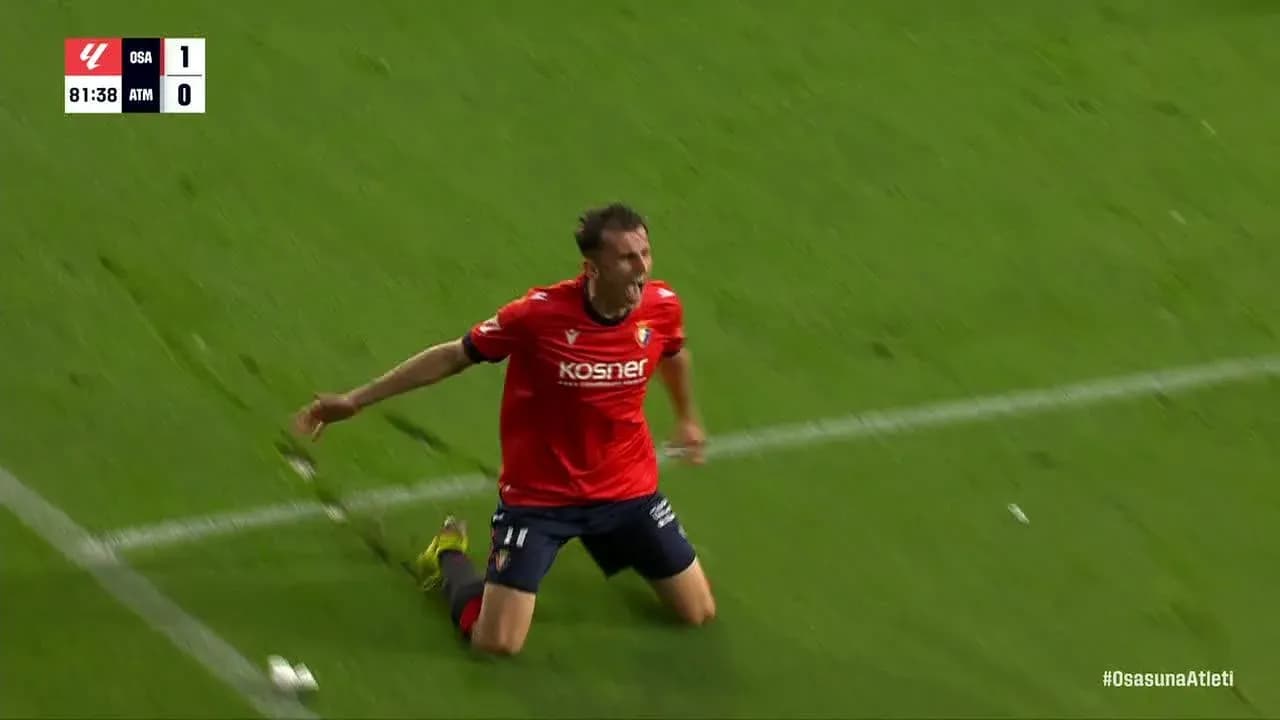
Osasuna’s 2-1 defeat to Atletico Madrid at Estadio El Sadar was defined by contrasting tactical identities: Osasuna’s territorial dominance and volume of attacks against Atletico’s ruthless efficiency and game management, even after going down to ten men.
Atletico began in a 4-4-2 that was clearly designed to play vertically and attack space quickly. With A. Griezmann and A. Lookman up front, Diego Simeone’s side accepted long phases without the ball (42% possession, 358 passes, 80% accuracy) in exchange for high-value situations. The early “Penalty confirmed” VAR decision involving Antoine Griezmann at 13 minutes underlined their approach: win duels high, break quickly, and force Osasuna’s back four into emergency defending. A. Lookman’s converted penalty at 15 minutes gave Atletico the ideal game state to retreat into a compact mid-block and choose their pressing moments.
Osasuna, in Alessio Lisci’s 4-2-3-1, were structurally the more proactive team. The double pivot of L. Torro and J. Moncayola tried to control rhythm and circulate the ball wide to full-backs J. Galan and V. Rosier, while the line of three behind A. Budimir (R. Moro, M. Gomez, Ruben Garcia) was tasked with overloading the half-spaces. The numbers support that territorial intent: 58% possession, 477 passes with 415 accurate (87%), and a massive 23 total shots, 18 from inside the box. Their xG of 2.16 against just one goal highlights a recurring theme: good structures to reach the final third, but imprecision and decision-making issues at the last touch.
First Half
The first half showed the basic pattern. Atletico defended in a narrow 4-4-2, with O. Vargas and T. Almada (before his substitution) tucking in to protect the half-spaces and funnel Osasuna wide. The back four of M. Ruggeri, D. Hancko, M. Pubill and M. Llorente stayed compact, allowing crosses but fiercely defending the six-yard box. Osasuna responded by flooding the box with Budimir plus late runs from Ruben Garcia and M. Gomez. The volume of “Shots insidebox” (18) shows they repeatedly managed to penetrate, but the lack of clear, uncontested chances suited Atletico’s defenders and J. Musso, who finished with four saves and 0.32 goals prevented.
Lisci’s in-game management was aggressive. The 37-minute substitution, with Kike Barja (IN) coming on for R. Moro (OUT), added more directness and 1v1 threat on the flank. After the break, a double change at 60 minutes — R. Garcia (Forward, shirt 9) (IN) for Ruben Garcia (Midfielder, shirt 14) (OUT), and A. Bretones (IN) for J. Galan (OUT) — tilted Osasuna further towards an attacking 4-2-4 in possession. Later, at 72 minutes, A. Oroz (IN) for L. Torro (OUT) and A. Osambela (IN) for M. Gomez (OUT) effectively removed a holding presence to add more creativity and vertical runs between lines. These moves explain the late surge that culminated in Kike Barja’s 90-minute goal, assisted by R. Garcia (Forward, shirt 9): Osasuna had layered the box with finishers rather than controllers.
Atletico’s Strategy
Simeone’s substitutions were more about control and protection of the lead. At 18 minutes, R. Le Normand (IN) came on for R. Mendoza (OUT), tightening the central defensive axis and hinting at an early adjustment to Osasuna’s aerial threat. At 46 minutes, A. Sorloth (IN) for T. Almada (OUT) shifted Atletico into a more direct front pairing, and it was precisely this reconfiguration that paid off: at 71 minutes, A. Sorloth scored a “Normal Goal” from a transition, assisted by M. Llorente. Atletico had just five total shots (four on goal) but produced 1.64 xG, showing that when they did attack, they created high-quality chances.
The turning point in game management terms came at 79 minutes, when Marcos Llorente collected a Yellow Card for “Foul” and then a Red Card for “Foul” in the same minute, leaving Atletico with ten men. Up to that point, Atletico’s defensive index was excellent: low shot volume conceded on goal (five on target from 23 total) and good box protection. After the dismissal, they sank even deeper, converting the 4-4-2 into a 4-4-1 with Griezmann and then, after 82 minutes, C. Lenglet (IN) for A. Lookman (OUT) reinforcing the back line. This last change signaled a pure survival phase, with Atletico prioritizing clearances and compactness over any counter-attacking ambition.
Osasuna’s goalkeeper A. Fernandez made two saves with 0.32 goals prevented, indicating that while Atletico were efficient, they did not bombard his goal. Instead, the story of the match was Atletico’s defensive concentration and Osasuna’s wastefulness. Despite a higher xG and more territory, Osasuna’s final-third execution lagged behind their structure. Atletico, by contrast, maximized limited possession through verticality, clinical finishing, and a resilient block that held even after the red card.
Statistically, the match encapsulated two opposing models. Osasuna, with superior overall form indicators in this game — more possession, more shots, higher xG — lacked the penalty-box clarity to convert dominance into points. Atletico’s defensive index was built on discipline in their shape rather than discipline in cards (12 fouls, five yellows, one red), but they balanced that aggression with compact distances and smart positioning. In the end, Atletico Madrid’s 2-1 away win, forged from efficiency and resilient game management, overrode Osasuna’s volume-based attacking strategy at Estadio El Sadar.