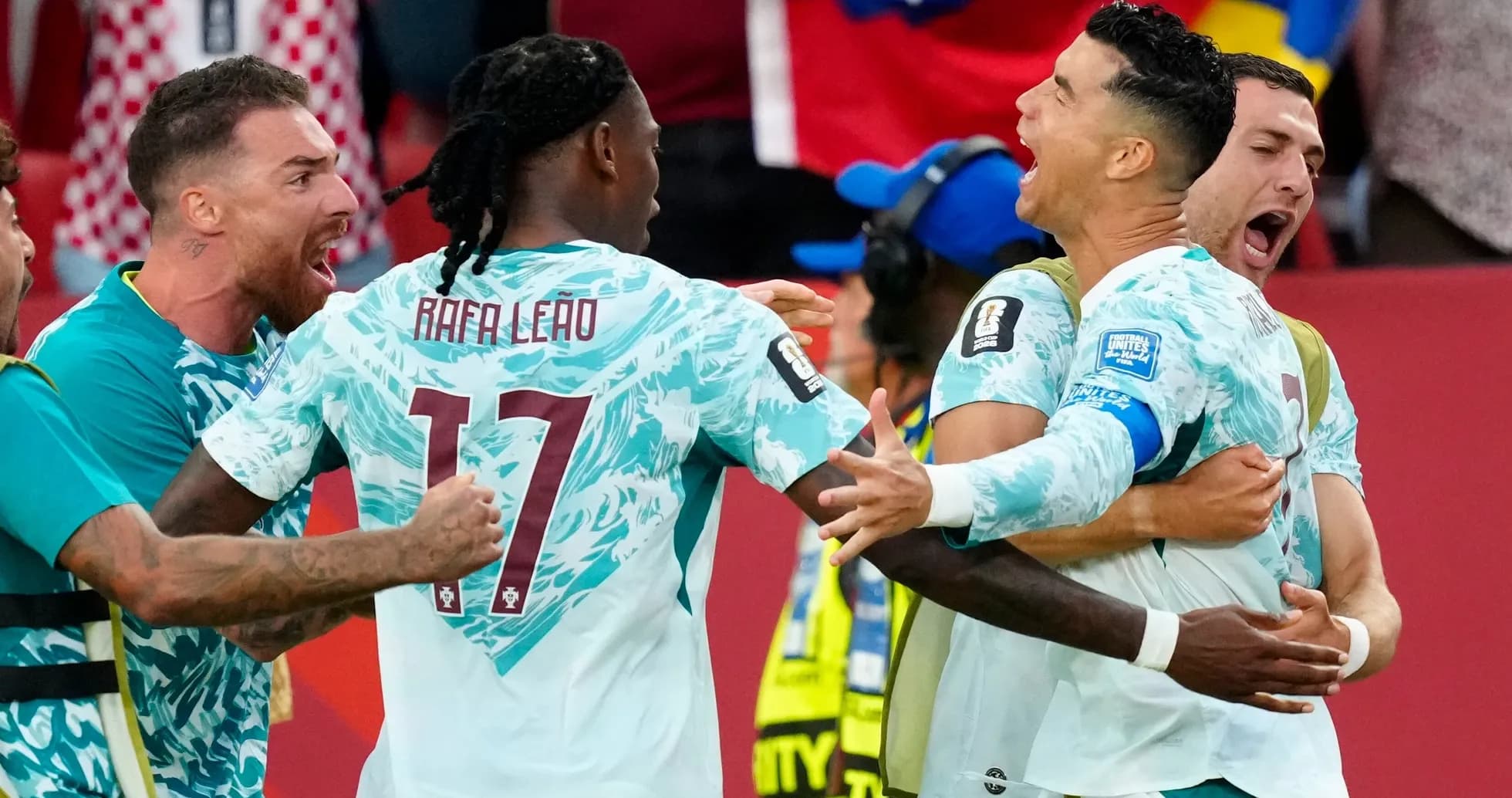
Portugal Triumphs 2-1 Over Croatia in World Cup Round of 32
Portugal’s 2-1 win over Croatia at BMO Field in this World Cup Round of 32 tie was a victory built on territorial control and structural discipline. Roberto Martinez’s side used their 4-2-3-1 to dominate the ball (61% possession, 584 passes at 91% accuracy) and gradually wear down Zlatko Dalic’s similarly shaped 4-2-3-1, which relied more on vertical surges and individual quality than sustained control. The late winner reflected the broader pattern: Portugal’s ability to keep Croatia pinned back for long stretches eventually translated their statistical superiority into a narrow but deserved passage.
First Half
Croatia struck first through Ivan Perišić on 53 minutes, punishing a transitional moment despite Portugal’s earlier control. The response was systemic rather than emotional. Portugal continued to circulate the ball patiently, trusting the Bruno Fernandes–Vitinha–João Neves axis to progress play between the lines and Rafael Leão’s left-sided threat to destabilise Croatia’s back four. The equaliser came from the penalty spot via Cristiano Ronaldo on 68 minutes, a reward for Portugal’s persistent pressure in the final third. The decisive moment arrived deep into added time, when Gonçalo Ramos converted at 90+4', assisted by Rafael Leão, capping a spell in which Croatia were pushed increasingly deep and forced to defend their box.
Disciplinary Moments
Disciplinary moments underlined the game’s physical and psychological undertone. At 17', Rúben Dias (Portugal) received a yellow card for “Elbowing”, a rare lapse in an otherwise controlled defensive display from the Portuguese back line. Croatia’s midfield leader Luka Modrić was booked on 59' for “Tripping”, a sign of Croatia’s growing struggle to contain Portugal’s rotations between the lines. In the final added-time stretch, with Croatia chasing an equaliser, Ivan Perišić (Croatia) was shown a yellow card at 90+8' for “Unsportsmanlike conduct”, reflecting rising frustration as Portugal closed out the result.
VAR Decisions
VAR was a recurring tactical pivot. At 61', a potential goal by Cristiano Ronaldo for Portugal was disallowed by VAR for offside, briefly threatening to derail Portugal’s momentum but ultimately reinforcing their resolve to keep Croatia under pressure. On 81', a potential goal by Petar Sučić for Croatia was similarly ruled out for offside, denying Dalic’s team a late swing in control. Finally, at 90+13', a potential goal by Joško Gvardiol for Croatia was disallowed by VAR for offside, encapsulating Croatia’s late chaos in the box rather than structured chance creation.
Tactical Interpretations
Both teams lined up in a 4-2-3-1, but the interpretations were markedly different. Portugal’s back four of João Cancelo, Rúben Dias, Renato Veiga and Nuno Mendes played high and narrow in possession, compressing the pitch and allowing the double pivot of João Neves and Vitinha to dictate tempo. With 584 passes and 532 accurate (91%), Portugal built methodically, using Bruno Fernandes as a high free man between Croatia’s lines and Rafael Leão as the primary outlet to attack the left half-space and wide channel. Pedro Neto on the opposite flank stretched Croatia horizontally, opening central pockets for Ronaldo to drop into.
Croatia’s 4-2-3-1 was more reactive. Josip Stanišić and Ivan Perišić had to defend deep and wide against Leão and Neto, which limited their ability to support attacks. The midfield pairing of Luka Modrić and Mateo Kovačić sought to launch quick vertical combinations to Nikola Vlašić, Petar Sučić and Martin Baturina, with Ante Budimir providing a reference point up front. Croatia completed 368 passes with 311 accurate (85%), indicating competence in circulation but far less territorial control than Portugal.
Substitutions
The substitutions around the hour were a tactical hinge. Croatia’s first change came immediately after half-time: Igor Matanović (IN) came on for Ante Budimir (OUT) at 46', adding mobility up front but sacrificing some hold-up strength. Portugal’s response after falling behind was aggressive and structural. At 62', Bernardo Silva (IN) came on for Vitinha (OUT), adding more line-breaking passing and pressing intelligence higher up. On 63', Francisco Conceição (IN) replaced Pedro Neto (OUT), while Nélson Semedo (IN) came on for Bruno Fernandes (OUT), and Gonçalo Ramos (IN) replaced João Cancelo (OUT). These moves reconfigured Portugal into a more aggressive, almost 4-4-2/3-2-5 attacking shape, with Ramos and Ronaldo sharing central spaces, Leão and Conceição attacking wide channels, and Bernardo Silva knitting play in the half-spaces.
Croatia’s later changes were more reactive than proactive. Mario Pašalić (IN) replaced Martin Baturina (OUT) at 68', seeking extra late runs into the box. At 90+2', Joško Gvardiol (IN) came on for Nikola Vlašić (OUT), adding aerial presence and late attacking threat from deep. Finally, at 90+6', Andrej Kramarić (IN) replaced Mateo Kovačić (OUT), as Dalic pushed more attackers onto the pitch in search of an equaliser. Portugal’s final key change came at 81', when Rúben Neves (IN) replaced Cristiano Ronaldo (OUT), signalling a shift to game management and midfield reinforcement once the scoreline was level and control needed to be consolidated.
Goalkeeping Performance
In goal, Diogo Costa (Portugal) was statistically solid, making 5 saves. Although he conceded once, the underlying numbers show he faced 6 shots on target from a Croatian side that generated 1.34 xG from 13 total shots (10 inside the box). His “goals prevented” figure of -0.45 suggests Croatia finished slightly above expectation on their best chance, but Costa’s handling and positioning under pressure—especially as Croatia loaded the box late—were crucial to protecting the narrow lead. At the other end, Dominik Livaković (Croatia) made 2 saves against 3 shots on target, with Portugal producing 2.18 xG from 15 total shots (10 inside the box). Croatia’s “goals prevented” value of -0.45 mirrors Portugal’s, indicating that Livaković conceded marginally more than the model would predict, particularly on high-quality situations created by Portugal’s sustained territorial dominance.
Statistical Verdict
The statistical verdict aligns closely with the tactical story. Portugal’s 61% possession, 9 corner kicks to Croatia’s 5, and superior passing volume and accuracy reflect a side that controlled space and tempo for most of the match. Their 15 shots to Croatia’s 13, combined with a higher xG (2.18 vs 1.34) and more blocked shots (4 vs 2), show that Portugal not only created more but forced Croatia into deeper, more desperate defending. Fouls (Portugal 6, Croatia 12) and yellow cards (Portugal 1, Croatia 2) underline Portugal’s cleaner control versus Croatia’s more stretched, reactive defending.
Croatia’s 6 shots on target to Portugal’s 3 indicate that when they did attack, they found reasonably clear sights of goal, often in transition or from late surges. However, Portugal’s structure—anchored by the double pivot and managed through intelligent in-game adjustments—meant those moments were too sporadic to overturn the broader balance. In the end, the combination of territorial dominance, flexible attacking structure after the substitutions, and Diogo Costa’s (Portugal) reliable goalkeeping underpinned a performance that was as much about control as it was about late drama.