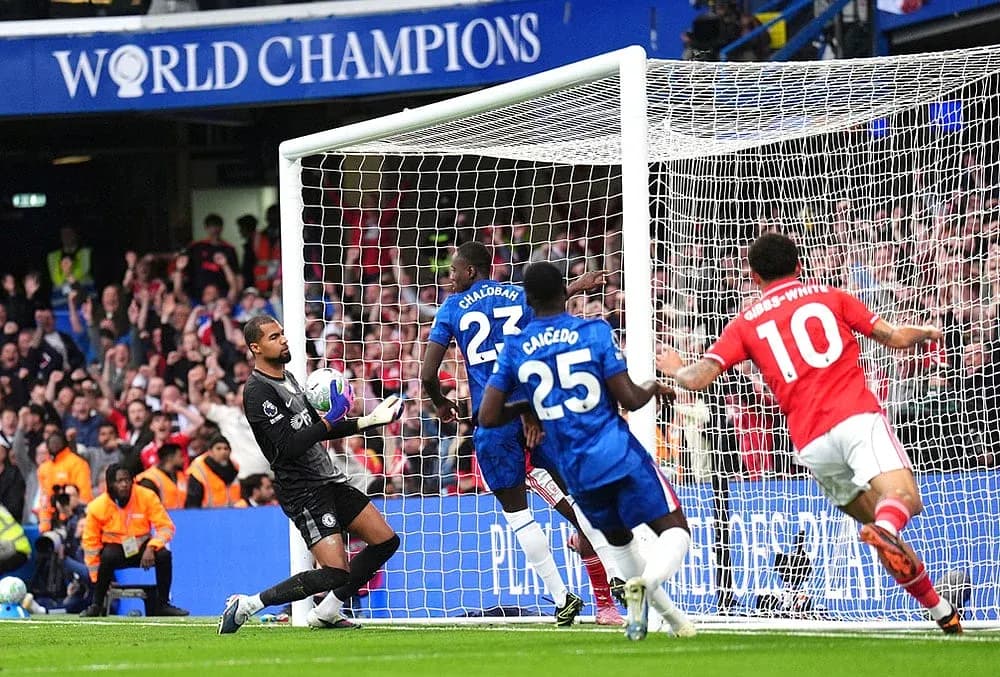
Nottingham Forest Triumphs Over Chelsea 3-1 in Premier League Clash
Stamford Bridge had the feel of a crossroads fixture, and following this result it is Nottingham Forest, not Chelsea, who stride away with clarity of purpose. A 3-1 away win in the Premier League’s Regular Season - 35 round underlines a stark contrast: Chelsea, 9th with 48 points and a goal difference of 6 (54 scored, 48 conceded overall), are a team drifting; Forest, 16th with 42 points and a goal difference of -2 (44 scored, 46 conceded overall), are a side that suddenly look far more coherent than their league position suggests.
The scoreline mirrors the season’s statistical DNA. Chelsea’s campaign has been defined by volatility: overall they average 1.5 goals for and 1.4 against per match, but the split is telling. At home they score 1.3 and concede 1.3 on average, a flat profile that hints at a side unable to tilt tight games in their favour. Forest, by contrast, have built a survival blueprint on their travels. Away from home they average 1.4 goals scored and 1.4 conceded, and with 7 away wins from 18 they arrived at Stamford Bridge with a clear, repeatable plan – and executed it.
I. Tactical shapes and structural stories
Calum McFarlane stayed loyal to Chelsea’s season-long backbone: a 4-2-3-1, the same shape they have used in 30 league matches. Robert Sánchez in goal sat behind a back four of Malo Gusto, Trevoh Chalobah, Tosin Adarabioyo and Marc Cucurella. In front, the double pivot of Romeo Lavia and Moisés Caicedo was tasked with both screening transitions and initiating build-up. Ahead of them, an attacking trio of Cole Palmer, Enzo Fernández and J. Derry operated behind João Pedro, the league’s third-ranked attacking rating for Chelsea and the club’s attacking talisman.
On paper, it is a structure designed to dominate territory: full-backs high, Palmer and Fernández between the lines, João Pedro pinning the centre-backs. But it also demands precision and intensity from the double pivot, and that is where the game’s fault line emerged.
Vítor Pereira, meanwhile, chose a more orthodox 4-4-2 for Nottingham Forest, a shape he has used less often than his usual 4-2-3-1 but one that made perfect sense here. Matz Sels was protected by a back four of Z. Abbott, Cunha, Morato and Luca Netz. Across midfield, D. Bakwa, Ryan Yates, Nicolás Domínguez and James McAtee formed a compact, hard-running band behind the front pair of Igor Jesus and Taiwo Awoniyi.
The 4-4-2 was not a throwback but a trap: two strikers to press Chelsea’s centre-backs, narrow wingers to choke the half-spaces where Palmer and Fernández like to live, and a central duo prepared to suffer without the ball.
II. Tactical voids and the weight of absences
Both squads came into this fixture thinned in important areas. Chelsea were without M. Mudryk (suspended) and wide options like A. Garnacho, J. Gittens and P. Neto, all listed as missing. That stripped McFarlane of vertical, touchline-running wingers who might have stretched Forest’s back line and forced their full-backs into deeper starting positions. Instead, Chelsea’s “three” behind João Pedro were all players who prefer to come inside, condensing the central lane and making Forest’s defensive task more manageable.
Forest’s absentees were just as significant but differently distributed. O. Aina, W. Boly, Murillo, D. Ndoye, I. Sangaré, N. Savona, John Victor and C. Hudson-Odoi were all unavailable. That is a heavy hit to the defensive and athletic spine – centre-backs, a ball-winning midfielder, and a direct winger. Pereira’s answer was to trust Morato and Cunha at the heart of the defence and to lean on the work rate of Yates and Domínguez in midfield. The risk was obvious: could a patched-up back four withstand Chelsea’s 1.8 goals-per-game attack on their travels, now transposed to Stamford Bridge?
Disciplinary profiles also framed the contest. Chelsea are one of the league’s most card-prone sides. Their yellow-card distribution peaks late: 22.35% of their yellows arrive between 76-90 minutes, with another 20.00% between 61-75. Red cards spike in the 61-75 window at 28.57%. Moisés Caicedo embodies that edge: 10 yellows and 1 red this season, plus another red for Sánchez and one for Cucurella and Chalobah. Forest, by contrast, see 23.21% of their yellows between 46-60 and another 23.21% between 61-75, with a single red in the 31-45 range. This was always likely to be a game where control of emotion in the second half would matter.
III. Key matchups – Hunter vs Shield, and the Engine Room
The headline duel was João Pedro against Forest’s defensive block. With 15 league goals and 5 assists, plus 48 total shots (28 on target), he is Chelsea’s hunter-in-chief. His movement across the front line is supported by 29 key passes and 67 attempted dribbles, 33 successful. Forest’s shield, though, is not a single player but a structure: Morato’s aggression, Cunha’s positioning, and the screening of Yates and Domínguez.
Forest’s away numbers suggested they were built to cope. On their travels they concede 1.4 goals per game and have kept 5 away clean sheets, more than Chelsea’s 5 at home. Their biggest away defeat is only 3-0, matching Chelsea’s heaviest home loss. Here, the plan was clear: deny Pedro the ball in dangerous zones rather than win every duel he engages in.
In the engine room, the clash was more personal. Caicedo, one of the league’s standout holding midfielders, arrived with 1,877 passes at 92% accuracy, 83 tackles, 14 blocked shots and 56 interceptions. He is both Chelsea’s metronome and their fire blanket. Opposite him, Yates and Domínguez were tasked with disrupting that rhythm, while McAtee floated into pockets to exploit any over-commitment.
Forest’s choice to start with a flat four in midfield meant Caicedo and Lavia were often outnumbered when Palmer and Fernández were pushed high. That imbalance was at the heart of Forest’s first-half dominance: their two banks of four compressed space, while transitions through McAtee and Bakwa targeted the channels either side of Chalobah and Adarabioyo.
IV. Statistical prognosis and what the result tells us
Following this result, the numbers and the narrative converge. Chelsea’s overall goal difference of 6 (54 for, 48 against) feels misleadingly positive for a team whose recent form line reads “LLLLL” in the standings. The underlying pattern – 9 clean sheets overall, but 7 matches where they have failed to score – is of a side oscillating between fluency and sterility. The 1-3 home defeat fits the negative trend: they can be opened up, especially when chasing games and exposing that back four.
Forest’s overall goal difference of -2 (44 for, 46 against) now looks more like the profile of a mid-table side than a relegation candidate. Their away record – 7 wins from 18, 26 scored and 25 conceded – is the bedrock of their survival push. The 3 goals at Stamford Bridge are entirely consistent with a team that has already produced a 0-5 away win this season; when their counter-attacking patterns click, they carry genuine punch.
In xG terms, this type of contest would almost certainly tilt towards a relatively even expected goals tally, with Chelsea’s territorial dominance balanced by Forest’s high-quality transition chances. But the defensive solidity and clarity of Forest’s 4-4-2 block, combined with Chelsea’s late-game disciplinary vulnerability and structural imbalance in midfield, turned the marginal into the emphatic.
The story of this match, and of these squads, is that system and mentality are currently worth more than raw talent. Chelsea possess the league’s third-ranked attacking rating in João Pedro and one of its most complete holding midfielders in Caicedo, yet lack a stable emotional and structural platform. Forest, missing a raft of key names, leaned into simplicity and collective discipline – and walked out of Stamford Bridge with three goals, three points, and a performance that finally matches the promise hidden in their away statistics.