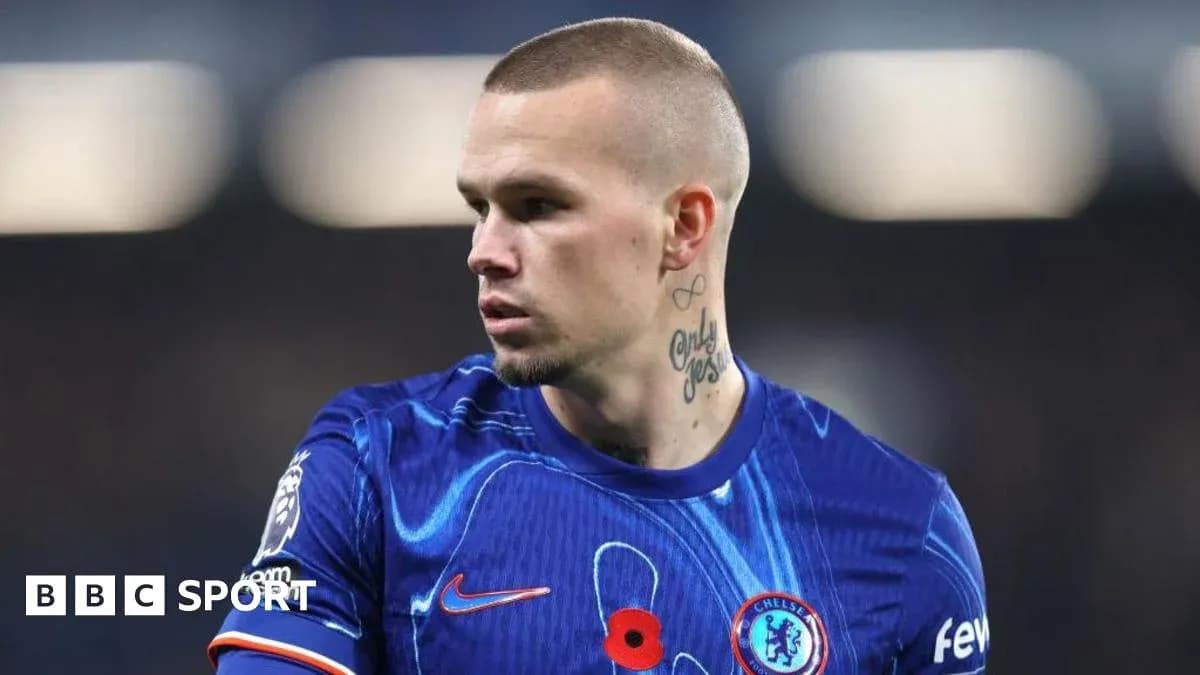
Mykhailo Mudryk Cleared to Return to Football After Doping Case
Mykhailo Mudryk’s long wait is over. After 20 months in limbo, the Chelsea winger has been cleared to return to competitive football immediately, drawing a line under one of the most complicated doping cases English football has seen in recent years.
The 25-year-old Ukraine international had not played since November 2024, frozen out of the game after an out-of-competition test on international duty flagged an “adverse finding” for meldonium, a banned cardiovascular medication linked to increased stamina and respiratory capacity.
What followed was brutal. The Football Association’s independent commission initially imposed the maximum sanction: a four-year ban, effectively threatening to wipe out the prime of his career and keep him sidelined until around December 2028.
Mudryk appealed to the Court of Arbitration for Sport. Now that appeal has ended in a negotiated resolution, agreed by Mudryk, the FA and the World Anti-Doping Agency (WADA). The winger has accepted that he broke anti-doping rules, and his suspension has been set at the time he has already served. He can play again “with immediate effect”.
A ban overturned by science and timing
For months, the FA had refused to disclose details of the case, citing the strict confidentiality of its anti-doping programme. On Friday, that changed.
In a detailed statement, the FA confirmed that Mudryk’s October 2024 sample contained a “low concentration” of meldonium. Since then, WADA has updated its technical document on the substance. Those changes do not apply retrospectively, but they alter the picture dramatically.
The FA noted that if Mudryk’s test had been taken under today’s guidelines, “the concentration of meldonium in the sample would not have been reported” and there would have been no adverse finding at all. The test that once defined his career would, under current rules, barely register.
The science moved. The case followed.
Chelsea’s support and a player in exile
Throughout the process, Chelsea kept their public stance measured but firm. The club stressed on Friday that they are “pleased that the matter has now reached a conclusion which allows him to return to football with immediate effect”, adding that they “have always supported Misha throughout this process while fully respecting the integrity of the anti-doping system and the legal process”.
Behind the scenes, that support had limits imposed by regulation. Under the terms of his suspension, Mudryk could not use Chelsea’s training ground or work with club staff. For a player signed for £61m from Shakhtar Donetsk in 2022 and tied to a contract until 2031 as part of the club’s long-term amortisation model, it was a surreal existence: a marquee asset locked out of his own workplace.
His only known public interaction with the first-team group during that spell came at the Conference League final celebrations in May 2025. No dressing room, no training pitch, no daily rhythm of elite football.
So he built his own.
Mudryk hired private coaches, paid for goalkeepers to join individual sessions, and found a home at non-league Uxbridge FC in London, where he worked on a borrowed pitch. He even organised a training camp in Austria, with footage from those sessions showing him driving through attacking drills and finishing exercises, trying to replicate the intensity he had lost.
Those close to him admit that no amount of private work can fully mirror the demands of top-level competition. But they also insist he never allowed his fitness to drift and that he emerges from this exile hardened, not broken.
“The most difficult period” – and a new chapter
Mudryk has called this “the most difficult period” of his career and spoke of his gratitude at being able to return. He has again maintained that he never “knowingly or intentionally” took a banned substance.
Chelsea, for their part, say they are looking forward to helping him “return to full fitness, back into the squad and back onto the pitch”, with the winger set to join the club’s pre-season tour. Inside the club, there is a recognition that this is not a simple plug-and-play return. Twenty months out leaves scars, physical and psychological.
Yet there is also a sense of opportunity. The Blues have highlighted that under current testing standards “no anti-doping rule violation would have resulted” from his sample, calling that context “an important part of the context surrounding the agreed resolution and [something that] allows everyone involved to move forward”.
Sources close to Mudryk say he is confident he can climb back to his best level, pointing to the discipline of his solo training regime and the backing he has felt from the club, even at a distance. He is said to be realistic about the challenge, but convinced he can overcome it.
What next for Chelsea and Mudryk?
The legal case is over. The football questions now begin.
Chelsea intend to offer a pathway back into the professional game, but the form that takes is still open. Reintegration into the first team is one route. A loan move is another, with sister club Strasbourg an obvious candidate if the club decide he needs a softer landing in a less intense environment. A permanent transfer cannot be ruled out either, given the scale of the rebuild and the financial calculations around a long, heavily amortised contract.
For now, though, Mudryk has something far more basic, and far more precious, than a tactical role or a transfer plan. He has the right to play again.
He arrived at Stamford Bridge in one of the most closely watched transfer sagas of 2023, a symbol of a new ownership’s ambition and a new recruitment model’s risk. That story was paused by a test tube and a technical document.
It restarts on the training pitch, under a different set of rules, with his career back in his own hands.