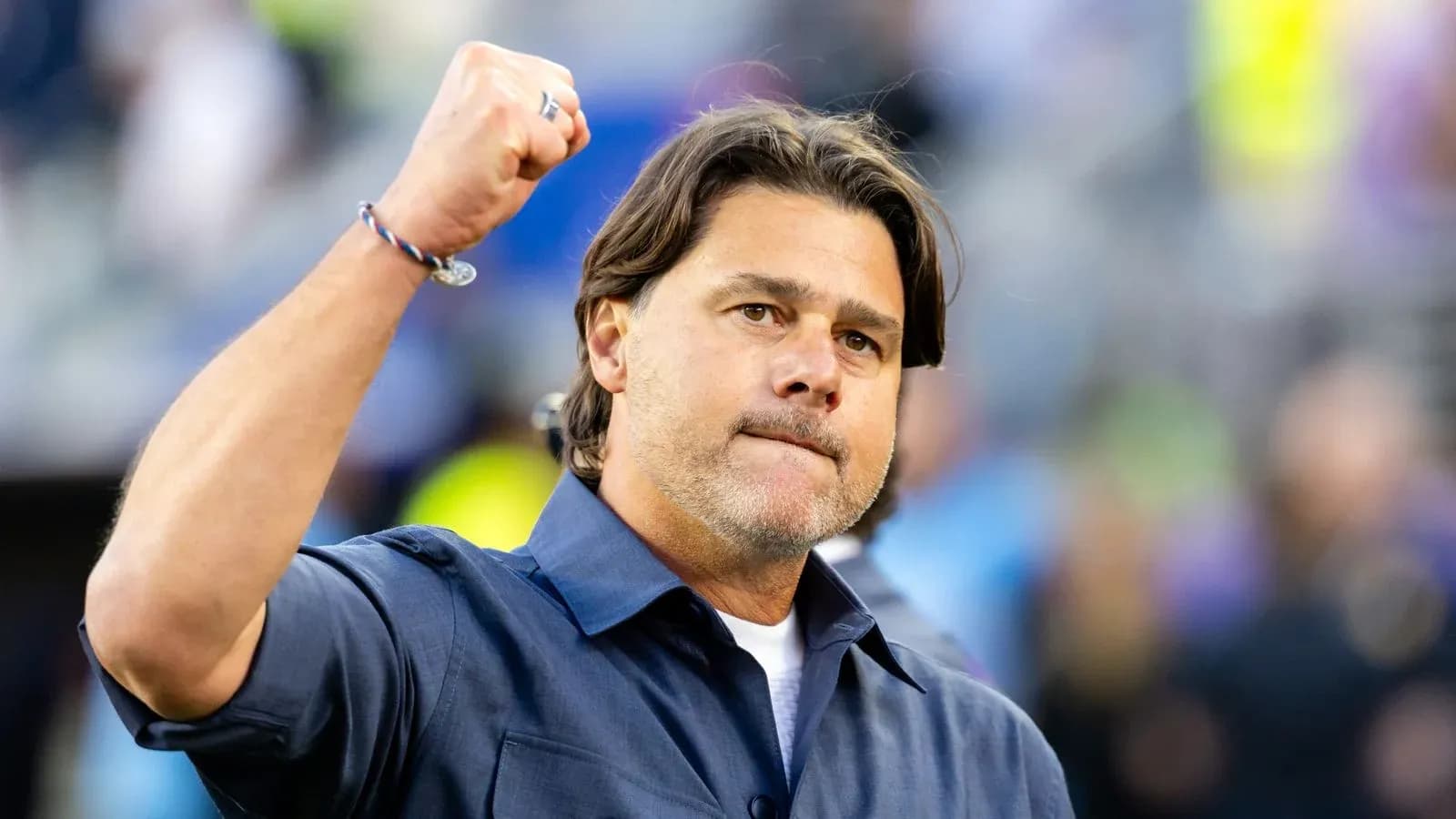
Mauricio Pochettino Reflects on World Cup Journey and Future Ambitions
Mauricio Pochettino walks into the room and it feels less like an interview, more like a reunion. Hugs, jokes, swapped holiday stories. He looks rested, but his summer has been anything but quiet.
He has just taken the USA to the last 16 of a home World Cup, watched the host nation's dream smashed by Belgium, ridden out a political storm around Folarin Balogun, shared a dressing-room moment with Donald Trump and, somewhere along the way, become an unlikely style reference point for Wayne Rooney.
For a man supposedly taking a breather from club football, he has barely stopped.
‘We are much better coaches now’
Ask Pochettino what he takes from the World Cup and he does not talk first about results or pressure. He talks about learning.
"We are much better coaches now," he says, and you can tell he means it. The tournament has sharpened him. Reinforced his obsession with detail. Reminded him how hard it is to impose a complex idea on a group that comes together for a few weeks, not 11 months of the year.
He leans into the idea that everything at that level is decided by inches and split seconds. The smallest mistake in preparation, the tiniest misread of a game state, and four years of planning can disappear in a moment.
"Everything needs to be perfect," he says. That is the standard he set himself and his staff, including long-time assistant Jesus Perez.
Perfection, of course, is impossible. Especially at a home World Cup with a president who thrives on the glare of the cameras.
Trump, politics and Balogun
Life did feel wild at times. Pochettino does not bite on the more colourful parts of the Trump circus, instead choosing to highlight the backing the team received from the White House. But the political noise did crash straight into football when Balogun’s availability became a global story.
His suspension was suspended on the eve of the last-16 tie with Belgium, triggering anger, accusations and talk of manipulation.
Pochettino did not deny the atmosphere around that game felt polluted. He admitted at the time that "politics and manipulation" overshadowed the football. Now, he strips his role back to something simple.
"If you pay attention to the noise, you become crazy," he says. FIFA cleared Balogun, the letter arrived the day before the game, and for Pochettino the call was obvious: if he is available, he plays.
Balogun has stayed in the headlines since. His proposed move from Monaco to Everton collapsed late on Deadline Day. Pochettino has kept his distance for now.
He knows what a failed transfer feels like. Knows the bruising mix of disappointment and public scrutiny. He wanted to see Balogun in the Premier League, to test himself in English football, but for now the striker remains in Monaco.
Pochettino just hopes he finds his rhythm again. Finds a good place.
The summer of navy and four more years
Amid the tactical talk and political drama, something as simple as a navy outfit caught fire. Pochettino has always dressed with care, but even he did not expect his World Cup touchline look to go viral.
It did. So much so that Wayne Rooney went out and bought the same ensemble.
"I saw him," Pochettino laughs. "He looked good on him, like a top coach."
It was that kind of summer. A World Cup run, presidential cameos, fashion headlines.
Then, just as the club rumour mill began to spin and his name was linked with vacancies across Europe, came another twist: Pochettino committed to the USA until 2030.
Four more years. A clear project. A statement that he is not done with international football yet.
‘My dream now is USA – but after that, why not?’
Six years away from club football would be a long time for a coach whose reputation was built in the week-to-week grind of the Premier League and Champions League. Is this it? Is the English chapter closed?
He pushes back on that immediately.
"I have the ambition," he says. "My dream now is to be in the USA for four years, but after that, why not? We are still young, and I think coming back is always my goal; to win the Premier League, to be in the Premier League and to build a project with the possibility of winning."
He is clear. He wants to return, and not just to make up the numbers.
"I love the football here. I think to have the chance again is one of my wishes and I hope that happens."
The door is not just ajar. In his mind, it is waiting to be pushed open.
The Spurs question that never goes away
Talk of unfinished business inevitably leads to Tottenham. Eighteen months ago, Pochettino spoke openly about his desire to go back one day. At that point, Spurs were struggling under Ange Postecoglou. Since then, Postecoglou has gone, Thomas Frank and Igor Tudor have come and gone, and the club has flirted dangerously with the drop.
Did the call ever come? Was there a moment when Spurs seriously asked him to come back and steady the ship?
"Always I say, one day, why not?" he replies when the prospect of a return is raised.
Pressed on whether it was a live option this time, he is more specific.
"People talk and maybe we receive some approach, but it never was close." Not this time, then. The romantic reunion stays on hold.
What about elsewhere? At one point AC Milan looked a realistic landing spot.
"We were not open during the World Cup to talk with different clubs that were interested," he says.
Were there many? He almost shrugs.
"Yes, always," he replies. "Yes, always have different, you know, options."
Did any of them tempt him? Did any of them get close?
"We never gave the opportunity to be close. We always closed the door before it got close."
The message is consistent: during the World Cup, his focus was the USA. After it, the extension made the rest academic.
Spurs, Chelsea and the £300m question
From his vantage point now, Pochettino watches his former clubs with a mix of affection and curiosity.
Spurs, he notes, are doing things differently. "They are investing like other clubs," he says, and he understands the shift. After a couple of difficult seasons, the club has changed tack, targeting players already battle-hardened in the Premier League and spending heavily to do it.
It is hard not to think back to his own era in north London. To the title races, the Champions League final, the near-misses that came with a fraction of the current outlay.
What would he have done with £300m to spend? He grins and feigns ignorance, joking that he cannot even imagine what £300m looks like.
So will this strategy work?
"You never know," he says. "We need time to see if that works or not.
"Like in all the games, when you make a decision like a coach that can work well or not. I think it's a different strategy and a different way to operate. I always wish the best for Tottenham because it's in my heart."
Chelsea, too, have pivoted since his spell at Stamford Bridge. The role he held has changed from head coach to manager. The transfer policy has shifted as well, away from long-term projects towards Premier League-ready signings under Xabi Alonso.
Pochettino is careful not to draw direct lines between his tenure and the current regime, but he recognises the intent.
Buying players like this, he says, means you can expect to fight. Expect to be a contender for the Premier League.
Chelsea’s defeat to Arsenal has already checked some of that early optimism. Pochettino, though, urges patience with Alonso.
"Of course they are disappointed after the defeat against Arsenal, but I think we need to give time to Xabi's first season after three games in the Premier League," he says.
"I think we need to give time, and of course for Tottenham the same."
Both of his old clubs are trying to accelerate back towards the top. Both, in his view, need space to breathe.
‘Mikel is the best coach in the Premier League today’
Ask Pochettino who sets the standard right now and he does not hesitate.
For him, Arsenal are in pole position. And at the centre of that, Mikel Arteta.
"Mikel is the best coach in the Premier League today," Pochettino says. "Knowing what he needs to do, it's going to be tough to beat them."
It is a striking admission from a man whose own reputation in English football remains high, and whose competitive fire is clearly still burning.
For now, his world is red, white and blue. The USA, another four-year cycle, another shot at shaping a national team in his image.
But somewhere beyond 2030, the thought lingers: a Premier League dugout, a long-term project, a chance to finally lift the trophy that slipped through his fingers.
If he really is a better coach now, who will be brave enough to hand him that chance?