Manchester United's Decline: Apathy at Old Trafford
The boos came first. Then the shrug of the shoulders, the slow shuffle to the exits. Old Trafford did not rage on Wednesday night as Manchester United slipped out of the Carabao Cup; it sagged. The soundtrack was a mix of jeers and something worse for any club of this size: apathy.
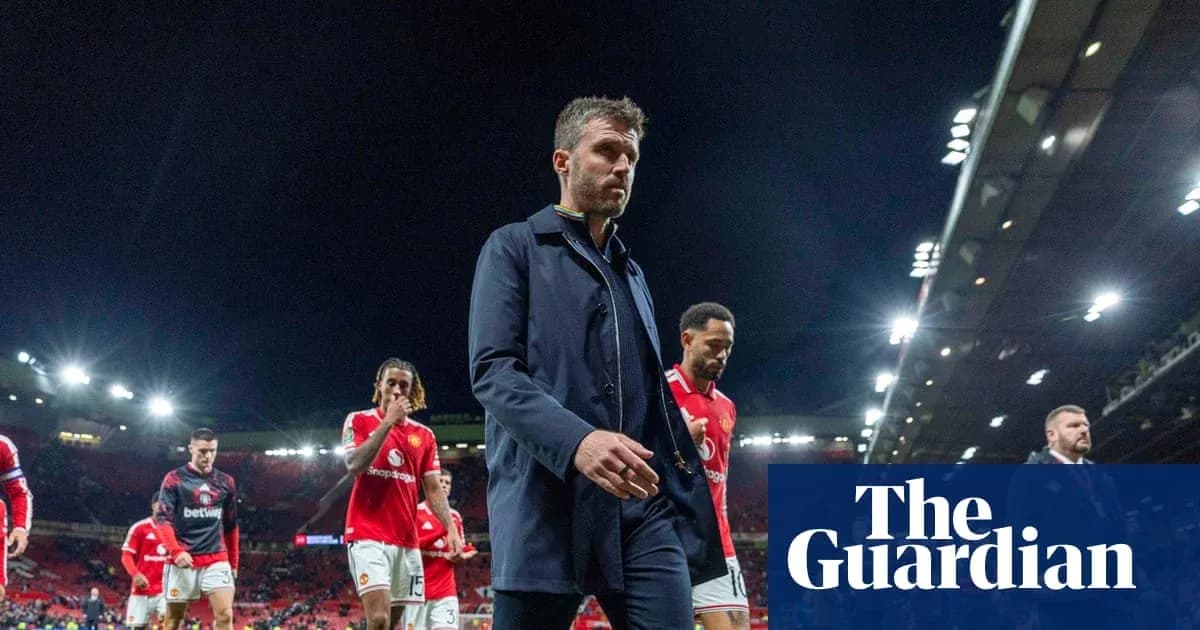
Michael Carrick walked off with the look of a man who knew exactly where the fingers would point. He and his players took the brunt of it. Jason Wilcox, high in the directors’ box, cut an unimpressed figure as he left, but the director of football and those above him cannot pretend this is someone else’s mess.
Supporters understand the ecosystem. They see the head coach fronting up to the cameras, doing the sponsor duties, carrying the public face of the club. They also know he is only one part of a structure that has been creaking for years.
Carrick only returned to United in January. The long-term planning, the strategy that frames his work, belongs to others. That will not save him if results keep sliding. A defeat at Fulham on Sunday would not just turn up the volume; it would crank it to a new level.
United fans are not naïve about who runs their club. Protests against the Glazer family and Sir Jim Ratcliffe have become part of the backdrop. They can separate a bad 90 minutes from a bad decade. The boos are for what they have just watched. The flat indifference is for what the club has become.
It stings even more with United back in the Champions League yet outspent in the summer by promoted sides. Years of financial mismanagement have left a squad that needs surgery and a budget that demands precision. Every pound now has to count.
The 3-2 defeat by Brighton told its own story. Two goals up inside 10 minutes, United then all but vanished for the remaining 80 and deservedly lost. That is not a blip; it is a warning siren. Carrick does not need telling.
Brighton arrived heavily rotated yet still bristling with energy and talent, the product of smart scouting and bold recruitment across the globe. This summer alone they brought in players from clubs in seven different countries. United, by contrast, shopped almost exclusively in their own backyard, signing four players from fellow Premier League teams.
Calculated risk? Dynamism? Those words rarely feel at home at Old Trafford these days. The irony is that last summer’s most effective signing, judged on value and consistency, was Senne Lammens from Royal Antwerp – a rare example of the kind of opportunism others have made their trademark.
This season’s transfer plan has only deepened the scrutiny. Carrick and Wilcox cannot be fully judged until Carlos Baleba, the most expensive of the three summer buys, is fit and available. On paper, his mobility should address one of the team’s most glaring flaws in midfield. Targeting the middle of the pitch made sense after Casemiro’s departure and Manuel Ugarte’s struggles. But it was never the only area crying out for attention.
Inside the club, there was an acceptance that the squad was short in several departments. The decision to pour so much of the budget into one position now looks naïve. It is certainly being exposed.
Buying from Premier League rivals is almost always expensive, but at least it reduces adaptation time. Even so, with a shortage at left-back and Joshua Zirkzee failing to convince, finding a cheaper alternative to the £50m Andrey Santos might have served the wider balance of the team far better. Instead, United committed around £155m on three players in essentially the same role.
Someone in authority needs to step forward and explain that logic. Why that profile, at that price, in that volume? While the outside world speculates, Carrick is left to improvise a plan B at left-back now that Luke Shaw, as many expected, is sidelined again.
Wilcox has spoken about the project before, but only when the waters were calm. On 30 October 2025, after three straight wins, he sat down with United’s in-house media to outline the long-term vision. Barely two months later, Ruben Amorim was sacked and that plan was in pieces.
Since then, beyond terse statements when managers are dismissed, Wilcox has largely retreated from public view. Across Europe, sporting directors routinely front up to the press. In the Premier League, the trend has been slower to catch on, and at United the silence now feels deafening with the team marooned in 13th.
Wilcox’s story at the club has been one of promotion and pressure. He arrived from Southampton in 2024 as technical director and played a part in the decision to keep Erik ten Hag after an eighth-placed finish. Ten Hag did not survive the poor start to the following season. Amorim came in from Sporting, his possession-heavy style never quite matching a squad that lacked the tools – and with little money to reshape it, the mismatch was baked in.
The result was grim. United slumped to 15th and lost tamely to Tottenham in the Europa League final. When Amorim was finally dismissed after 14 months, Wilcox was given another chance to reset the football operation. That reset is now under the microscope.
Carrick is not being spared in the debate. Nor should he be. United have underperformed in the league and big wins over promoted Ipswich and Azerbaijani side Sabah do not disguise a shaky start.
Defensively, they have been porous, conceding seven goals in four Premier League games. Against Brighton, the central pairing of Leny Yoro and Ayden Heaven looked alarmingly out of their depth. Up front, the attack has rarely felt like a coherent unit.
Wilcox’s reputation from his days as Manchester City’s head of academy remains strong. Those who worked with him speak highly of his eye for talent and suitability for youth-focused roles. The step up to running the football department at United is a different test, and his decisions are now being pulled apart.
If JJ Gabriel does leave, frustration among supporters will be fierce. Yet in that specific case, Wilcox cannot be accused of neglect. He has pushed hard to keep the teenager, working through the player’s inner circle to try to convince him that his future lies at Old Trafford.
The bigger picture is harsher. At United, power carries a cost. So far, only the head coaches have been made to pay it. Ten Hag and Amorim lost their jobs as the team floundered, while others higher up the chain have stayed in place.
Carrick and Wilcox are both deeply invested in making this work. But as the pressure builds and the table refuses to flatter, the sense grows that if results do not turn soon, only one of them will be asked to carry the blame.