Manchester City: The Rodri Dilemma in Enzo Maresca's Era
Manchester City stand at a crossroads.
Ten years of Pep Guardiola have given way to Enzo Maresca, and the transition is anything but gentle. The treble-winning core has been ripped open: Manuel Akanji, Nathan Ake, Bernardo Silva and John Stones have all gone in the same summer. Four pillars from Istanbul 2023, gone in a single swing of the transfer window.
In their place, City have pushed £116m on Elliot Anderson and rolled the dice on 17-year-old Jeremy Monga. Two intriguing pieces, not yet proven at this level, dropped into a dressing room that has lost its old shape and its old voice.
And then there is Rodri.
The Rodri dilemma
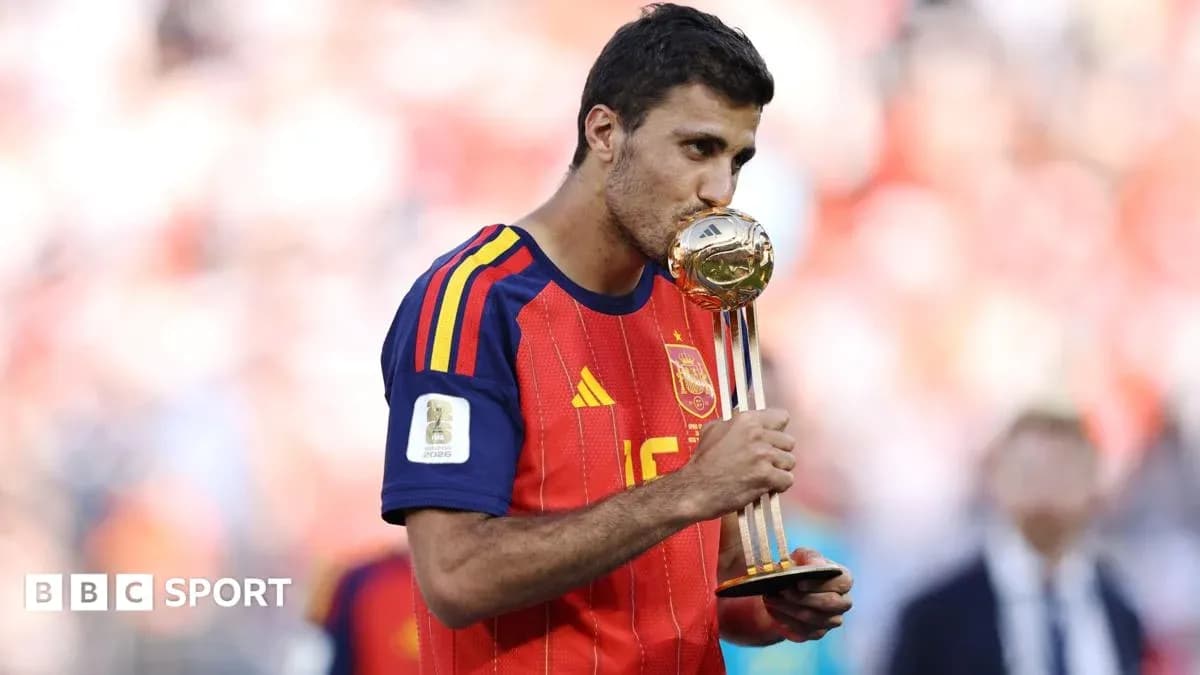
Fresh from lifting the World Cup as Spain captain and claiming the Golden Ball, the best midfielder on the planet now heads for back surgery on Monday. He has one year left on his contract. Real Madrid are, according to reports, “operating on the basis” that he will join them.
The timing is brutal. The uncertainty even more so.
Maresca did not flinch when asked about him in his first news conference.
“I think every manager wants to have Rodri because he is a top player,” he said. “But now, surgery on Monday... he needs a holiday... he needs to rest and recover and then he will be back with us.”
The message from the new manager is clear: keep him, build around him, wait for him. Yet the market whispers a different story. If Madrid truly believe Rodri is theirs, City face a stark choice once he returns to fitness: cash in on a 30-year-old with a year left on his deal, or double down on their cornerstone and risk losing him for far less later.
For a decade, City’s big decisions have been made from a position of strength. This one feels different. This one carries jeopardy.
The brain of Maresca’s City
To understand why Rodri matters so much to Maresca, you have to understand how the Italian sees the game.
A devoted disciple of positional play, Maresca talks about football like a chess grandmaster. He studies patterns, counter-moves, the geometry of the pitch. “The most important is positional play and strategy,” he has said. “Develop a plan, study counter-moves, choose the arrangement of the pieces.”
On the ball, his teams usually morph into a 3-2-2-3. It is not just a formation, but a framework: three at the back, two holding midfielders, two advanced interiors, three across the front. The beauty lies in how you arrive there.
At Leicester and then Chelsea, Maresca showed a taste for bold structural tweaks. His sides often defended in a 4-4-2, then shifted into that 3-2-2-3 when they had possession. At City in the treble season, with Maresca on Guardiola’s staff, it was Stones who stepped out from centre-back to form a double pivot with Rodri. At Chelsea, Moises Caicedo started on the teamsheet as a right-back, then glided inside into midfield when the team attacked.
The pattern repeats: defend with four, attack with three at the back and two holding in front. The names change, the roles don’t.
In that world, Rodri is priceless. He can drop into the back line, step into midfield, or surge into space when the game opens up. During Spain’s World Cup run, he routinely slipped back alongside Aymeric Laporte when his former City team-mate carried the ball forward, then re-emerged into midfield to dictate tempo. He read danger, he read space, he read risk.
That is not something you buy off the shelf. It is something you grow.
Anderson, Bouaddi and the new board
City’s recruitment suggests they know they cannot simply replace Rodri like-for-like. They are trying to rearm the midfield, not clone it.
Anderson, signed for £116m, will be one of the first pieces Maresca moves around his board. He has the energy and technique to operate in those interior slots, or deeper if needed, but learning Maresca’s positional demands will take time. Monga, at 17, is one for later, a prospect rather than a plug-in solution.
Behind them, City are tracking Lille’s 18-year-old Ayyoub Bouaddi, who caught the eye with Morocco at the World Cup. Again, the profile fits: a young midfielder comfortable receiving under pressure, able to shift between roles, mouldable within a complex structure.
None of them, though, arrive with Rodri’s encyclopaedic sense of when to slow the game, when to accelerate it, when to gamble and when to kill the tempo. Even Rodri needed seasons under Fernandinho’s guidance before he became the metronome of Europe’s most dominant side.
If he stays, Maresca has his organiser, his safety net, his chessboard king. If he goes, the Italian will lean on a different skill: his knack for seeing new roles in familiar players.
He has done it before. Stones into holding midfield. Caicedo into full-back. Marc Cucurella pushed into attacking midfield. Each shift looked strange on paper, then logical once the pattern emerged on the pitch.
Life with Rodri – and without him
With Rodri, Maresca can accelerate his ideas. The 3-2-2-3 can be built around a midfielder who already understands positional play at the highest level. Rotations become cleaner. Risk becomes manageable.
Without him, the project changes tone. City would still have talent, perhaps more of it across the squad than in Guardiola’s final years, when he preferred a lean group of trusted lieutenants. Maresca is more open to numbers, more open to variety. A larger squad gives him more pieces to experiment with, more combinations to test.
That flexibility might be his greatest weapon if the club decide to sell Rodri. The shape will remain. The personnel within it could look very different.
What is certain is that City cannot drift. A decade of Guardiola has conditioned the club to clarity: a defined style, a defined core, a defined leader on the pitch. This summer has already stripped away four starters from the treble team. The next decision, on the man who held that side together, will define Maresca’s first era.
Does he get to build around the best holding midfielder in the world? Or does he have to prove, immediately, that he can reinvent a champion team without its brain?
The answer will decide whether this is a gentle evolution of a dynasty, or the start of something far more volatile at the Etihad.