Lazio and AC Milan Draw 2–2: A Tactical Showdown
Under the late summer light of the Stadio Olimpico, Lazio and AC Milan produced a 2–2 draw that felt less like an early-season skirmish and more like a statement of intent from two sides with Champions League ambitions. The table backs that up: following this result Lazio sit on 10 points in Serie A, 4th with a goal difference of +3 (6 scored, 3 conceded overall), while Milan are just behind on 8 points in 6th, also with a goal difference of +3 (7 scored, 4 conceded overall). Both remain unbeaten after 4 matches, and this fixture showed exactly why.
I. The Big Picture – Systems in Conflict
This was a meeting of clear tactical identities. Lazio stayed loyal to their 4-3-3, a shape they have used in all 4 league matches, and which has powered an overall scoring average of 1.5 goals per game both at home and on their travels. Gennaro Gattuso’s side, with 3 wins and 1 draw overall, have built a platform on balance: 6 goals for, only 3 against, and 2 clean sheets already.
Opposite them, Ruben Amorim brought his trademark 3-4-2-1, also used in all 4 of Milan’s league outings. Milan’s numbers tell a similar story of controlled aggression: overall they average 1.8 goals scored per match, conceding 1.0, and they have yet to lose. On their travels specifically, they have scored 5 and conceded 4 in 3 away games, an away scoring average of 1.7 goals and an away concessions average of 1.3.
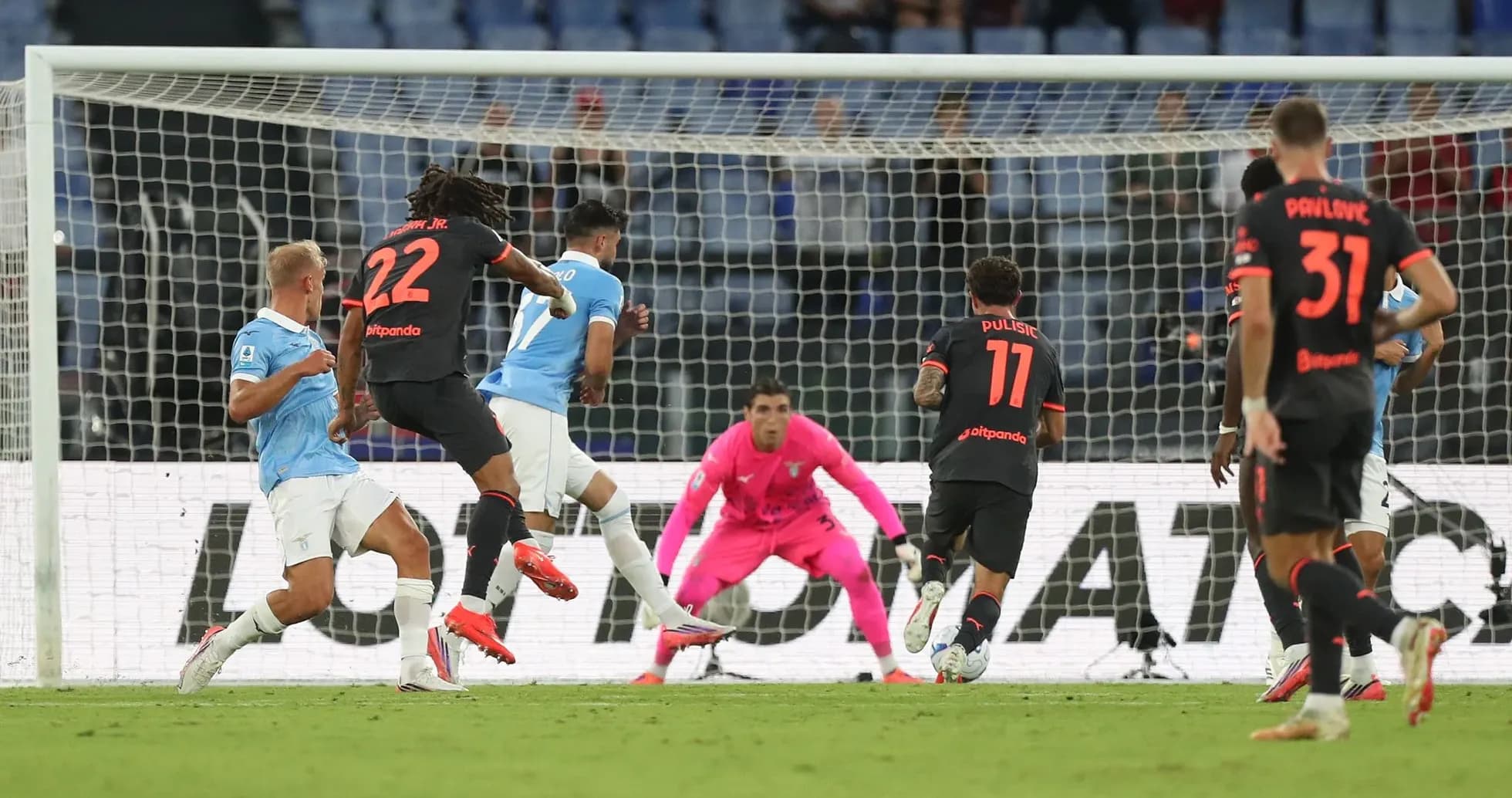
The first half belonged to Lazio’s structure. The 4-3-3 stretched Milan’s back three horizontally, with Mattia Zaccagni and T. Noslin pinning the outside centre-backs, while M. Cancellieri threatened the space behind. With the ball, Lazio’s 4-3-3 morphed into a 2-3-5: full-backs R. Floriani and N. Tavares advanced, D. Frattesi surged beyond R. Belahyane and K. Taylor, and the front line occupied all five attacking lanes. The reward was a 2–0 half-time lead, fully in keeping with a side that at home averages 1.5 goals scored and only 1.0 conceded.
But Amorim’s Milan are built for adaptation. In the second half, their 3-4-2-1 became more aggressive, with wing-backs S. Chukwueze and P. Estupiñán pushing so high that it often resembled a 3-2-5. The pressure eventually told as Milan, whose away attack has already delivered 5 goals this season, clawed back to 2–2 by full time.
II. Tactical Voids – Absences and Discipline
Lazio’s squad sheet carried the scars of a long injury list. F. Dele-Bashiru, D. Doekhi, A. Furlanetto, A. Marusic, Patric, L. Pellegrini and N. Rovella were all ruled out. That cluster of absences in defence and midfield forced Gattuso to lean heavily on J. Sutalo and O. Provstgaard as the central pairing, with Floriani and Tavares as full-backs. It also elevated Belahyane into a more central organisational role than he might otherwise have had this early in the season.
The disciplinary patterns from the season framed the risk. Lazio’s yellow cards tend to spike in the 16–30 and 31–45 minute windows, each carrying 25.00% of their total yellows, with another 25.00% coming in stoppage-time periods (91–105). That early and late volatility is the tax they pay for an intense, front-foot style. Milan, by contrast, accumulate their cautions almost exclusively after the interval: 25.00% of their yellows in each of the 46–60, 61–75, 76–90, and 91–105 minute ranges. They grow more combative as matches stretch and spaces open.
Within this fixture, those trends shaped the emotional rhythm: Lazio’s first-half ferocity, Milan’s second-half response. Zaccagni, already on 2 yellows this season, again walked the tightrope between creative menace and disciplinary risk, while S. Pavlović – also on 2 yellows in the league – embodied Milan’s willingness to defend aggressively on the front foot.
III. Key Matchups – Hunter vs Shield, Engine Room vs Enforcer
The headline duel was in midfield. On Lazio’s side, Davide Frattesi arrived as one of Serie A’s most in-form midfielders: 3 goals in 4 appearances, with a strong all-round profile – 5 shots (3 on target), 78 completed passes at 82% accuracy, 6 tackles, and 3 blocked shots. His role in the right half-space was to time late runs beyond Noslin and Cancellieri, attacking the channels between Milan’s wide centre-backs and wing-backs.
Facing him, Milan’s shield was a collective more than an individual. Pavlović, with 12 tackles, 1 block and 1 interception this season, and an imposing duel record (40 duels, 29 won), anchored the back three. In front of him, Adrien Rabiot acted as the hinge: 133 completed passes at 84% accuracy and 2 assists in 4 games show how he both screens and starts transitions. The Frattesi–Rabiot axis was the game’s engine room confrontation: Lazio’s surging runner against Milan’s metronomic enforcer.
Further forward, the creative duel tilted red and black. Chukwueze has been one of Serie A’s most productive wide creators so far, with 2 assists, 10 key passes and 6 successful dribbles from 9 attempts. His positioning on the right side of Milan’s midfield line targeted Tavares and the left interior space behind Zaccagni. On the opposite side, Zaccagni answered with 2 assists, 8 key passes and 10 shots (6 on target) this season, constantly driving at Milan’s left channel and forcing their back three to defend wider than they like.
Up front, the “Hunter vs Shield” narrative was more collective than individual. Lazio have spread their 6 league goals among multiple threats, with Frattesi emerging from midfield rather than a classic number nine. Milan’s attack, boosted by A. Cissé’s 2 league goals and G. Ramos’ presence, tested a Lazio defence that had conceded only 3 goals in 4 matches overall and kept 2 clean sheets. Over 90 minutes, Milan’s overall attacking average of 1.8 goals per game met Lazio’s overall concessions average of 0.8 – and the 2 goals they scored in Rome fell closer to Milan’s attacking ceiling than Lazio’s defensive baseline.
IV. Statistical Prognosis – A Draw That Feels Like a Warning
Following this result, the numbers paint two sides that are not just unbeaten, but sustainable. Lazio’s overall record of 3 wins and 1 draw, with 6 scored and 3 conceded, suggests a team whose 4-3-3 is already bedded in. Their failure to lose despite a long injury list hints at depth and tactical clarity. Milan’s 2 wins and 2 draws, 7 goals scored and 4 conceded overall, show a side that can both control and chase games, especially away where they remain undefeated in 3 outings.
Neither team has taken a penalty this season, so there was no spot-kick drama or narrative of missed opportunities from the spot to distort the underlying story. Instead, the draw felt like a pure expression of structure and adaptation: Lazio’s scripted first-half dominance against Milan’s second-half recalibration.
From a tactical and statistical lens, the 2–2 feels almost inevitable: Lazio’s home scoring average of 1.5 and Milan’s away average of 1.7 intersecting around a shared expectation of two goals apiece. If this is what both sides look like in September, the rest of Serie A has been given fair warning: the race for the top four will run straight through Rome and Milan.