
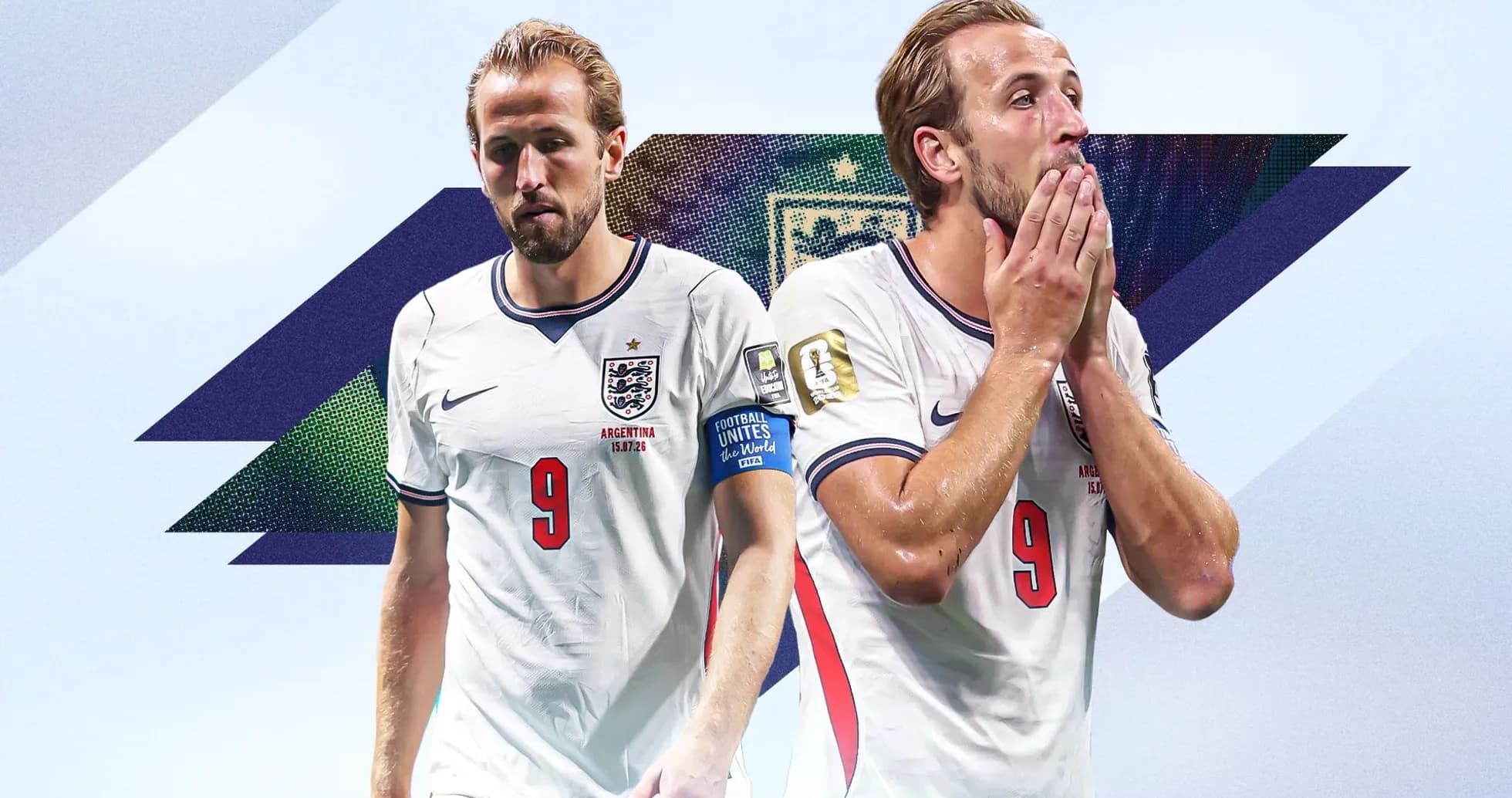
Kane's World Cup Heartbreak: England's Semi-Final Collapse Against Argentina
For an hour in New Jersey, England went toe-to-toe with the world champions and looked like they belonged. Thomas Tuchel’s team didn’t dominate Argentina, but they matched them stride for stride, tackle for tackle. When Anthony Gordon swept in the opener on 55 minutes, it felt less like a shock and more like a reward for nerve.
It was the kind of first punch you throw knowing another is coming back. Argentina would respond. England, you thought, were built to respond again.
They weren’t.
Once ahead, England shrank. Argentina did the opposite. They played as if someone had flicked a switch, pouring forward with a kind of ruthless clarity that Lionel Scaloni later distilled into one phrase: his side had “smelled blood in the water”. Tuchel’s England, by contrast, backed off and backed off again, as if the only plan was to see how long they could survive with the sharks circling.
And through it all, Harry Kane drifted around the game like a ghost at his own party.
A captain in the chaos
The numbers are brutal. Twenty-six touches. Nine completed passes. One shot, blocked. No touches in Argentina’s box. On paper, it reads like a non-performance from England’s captain, a star striker who vanished when the stage was at its brightest.
The truth was a little messier. This was a scrappy, bitty semi-final, a contest that never really settled into any sort of rhythm. Kane embraced the chaos early. He fought, he wrestled, he chased. In the first half he hurled himself into more duels than Lisandro Martínez and Alexis Mac Allister, sometimes with a recklessness that made you wince. He spent 45 minutes behaving less like a finisher and more like a holding midfielder who’d been told his contract depended on winning second balls.
That work mattered while the game was ugly and disjointed. England needed someone to absorb contact and slow Argentina’s early surges. Kane did it. But the moment England scored, the match changed and he didn’t – or perhaps couldn’t.
This was when Tuchel’s evening began to twist.
Tuchel’s dilemma, Kane’s limitation
The second half presented a tactical riddle. Tuchel was managing a squad running on fumes. England had already emptied themselves at the Azteca, where they clung on to beat Mexico with a backs-to-the-wall defensive stand. Kane had gone 89 minutes there too, scrapping and pressing, the sort of shift that leaves lactic acid in the legs for days.
Yet here he was again, asked to lead the line, asked to lead the press, asked to do everything.
Afterwards, Kane spoke like a man who knew England had retreated too far.
“For one reason or another, we struggled to be on the ball, we struggle to put pressure on the ball and it allowed them to create more momentum and created more attacks for them in our final third,” he said.
The irony is painful. Kane was describing a problem he helped create.
What England needed in that final half-hour was not another body in their own half. They needed a release valve. A striker to pin one of Argentina’s heavy-legged centre-backs, force them to turn, make them run towards their own goal. Someone who would stand high, stay high, and give desperate defenders a target.
Kane is almost everything you want in a modern No 9. He links play, he finishes, he thinks a phase ahead. But he does not run away from people anymore. He cannot stretch a back line with raw speed. When the tide turned, his instincts dragged him deeper, trying to plug gaps in midfield as wave after wave of Argentina pressure crashed onto the edge of England’s box.
It was no longer a game for him. Tuchel had to see that. He didn’t. Kane stayed on, rooted between the lines, watching the collapse unfold in front of him, unable to change its course.
From Bayern brilliance to World Cup heartbreak
Viewed against the season he has just produced, this exit feels particularly cruel. Kane has been nothing short of devastating for Bayern Munich. Fifty-eight goals in all competitions. Thirty-six in the Bundesliga alone, the highest domestic tally in Europe’s top five leagues. He became the fastest Bayern player ever to reach 100 goal contributions. Bayern won the title by 16 points, easing off long before the finish line.
These are not just big numbers. They are historic ones. Robert Lewandowski never hit them. They brushed up against the statistical realms usually reserved for Lionel Messi and Cristiano Ronaldo. On club form alone, there was a serious case for Kane to become the first English Ballon d’Or winner since Michael Owen.
But Bayern’s season had holes. They fell 6-5 in the Champions League semi-finals to eventual winners PSG, failing to overturn a first-leg deficit. The big European nights that swing votes never quite fell his way.
So Kane turned to the World Cup as his fresh canvas. He admitted as much before the tournament. A strong run with England, a deep surge towards the trophy, and he would be right back in the Ballon d’Or argument.
“I’d be one of the favorites, definitely,” he said. “Given the trophies I’ve won this season and the number of goals I’ve scored, I’d be in the running. Especially as, should England win the World Cup, one could imagine the trophy going to an English player.”
For five games, he played like a man chasing history. Two goals against Croatia. One against Panama. Two more against Congo. An assist in that epic at the Azteca. He and Jude Bellingham dragged England forward while everyone else did the dirty work around them.
The Golden Boot, that old friend of individual awards campaigns, hovered into view. Heading into the semi-final, Kane sat two behind Messi and Kylian Mbappé. If England were to reach the final, they would almost certainly need him to score. It felt set up for him.
He didn’t. And with that, the Golden Boot has all but gone. Even a hat-trick against France in a third-place game he really should be nowhere near would not realistically change the picture. Messi, with Spain in front of him in the final, is unlikely to stand still.
Kane will fly back to Germany with a record-breaking club season, no World Cup, and no Golden Boot. A brilliant year, stripped of its crowning moment.
A legacy without a trophy
This is the part that stings. Because this might have been his last, best shot.
Kane’s move to Bayern was a career reset that came a year or two late. He was extraordinary at Tottenham, year after year, one of the Premier League’s finest players. But the supporting cast was rarely good enough and the investment rarely serious enough. Only now, as he thrives in Bavaria, have Spurs decided to spend like a club that truly wants to compete.
His success in Germany has been a statement of legitimacy. He can do it outside of England. He can do it under different pressures, different systems, different expectations. He has spoken often about studying other sports, learning from athletes who have extended their primes by treating their bodies like precision instruments. His numbers at Bayern suggest he can hold off decline at club level for some time yet.
International football laughs at such control. There are no long arcs here, no months to bed in ideas, no gentle stretches in the schedule to rest heavy legs. Camps are short, tournaments shorter. This World Cup, even with England’s extended preparations, was a sprint tacked onto the end of a marathon season. When it mattered most, when the sprint reached its final bend, Kane’s legs and influence deserted him.
So where does that leave his England legacy?
On one level, he is already out on his own. He is surely England’s greatest striker, and the numbers will only harden that claim. If he stays fit, 100 international goals is within reach. Peter Shilton’s record of 125 caps should fall; Kane is on 121. He has scored more World Cup penalties than any player in history. He won the Golden Boot in 2018.
Yet the major-tournament void sits there, unfilled. Euro 2024 passed with him on the fringes. In Qatar, he missed a penalty that could have changed everything. In 2018 and at the delayed Euro 2021, he was operating in squads that were not as deep or polished as this one, but the fact remains: he has never dragged England to a trophy in the way his contemporaries and idols have done for their countries.
Messi, Ronaldo, Pelé, Diego Maradona, Thierry Henry – the names Kane’s numbers invite comparison with – all have a major international title to lift above their statistics. Kane does not.
England’s looming problem
The dilemma is not his alone. England have a Kane problem of their own making.
Look beyond him and the striker depth chart is worryingly bare. Tuchel brought a 30-year-old Ollie Watkins and a 30-year-old Ivan Toney to this World Cup. Both are fine forwards. Neither is a long-term heir. There is no 21-year-old phenom waiting in the wings, no obvious successor to ease the transition.
Which makes the next four years awkward. Kane will be almost impossible to dislodge on reputation, on output, on sheer presence. England will almost certainly build around him again for Euro 2028. On paper, they should still be strong. In reality, they may be doing so with a centre-forward edging past his physical peak and no clear alternative.
Kane, unsurprisingly, has no intention of stepping aside.
“The national team is my pride and joy,” he said. “It’s what I love to do most more than anything. Obviously four years is a long way away, I’m 33 this summer but it never ended with Leo [Messi] there, he’s still performing at the highest level. I never want to put a limit on these things.”
He shouldn’t. Nor should England bank on time standing still.
Kane has been here before, at tournaments where the path seemed to open in front of him, only for it to close with a thud. This World Cup, with his club form, his scoring streak, his Ballon d’Or narrative all aligned, felt like the moment everything might finally converge.
Instead, it will be remembered as the one that slipped furthest from his grasp.




