Juventus Edges Lecce 1-0 in Serie A Showdown
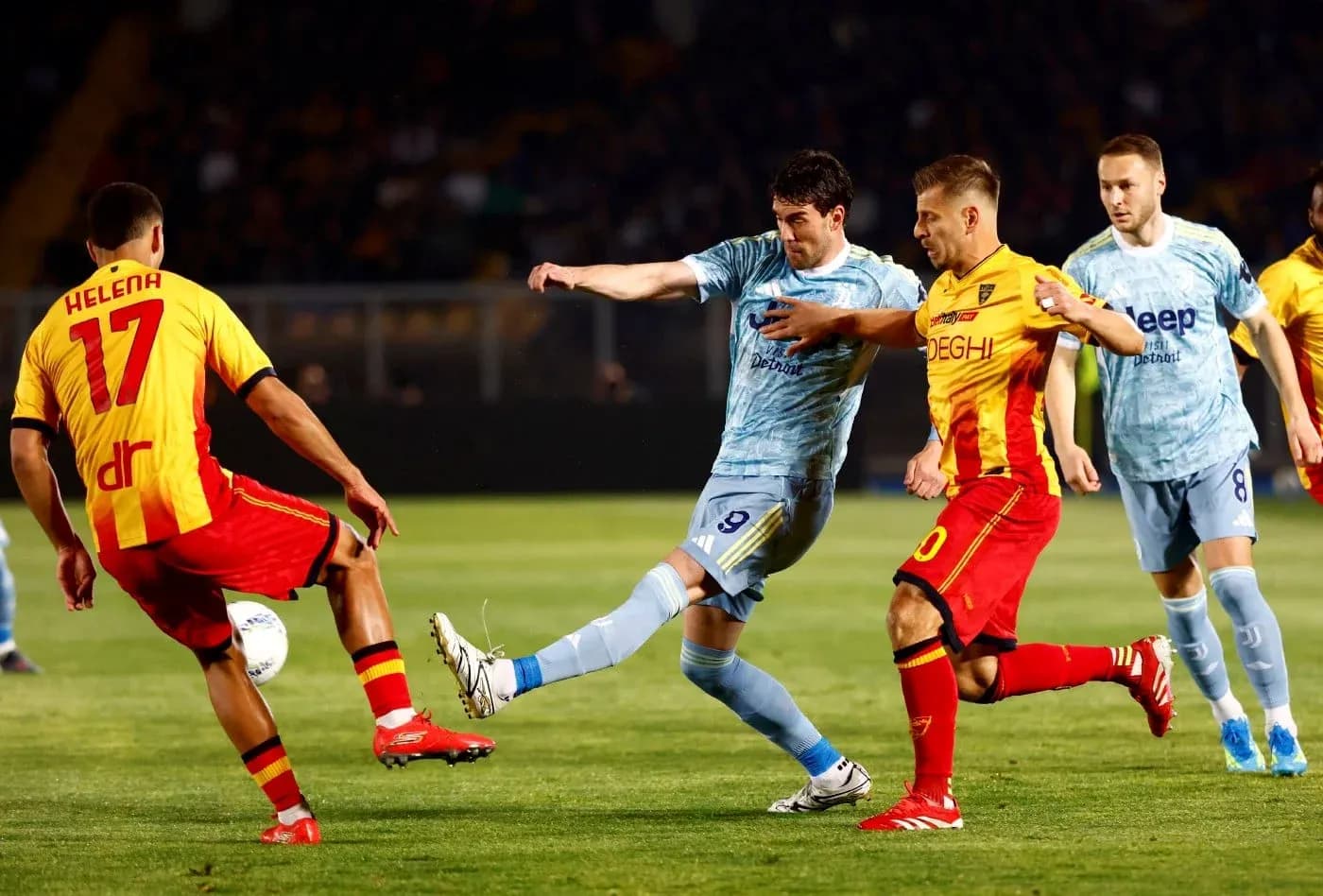
Lecce 0–1 Juventus at Stadio Ettore Giardiniero – Via del Mare was a study in territorial control and structural discipline from Luciano Spalletti’s side. In a Serie A Round 36 fixture, Juventus struck immediately and then managed the game through possession, pressing triggers, and compact rest defense. Eusebio Di Francesco’s Lecce stayed in the contest through a disciplined mid-block and a strong performance from Wladimiro Falcone, but with Juventus generating higher-quality chances and two second-half goals ruled out by VAR, the 1–0 scoreline reflected both Juve’s attacking superiority and Lecce’s resilience.
The scoring pattern was defined in the opening minute. At 1', D. Vlahovic finished a move created by A. Cambiaso, giving Juventus a 1–0 lead before Lecce could settle into their 4-2-3-1 structure. That early strike shaped everything that followed: Juventus could dictate rhythm with the ball, while Lecce were forced to chase territory and transitions rather than build patiently.
From there, the match narrative was punctuated by key interventions from VAR and a minimal but significant disciplinary record. At 50', a Juventus goal was cancelled after a VAR review involving Dušan Vlahović, and again at 61' another Juventus goal was ruled out following a check on Pierre Kalulu. Both incidents underline how Juventus repeatedly broke Lecce’s last line but lacked the final legal detail to extend the lead.
Substitutions then became the primary structural changes. For Lecce, Eusebio Di Francesco adjusted his attacking and wide profiles: at 62', O. Ngom (OUT) was replaced by G. Jean (IN); at 70', D. Veiga (OUT) made way for T. J. Helgason (IN), shifting both the right side and central occupation. At 76', W. Cheddira (OUT) was replaced by F. Camarda (IN), and simultaneously L. Banda (OUT) was swapped for K. Ndri (IN), refreshing the front line and left flank to chase an equaliser.
Juventus’ changes were more about energy management and maintaining control. At 77', D. Vlahovic (OUT) was replaced by E. Holm (IN), a move that tilted Juventus slightly more towards solidity and wide balance. On 83', a triple change re-armed the attack and wings: A. Cambiaso (OUT) for J. David (IN), K. Yildiz (OUT) for J. Boga (IN), and F. Conceicao (OUT) for E. Zhegrova (IN). Finally, at 86', W. McKennie (OUT) was replaced by F. Gatti (IN), adding another defensive profile to protect the lead.
The discipline log is short but tactically relevant. Card verification from the events array gives: Lecce: 1 yellow, Juventus: 1 yellow, Total: 2.
Disciplinary log
- 80' Francisco Conceição (Juventus) — Foul
- 82' Gaby Jean (Lecce) — Argument
Francisco Conceição’s caution at 80' for “Foul” reflects Juventus’ attempts to counter-press and stop Lecce’s late transitions high up the pitch. Two minutes later, Gaby Jean’s yellow for “Argument” at 82' shows the emotional temperature rising as Lecce pushed and felt decisions going against them. No reds were shown; control was maintained despite the stakes.
Tactically, both teams lined up in a 4-2-3-1, but the interpretations were very different. Juventus used their double pivot of M. Locatelli and T. Koopmeiners as a stable base for long, high-possession phases (65% possession, 501 passes at 86% accuracy). Locatelli primarily anchored in front of Bremer and L. Kelly, ensuring rest defense was always in place when full-backs pushed. Koopmeiners operated slightly higher, connecting to the line of three (F. Conceicao, W. McKennie, K. Yildiz) and feeding D. Vlahovic between the lines and into the box.
The shot profile underlines Juventus’ territorial dominance: 15 total shots, 14 from inside the box, and 6 on target. Their xG of 2.16, plus two VAR-cancelled goals, confirms that the 1–0 scoreline underestimates the volume of dangerous situations they produced. M. Di Gregorio, with only 3 saves to make, was mostly a distributor and auxiliary sweeper, benefiting from Juve’s ability to keep Lecce at arm’s length.
Lecce’s 4-2-3-1, with Y. Ramadani and O. Ngom as the double pivot, was more reactive. They allowed Juventus to have the ball, trying to compress space centrally and deny clean access into Vlahovic’s feet. However, with only 35% possession and 267 passes at 73% accuracy, Lecce struggled to sustain attacks. Their 8 total shots (3 on target) and xG of 0.88 show that while they did craft a few meaningful moments, they were mostly working from lower-probability positions and quick counters.
W. Falcone’s 5 saves, combined with a “goals prevented” value of 0.64, underline his importance in keeping Lecce alive. Juventus generated chances that, on average, should have produced more than the single goal; Falcone’s shot-stopping and positioning reduced that output. At the other end, Di Gregorio’s identical “goals prevented” value of 0.64, despite facing fewer shots, suggests that Lecce’s best chances were of relatively high quality, even if infrequent.
In wide areas, Lecce’s full-backs A. Gallo and D. Veiga initially had to cope with Cambiaso’s advanced positioning on one side and Kalulu’s overlapping threat on the other, plus the narrow movements of K. Yildiz and F. Conceicao. As the game progressed and Lecce introduced Gaby Jean and K. Ndri, they tried to push their own full-backs higher, but Juventus’ rest defense—Bremer and Kelly compact, Locatelli screening—limited clean breakaways.
Statistically, the verdict is clear: Juventus combined structural control with chance creation more effectively. Their 65% possession, 501 passes at 86% accuracy, and 7 corners to Lecce’s 1 show sustained pressure and territorial dominance. The xG split (2.16 vs 0.88) aligns with the eye test of Juve creating more and better chances, even with two goals wiped out by VAR. Both goalkeepers posted the same “goals prevented” figure (0.64), but Falcone had to make 5 saves to Di Gregorio’s 3, reflecting the volume of shots Juve generated.
Discipline was relatively even—1 yellow each, total 2—yet the foul count (Juventus 18, Lecce 7) indicates Juve were more aggressive in counter-pressing and breaking play, a deliberate tactical choice to protect their early lead. Overall, the numbers and structure converge: Juventus managed the match on their terms from the first minute, while Lecce’s organization and Falcone’s performance kept the scoreline respectable without ever fully tilting the tactical balance.