
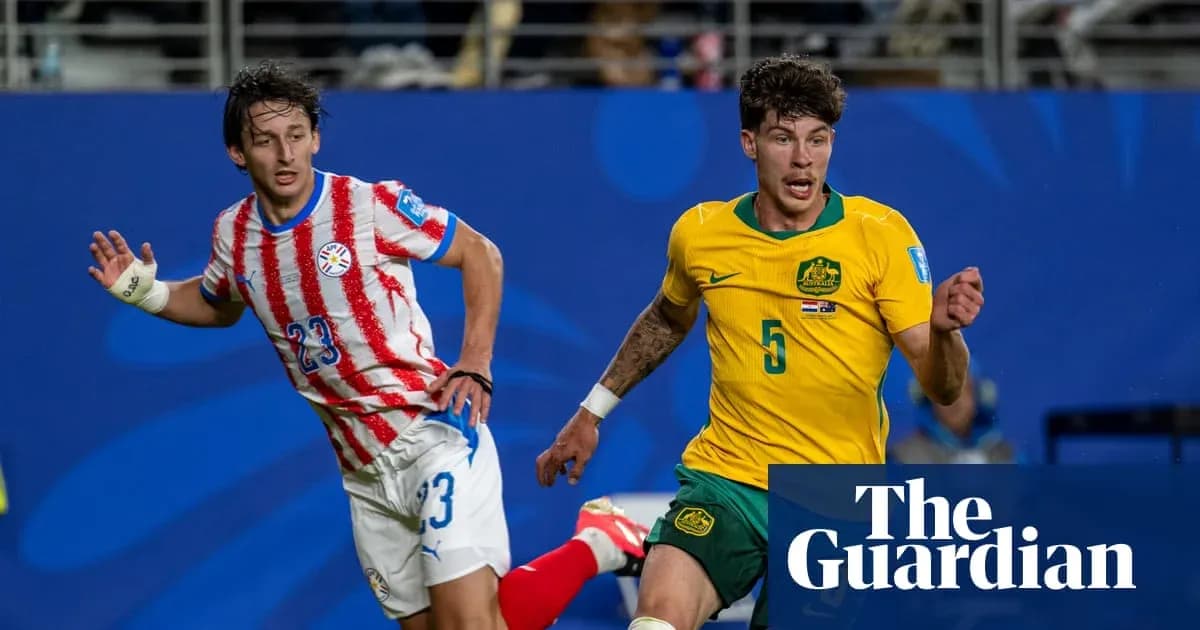
Jordan Bos: The Unleashed Left-Back Dominating the World Cup
Jordan Bos was running on the wrong side of the pitch and making it look like the most natural thing in the world.
The left-back who started on the right kept tearing down that flank, through one challenge, then another, hitting the box again and again. Each surge dragged Australia up the field, like a tide pulling everything in its wake. At times, the comparisons that have followed him – Gareth Bale, Dani Alves, Arjen Robben – didn’t feel outlandish. They felt inevitable.
This was 0-0 against Paraguay on a cool night by the San Francisco Bay, a stalemate on the scoreboard but not in the stakes. With every minute, the Socceroos edged closer to the World Cup last 32. With every Julio Enciso touch, that same progress felt under threat. Every time Patrick Beach had to fling himself into another save, you could feel 12,000 Australians in yellow tighten in their seats.
Tony Popovic started glancing at the clock. He knew what everyone else knew: his side did not need a goal to get through. What they needed was a performance that jolted their campaign back to life after the flat defeat to the United States. Something to cling to. Something that said this team was still here.
Their answer wore No. 3 and played like he’d been unleashed.
Bos’s role on the right of defence had raised eyebrows before kick-off. Popovic had right-backs in his squad – Kai Trewin, Jason Geria – and yet he trusted a left-back to flip sides on the biggest stage. He had seen Bos do it in Belgium with Westerlo, and again for half an hour against New Zealand nine months earlier. He knew the gamble. He also knew the upside.
From the opening whistle, Bos justified the call. He skipped past one would-be tackler, then another. He drove into space, carried the ball into areas where Paraguay did not want to defend, and in doing so, he dragged the match away from Australia’s penalty area and up into theirs. Every metre he gained was a small act of relief for the back line behind him.
Cristian Volpato, so bright in the first half, was withdrawn. Nestory Irankunda, the hero against Turkey, also went to the bench. The attacking stars were rotated. The constant was Bos. He just kept going, smashing into duels, arriving late in the box, refusing to fade.
From his vantage point on the right wing, substitute Ajdin Hrustic had the clearest view of what was unfolding. “He’s a great player, he’s got power, you’ve seen it,” he said afterwards, the understatement obvious. Aiden O’Neill stood nearby holding the player of the match trophy, sheepish as he admitted it probably belonged to Bos instead.
Inside the dressing room, the praise went up a notch. Captain Harry Souttar called him “a special player, a special guy, and just takes everything in his stride”, before adding a line that said as much about the mood as it did about the man. “The guy’s body’s just unbelievable to look at. I don’t want to obviously put too much pressure on him, but if he keeps performing like that then there’s no ceiling.”
No ceiling. No restraint, either, from Milos Degenek, who happily placed Bos in elite company. To Degenek, the 23-year-old is already among the five best left-backs in world football and the best of his age group. “That’s my opinion, I’m very biased, and I love him,” he said, grinning. Asked where Bos ranks as a right-back, Degenek didn’t miss a beat. “Top 10,” he replied, laughing.
Irankunda went even further. “He’s the best player in the world, Jordy Bos, best winger in the world,” he declared. It was hyperbole, of course, but it captured how it felt to share a pitch with him on this night. “He might have to switch to a winger, in my opinion. He’s done so well at right-back today, but he got so high up the pitch today and he showed glimpses of what he can do with the ball.”
Bos’s tournament until this point had been steady rather than spectacular. His season in the Dutch Eredivisie had marked him out as one of the most polished players in this young Socceroos squad, but in the opening group games he had not quite exploded. Against Paraguay, out of position and one yellow card away from suspension for the last 32, he chose his moment.
The numbers only tell part of it. No Australian took more shots than his three. He created the joint-most chances. He completed four dribbles, won more duels than anyone else on the pitch, and dominated in the air, winning seven of nine aerial contests. Each stat is a marker; the performance itself was the statement.
“I was enjoying it too, honestly, tonight,” Bos said, the smile doing as much talking as the words.
Inside the camp this week, Hrustic had started calling him “Dani Alves” in training, a nod to the Brazilian who turned the right flank into his own private runway at Barcelona. Others reached for Arjen Robben, the left-footed right winger who cut inside and bent games to his will. Bos brushed those off. “Unfortunately I didn’t score like him, but I tried,” he said.
The Bale comparisons have followed him the longest. A left-back who can become a winger. A player whose threat is built on power, stride, and the refusal to slow down. Asked which of the three he sees the most of in himself, Bos paused. “Yeah, Robben … I don’t mind Bale, to be honest,” he replied.
In truth, the choice no longer matters. Alves, Robben, Bale – those are reference points for everyone else. On a tense night in California, with a World Cup campaign teetering between anxiety and belief, Jordan Bos stopped being a comparison and became the headline. This was the night he stepped out of other people’s shadows and into his own.




