Golden Boot Race at the 2026 World Cup: Messi and Mbappe Lead
“Sometimes in football, you have to score goals.”
Thierry Henry tossed that line out in 2008 with a shrug. Eighteen years on, with four games left at the 2026 World Cup, it feels like the only law that matters.
The trophy is the prize everyone came for, but in the shadows of the semi-finals another race is raging — the scramble for the Golden Boot. It is a race that rarely rewards the man who lifts the World Cup itself. Not since Ronaldo’s eight goals for Brazil in 2002 has the tournament’s top scorer finished the job with the trophy in his hands.
Just Fontaine’s otherworldly 13-goal haul in 1958 still sits untouched, a record built in a different era and, remarkably, without a title. Yet this expanded World Cup — 16 extra teams, 40 more matches than Qatar 2022 — has produced a flood of goals and a leaderboard packed with superstars, each chasing their own slice of history.
How the Golden Boot is decided
The rules are ruthless. Since 1992, if players finish level on goals, the first tiebreak is assists. That is how Thomas Muller edged David Villa, Diego Forlan and Wesley Sneijder in 2010, all of them stuck on five goals but the German supplying three assists to their one.
In 2006, FIFA added another layer: if goals and assists are identical, the award goes to the player with the fewest minutes played. Every touch, every late substitution, every second now matters.
Messi vs Mbappe: the headline act
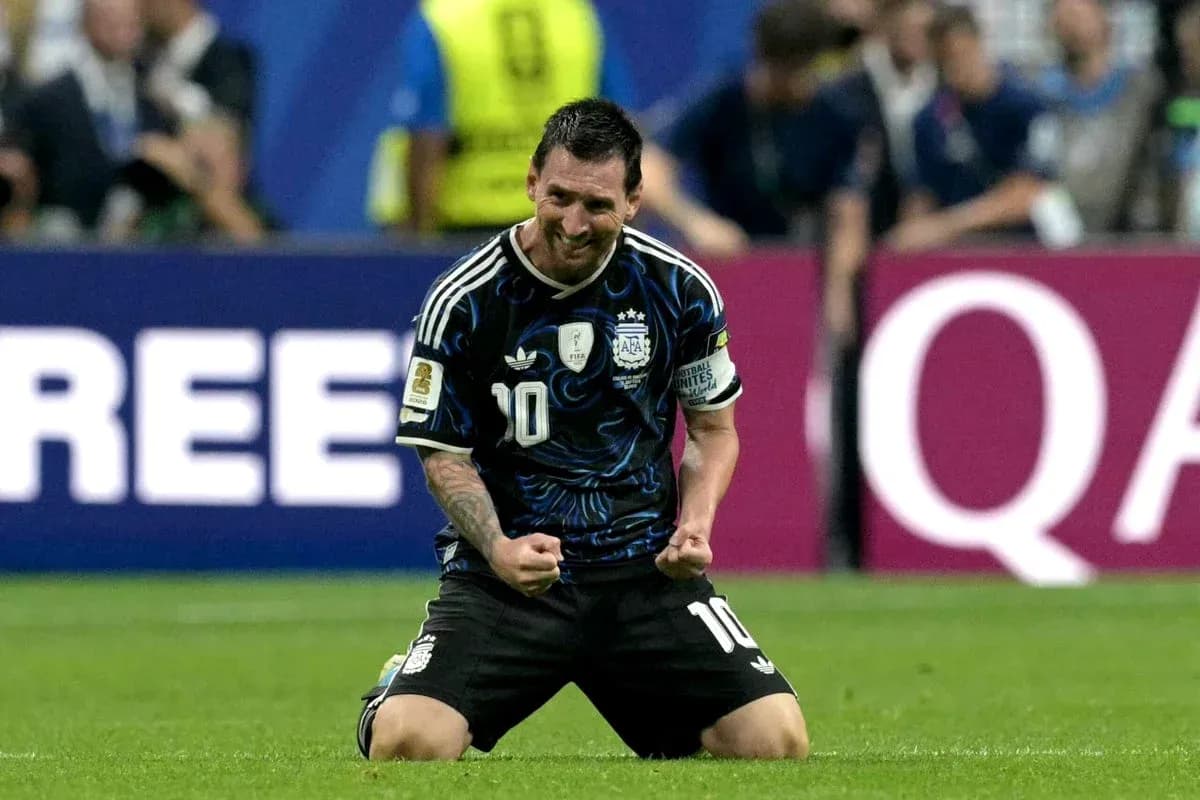
1. Lionel Messi (Argentina) – 8 goals
(4 assists – 712 minutes)
Messi’s World Cup began with frustration. He thought he had opened his account in Argentina’s opener against Algeria, only for VAR lines to slice the moment away for offside. He did not sulk. He adjusted.
From 20 yards, he whipped a left-foot shot into the corner, the sort of finish that has decorated his career. After the break, he pounced on a spill from Luca Zidane, tapping in the rebound as if it were a training exercise. The hat-trick goal was pure Messi theatre: a curling strike from the edge of the box, shaped like a pass, drifting beyond a helpless Zidane.
His fourth came against Austria, a first-time finish from a Facundo Medina pass after he had already missed a penalty. That strike carried extra weight — it pushed him clear as the men’s World Cup all-time leading scorer. Later in the same game, he added a fifth, reacting quickest after his initial effort had been blocked to stab home from close range.
He did not even start Argentina’s final group match against Jordan, yet still stepped off the bench to bend in an 80th-minute free kick, goal number six. In the round of 32, he struck again against Cape Verde, then delivered in the most dramatic fashion against Egypt, levelling late to make it eight for the tournament and keep Argentina alive.
Eight goals. Four assists. A playmaker and finisher rolled into one, dragging his country towards another final while simultaneously defending his own Golden Boot lead.
2. Kylian Mbappe (France) – 8 goals
(3 assists – 666 minutes)
Mbappe has matched him stride for stride.
France’s campaign opened with a 3-1 win over Senegal and a statement from their star forward: two goals, both ruthless, both emphatic. Against Iraq he struck from range to break the deadlock, then, after a long weather delay in Philadelphia, reappeared with the same sharpness to double the lead in the second half.
When the knockouts arrived, he did not ease off. Two more against Sweden in the round of 32, both crisp finishes. A penalty against Paraguay. Another goal against Morocco in the quarter-final, a blur of pace and precision that has become his trademark.
Spain finally stopped him in the semi-final, shutting France out in a 2-0 win that ended their title hopes. Mbappe’s World Cup will close with the third-place play-off on Saturday. One game left to tilt the Golden Boot his way.
Haaland, Bellingham, Kane: the chasing pack
3. Erling Haaland (Norway) – 7 goals*
(0 assists – 537 minutes)
Erling Haaland arrived at his first World Cup with expectations heavy on his shoulders. He treated them like a formality.
Against Iraq, he scored twice in a 4-1 win. The first, a classic Haaland goal: a sliding finish inside the six-yard box from David Moller Wolfe’s low cross. The second, pure aggression, closing down the goalkeeper and forcing the ball over the line.
He kept going. Against Senegal, he swept in a composed finish for his third of the tournament, then volleyed home a fourth with the kind of improvisation that separates elite strikers from the rest.
His fifth might be the most important of the lot — a late close-range winner against Ivory Coast in the round of 32, sealing a 2-1 victory. Then came the shock. Norway stunned Brazil in the last 16, Haaland scoring twice more, his seventh a surprise effort that underlined his knack for finding goals from unlikely angles.
Norway are out, which freezes his tally at seven. The number is big. The question is whether it will be big enough.
4. Jude Bellingham (England) – 6 goals
(1 assist – 574 minutes)
Jude Bellingham has turned this World Cup into a personal showcase of timing and authority from midfield.
He scored in both of England’s opening group wins — a 4-2 victory over Croatia and a 2-0 success against Panama — arriving in the box at the right moment, the way great midfielders do. Then the stakes rose and so did his output.
Against Mexico in the last 32, he struck twice, driving England forward in a tie that threatened to tighten. In the quarter-final against Norway, he repeated the trick, another brace that propelled him up the Golden Boot table and his country into the final four.
He sits above his captain Harry Kane on minutes played alone: 574 to Kane’s 627.
5. Harry Kane (England) – 6 goals
(1 assist – 627 minutes)
Kane’s World Cup has been more familiar: the steady, reliable drumbeat of a centre-forward who rarely wastes a chance.
He opened with two goals in that 4-2 win over Croatia, then laboured, like the rest of his team, in a flat 0-0 draw with Ghana. When England needed to steady themselves against Panama in the final group game, he stepped up again, scoring their second.
In the round of 32 against DR Congo, he became the hero, striking twice in the second half to turn a tight game in England’s favour. Against Mexico, he added a penalty, his sixth of the tournament, keeping him in the slipstream of the leaders.
The supporting cast: Dembele, Oyarzabal and the four-goal cluster
=6. Ousmane Dembele (France) – 5 goals
(2 assists – 492 minutes)
Before this World Cup, Ousmane Dembele had never scored in 19 major tournament appearances. That statistic now feels absurd.
He broke his duck against Iraq, scoring France’s third in a 3-0 win. Then he exploded against Norway, completing a first-half hat-trick that showcased his range: movement, finishing, and the confidence to take responsibility in the box.
His fifth came in the quarter-final against Morocco, a reminder that France’s threat has not just been about Mbappe. Dembele’s transformation from nearly man to end-product winger has been one of the more striking subplots of the tournament.
=6. Mikel Oyarzabal (Spain) – 5 goals
(1 assist – 519 minutes*)
Spain started slowly, held to a disappointing draw by Cape Verde, but Mikel Oyarzabal helped change the mood in their second group match. He scored twice in a 4-0 win over Saudi Arabia, finding pockets of space and punishing them.
He repeated the double act in the round of 32, scoring twice in a 3-0 victory over Austria as Spain began to look like themselves again. His fifth goal, the most significant of his tournament, came from the penalty spot in the semi-final against France, opening the scoring on a night when Spain’s control finally met cutting edge.
=8. Vinicius Junior (Brazil) – 4 goals*
(1 assist – 505 minutes)
Vinicius Junior started by rescuing Brazil. Morocco took a shock lead in their opener; he responded with a whipped, emphatic equaliser that restored order.
With Brazil in full flow against Haiti, he added his second, the game already tilted by two Matheus Cunha strikes. Against Scotland, he pounced on a mistake from Scott McKenna, sliding the ball past Angus Gunn for his third in as many games. His fourth was a back-post header, guided in from a teasing Bruno Guimaraes cross.
Brazil’s exit means he cannot add to those four goals, but his influence on their campaign is etched in the numbers.
=8. Ismaila Sarr (Senegal) – 4 goals*
(1 assist – 419 minutes)
Ismaila Sarr lit up Senegal’s second Group I match against Norway with two very different finishes. The first, an awkward, clipped effort while tumbling to the turf, somehow found its way in. The second, cleaner and more controlled, underlined his composure.
He scored again in Senegal’s final group game against Iraq, then struck a fourth in the round of 32 against Belgium. His team is out, but Sarr leaves with a tournament that has enhanced his reputation.
=8. Julian Quinones (Mexico) – 4 goals*
(1 assist – 440 minutes)
Julian Quinones wrote his name into this World Cup from the opening whistle. He scored the first goal of the tournament as Mexico beat South Africa 2-0, then followed it up in a 3-0 win over Czech Republic.
In the last 32, he once again broke the deadlock, this time against Ecuador. Even in defeat to England, he found the net, adding another to his tally. His scoring streak should surprise no one — he arrived as the top scorer in the Saudi Pro League, with 33 goals in 31 games, and brought that ruthless edge onto the biggest stage.
=10. 11 players – 3 goals
Behind them, a cluster of 11 players sit on three goals, close enough to dream but running short on time and opportunity.
History’s weight and the final sprint
The Golden Boot, first officially introduced as the Golden Shoe in 1982, has always carried a certain mystique. Before that, the top scorers were recognised but not formally crowned, their feats recorded without the gleam of an official award.
In 2022, Kylian Mbappe joined Geoff Hurst in a very exclusive club as the second man to score a hat-trick in a World Cup final. Unlike Hurst in 1966, Mbappe left without the trophy, but his eight goals matched Ronaldo’s 2002 benchmark for a single tournament in the modern era. Four years earlier, Harry Kane’s six goals were enough to take the prize as England reached the semi-finals before falling to Croatia.
Now the stage is set again. Messi and Mbappe are locked on eight. Haaland lurks on seven, his work done. Bellingham and Kane are within striking distance. Others, like Dembele and Oyarzabal, are ready to pounce if the chaos of knockout football opens a door.
Four matches remain. The World Cup will crown a champion. The Golden Boot will find an owner. In a tournament bursting with tactics, narratives and nuance, Henry’s old line still cuts through the noise.
Sometimes in football, you have to score goals. Over the next few days, we find out who scores the ones that history remembers.