Gianni Infantino Faces Legal Peril Over FIFA's World Cup Rights
“Tell Mike it was just business. I always liked him.”
“He understands.”
The Godfather lines have been floating around football for years, a handy meme for power and betrayal. This time, though, they land a little too neatly. Because for the first time since Gianni Infantino began trying to sell the sport’s crown jewels to the highest bidder – and, allegedly, to himself – it feels as though somebody is finally getting to him.
Infantino has been under siege for weeks. Not just criticised, not just mocked, but accused in hard legal terms of “criminal mismanagement” over a grotesque, covert plan to offload the World Cup’s commercial rights at a knockdown price, with a vast personal salary attached. The man hired to safeguard football’s shared global property is now painted as the man who tried to cash it in.
He has worn scandal before. He is, after all, already the president who sold the game twice: first to the market, then to Donald Trump, in exchange for proximity to power, a peace prize fantasy and the glow of White House validation. Usually, he rides out the storm, waits for the headlines to move on, then reappears at a lectern, arms whirling, talking about unity, solidarity, development, equality, all wrapped in the language of fiscal uplift.
Give it a month, the thinking went. Let him do the Football Jesus routine again. The flat, painted-on eyes will stare out from behind the papier-mache mask of power. The room will clap. The caravan will move on. You don’t buy me out. I buy you out.
This week, something felt different.
From gnats to heavy artillery
The sniping hasn’t stopped. Newspaper columns thunder on. Former players line up to condemn him. Even Mikaël Silvestre has weighed in. None of that ever really threatened Infantino. Those are gnats around the ankles: irritating, but nothing a president with a solid voting bloc and a control-freak’s grip on the levers of FIFA can’t brush aside.
Hard power is another matter. And that’s what has begun to stir.
Two developments, both tied to UEFA’s lawsuit in the United States, have shifted the mood. Nobody seriously expects UEFA to march into court and walk out with the World Cup in its pocket. This case looks more like a clever chess trap, a zugzwang: force your opponent to move when every square on the board is dangerous.
The first move came from Josh Kushner, the financier whose firm Thrive Capital stood behind the FIFA Forward deal. The coincidence of his role was always striking: the man you go to for money and favour just happens to be the brother of Jared Kushner, the president’s son‑in‑law and gatekeeper to Trump’s world.
Kushner has now tried to step back. In a statement, he said he “would not have gotten involved” in FIFA’s plans had he known the full picture and called the whole thing regrettable. Mild words on the surface, but they carve out distance. This is the sound of someone cutting the cord to the apron strings of political protection.
He has also brought in Alex Spiro, a lawyer known for stepping into the most combustible cases: defending Elon Musk after he called a cave diver “a pedo”, representing Alec Baldwin after a fatal on-set shooting. That is not a casual hire. That is a nuclear option.
FIFA, rattled, hit back with its own legal filing, dismissing the entire saga as a “smear campaign”. Then it said the quiet part out loud: it wants to resist discovery, urgently.
The word everyone fears: discovery
This is where the real peril lies. Discovery is the process that strips away secrecy: the emails, the internal memos, the WhatsApp messages fired off from a golf cart after lunch. The stuff nobody ever expects to see daylight.
Nobody on Infantino’s side wants that. Nobody in Trump’s orbit likes it either. Discovery is how myths of invincibility start to crumble.
UEFA’s suit goes straight at the heart of FIFA’s recent history. It accuses Infantino and the organisation of criminal mismanagement, focusing on the alleged undervaluing of World Cup rights. Wrapped into that is the allegation that Infantino stood to receive a huge personal salary from the deal – not as a side issue, but as part of the structure.
UEFA wants discovery not only from FIFA but from Thrive Capital and Greg Maffei, a Trump donor and deal adviser. Between them, they hold the paper trail from the period when Infantino was intoxicated by access to the White House and the Trump court.
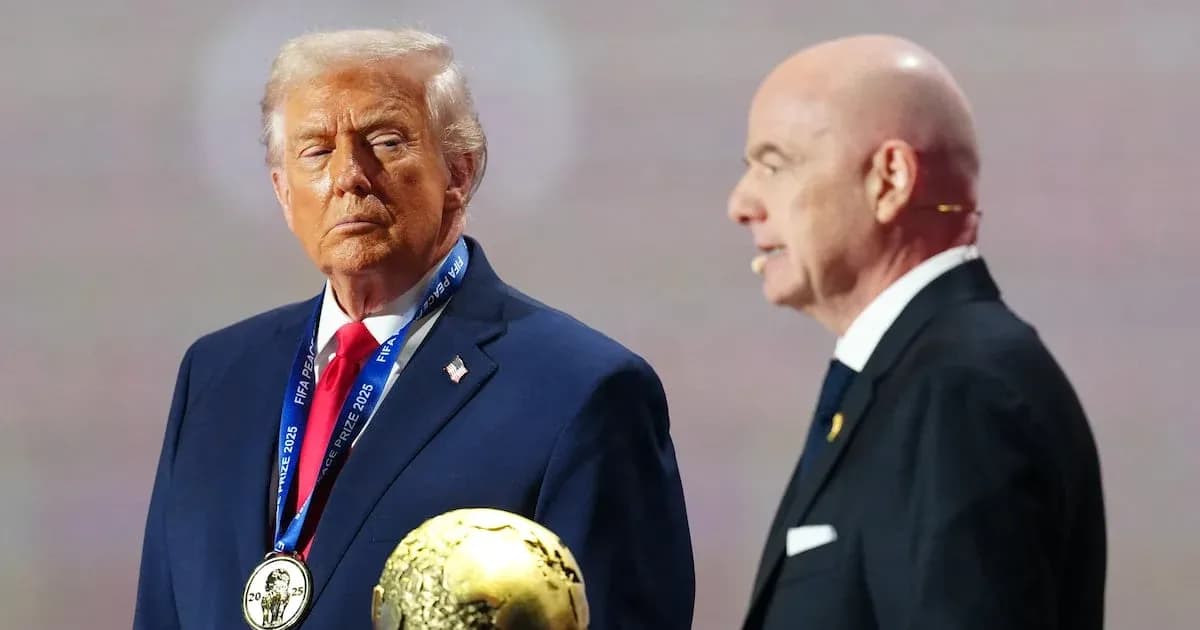
Picture the Club World Cup trophy: an unsettling object, all sharp edges and odd angles, like it might conceal a hidden drawer full of something you’d rather not see. That’s what this legal process is trying to open. The question is whether anyone really wants to look inside – and what happens if they’re forced to.
The Trump factor: all in, until you’re not
Trump’s early support for Infantino was loudly reported when it surfaced on Truth Social in early August. Look closely and it never quite sounded unconditional. The message was couched in a hypothetical: if, “for any reason”, FIFA removed Infantino, that would be very bad. Since then? Silence.
There is a sense of a shrug. Of someone ambling away from the stage.
Once, the Gianni-Trump axis looked like a perfect match: the gleaming bald impresario of global football and the former president who moves through the world like a man‑sized portion of deep‑fried Americana, honey‑glazed, wrapped in a baggy suit, capable of calling Infantino “a very tall, very handsome man” without blinking.
That kind of alliance is always brittle. Trump will usher you in, slap your back, remember your name. When you stop being useful, you’re gone. His politics has no core belief, only a brutal ledger of winners and losers. If you look like you might lose, bad things have a habit of happening around you.
The roll call of former allies is long and ugly. Michael Cohen, once the man who said he would “take a bullet” for Trump, ended up imprisoned, disbarred and exiled from the inner circle. Jeff Sessions, the attorney general who called Trumpism “a movement”, now lives outside the game, branded by Trump as weak, dumb, confused, “a disgrace” and worse.
There is a pattern. Get close, enjoy the warmth, but don’t fly too near the flames. If Infantino thought that bond would hold forever, he hasn’t been paying attention.
Thin corridors, closing doors
The real drama now sits with the court’s decision on discovery. Allow it, and the corridors around Infantino start to thin. The people who once guarded his door may decide they don’t want to be anywhere near it.
For the moment, he does what embattled presidents always do: tours the outer provinces, shakes hands, collects promises. Saudi Arabia has offered backing “at this time”, a phrase that carries as much warning as reassurance. There is a FIFA congress in November, a presidential election next March, and the machinery of world football still hums.
But how much do votes matter if the legal ground shifts beneath them? Sepp Blatter and Michel Platini both looked unassailable once. Then a single payment, one wire transfer, one allegation of illegality, detonated their careers without warning.
Legal actions often fizzle out. Cases settle. Technicalities intervene. UEFA doesn’t need to win outright to make its point. It just needs to keep pushing, keep the coals hot, keep everyone aware that documents might yet be prised open and examined line by line.
“Please, Mike, don’t do this, don’t do this to me.”
“Today I settle all family business. So don’t tell me you’re innocent.”
Infantino can still hope the credits roll before the lights come up. But if discovery goes ahead, the film doesn’t end. It moves into a new act, one where the president of FIFA no longer controls the script – and where the next twist may not be his to choose.