
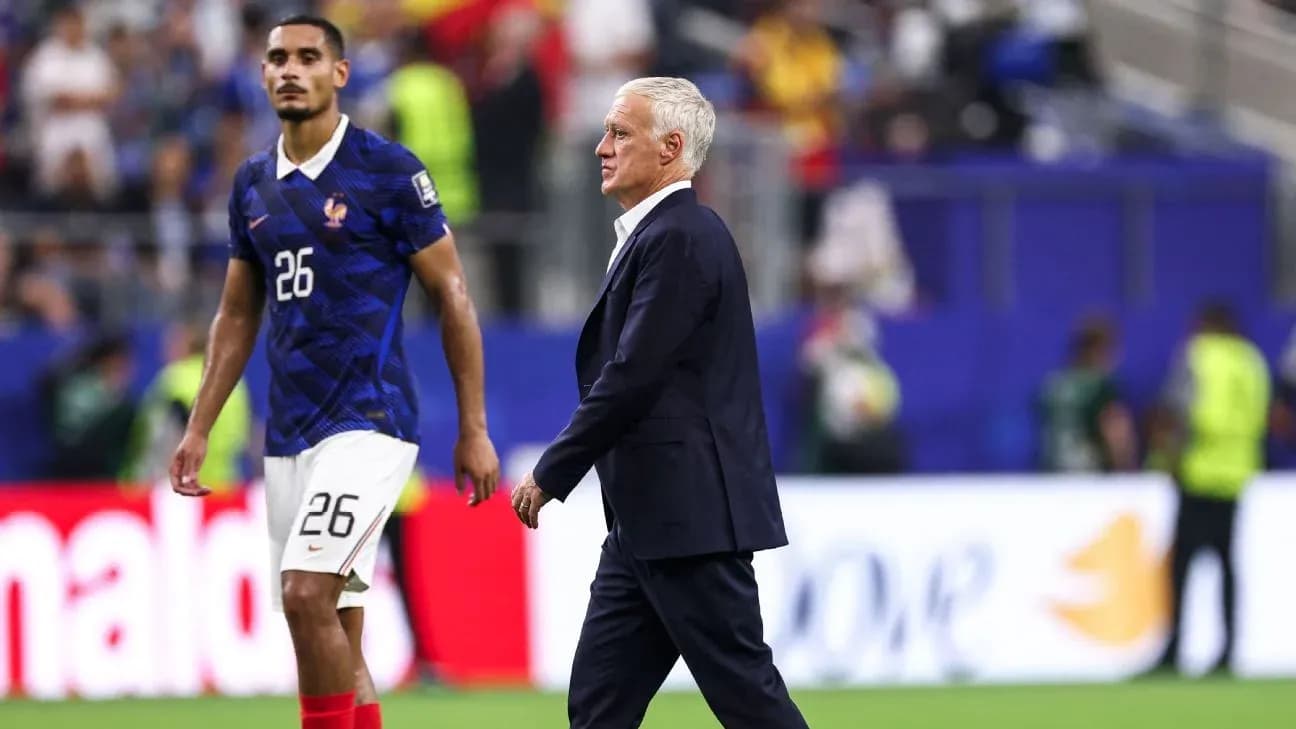
France's World Cup Exit: Deschamps' Dismantling by Spain
ARLINGTON, Texas — The end came quietly for France, and then all at once.
Fourteen years of Didier Deschamps on the touchline, three major finals, one World Cup lifted as coach, another as captain. All of it dissolved under the big screens and bigger expectations inside Jerry Jones’ vast Texas monument, as Spain picked them apart 2-0 and marched into the World Cup final with a calm, almost casual authority.
For the first time at this tournament, France went behind. They never looked like finding a way back.
Deschamps’ last stand
This was not a noble exit. It was a dismantling.
France arrived in the United States as the deepest, most talent-stacked squad in the competition. From back to front, they were loaded. Going out to Spain is no disgrace on its own; Luis de la Fuente’s side are not far behind them in quality. Going out like this, though — limp, passive, outplayed in every department — will sting for a long time.
The numbers tell part of the story. Across the first 64 minutes, with Kylian Mbappé, Michael Olise and the rest of that vaunted attacking line on the pitch, France produced 0.04 xG. That’s not misfortune. That’s a non-performance.
It fit an uncomfortable pattern. De la Fuente has now beaten Deschamps three times in three years: the Euro 2024 semifinal, the wild 5-4 Nations League tie in 2025 where Spain once led 5-1, and now this World Cup semifinal. Each time, Spain looked more assured. Each time, France looked less able to solve the puzzle in front of them.
Either De la Fuente is Deschamps’ bald, bespectacled kryptonite, or the Frenchman never found the learning curve.
Talent without the tools
Everyone knew how this game would look. Spain would have the ball, work their passing sequences, drag opponents into areas they did not want to go. The question was never about Spain’s approach. It was about France’s response.
Would Deschamps add a midfielder to plug the obvious gap Mbappé himself had pointed out — two French midfielders against three Spaniards? Would he ask his forwards to press, disrupt, turn the match into a more chaotic contest? Or would he trust his stars, keep the shape, and dare Spain to cope?
He chose the last option. He paid heavily for it.
Deschamps has built a formidable career on a simple creed: keep the dressing room happy, keep the tactics clear, let superior talent decide the rest. It worked when he played alongside Zinedine Zidane, Patrick Vieira and Thierry Henry in 1998. It worked when he guided France to the World Cup title in 2018 and the final again in 2022.
In a low-scoring sport, his logic has often been sound. Overcomplicate things and you risk blunting your best players. But that philosophy depends on those players having two basic ingredients: the ball and space.
Spain allowed them neither.
They monopolized possession. They squeezed the pitch. They denied the channels where Mbappé thrives, the half-spaces where Olise usually glides. Deprived of room and rhythm, France’s stars looked ordinary. At times, Olise seemed only marginally more threatening than a sitcom character with the same first name.
That is the moment when a coach has to intervene, to change the structure, not just the names. That has never been Deschamps’ strong suit.
His substitutions followed the script everyone in the stadium could recite: Manu Koné for Adrien Rabiot to add more ball-playing from deep, Désiré Doué for Bradley Barcola to freshen the flank. Logical changes, yes, but predictable to the point of parody — like hitting autocomplete on a smartphone.
On good days, those moves preserve stability. On nights like this, they simply extend the suffering.
Deschamps’ loyalty to certain players, Rabiot above all, has always cut both ways. It built trust and continuity. It also locked him into patterns he struggled to break, even when those patterns were clearly failing.
In the end, the same qualities that powered his extraordinary run as France coach — faith in his dressing room, devotion to simplicity, refusal to bend too far to the opposition — became the reasons his most gifted squad fell short.
Enter Zidane, with questions attached
Now comes Zidane.
France turn from one legend to another, from the captain who lifted the trophy in 1998 to the playmaker who defined that era. On paper, his résumé glitters: three Champions League titles, two LaLiga crowns with Real Madrid. He managed egos, handled pressure, and found ways to keep a superclub winning.
But the paper only tells part of the truth. Zidane has not worked in five years. His last trophy came in 2020. His only coaching job has been at Real Madrid, a club unlike any other, with resources and leverage no national team manager can dream of.
At the Bernabéu, if a player did not fit, he could be replaced. If a gap appeared in the squad, it could be filled in the next window. In international football, you live with what your country produces. You see your players for days, not months. You do not get to buy your way out of a problem.
Zidane also built his reputation without leaning on intricate, avant-garde tactics. He trusted his stars, shaped a clear framework, and let them express themselves. That sounds familiar.
The temptation is to assume he will be a sleeker, more glamorous version of Deschamps. That might not be the worst outcome; Deschamps’ record, even with this painful farewell, is elite. But if Zidane is to take France somewhere new, he will have to move faster along the tactical learning curve than his old teammate ever did.
He will need to recognize when “just let them play” is not enough. When balance matters more than names on a teamsheet. When the opponent’s plan demands a structural answer, not just a rousing team talk.
He knows, better than most, that you do not need a superstar at every position to win a World Cup. He did it in 1998 with Stéphane Guivarc’h leading the line. Deschamps was there too. Both lived the lesson that collective cohesion can outstrip individual brilliance, especially when the technical gap between two sides is narrow.
What comes next
Assuming Zidane takes the job, he will inherit a golden hand. France’s attacking options run deep. He will know this squad intimately already, their strengths, their blind spots, their personalities. He will not need long to understand what he has.
The real test will be what he does when he runs into the next Spain. The next team that keeps the ball away from Mbappé, that crowds out the dribblers, that refuses to give France the spaces they have grown used to exploiting.
If he merely matches Deschamps’ haul — a World Cup, another final, and perennial contention — he will be judged a success.
But after a night like Arlington, with the most talented France side of the era meekly ushered out, will that be enough?




