France Dominates Sweden in World Cup Round of 32
MetLife Stadium in New York staged a Round of 32 meeting that felt less like a tentative first knockout step and more like a statement of intent. France arrived as the World Cup’s most ruthless front-runner, top of Group I with 9 points from 3 matches and a goal difference of 8, having scored 10 and conceded 2 overall in the group phase. Sweden came as a dangerous but flawed outsider: 7 goals for and 7 against overall in the group stage, second in their path into the Round of 32, oscillating between explosive attacking surges and defensive collapses.
The 3–0 scoreline in France’s favour, built from a 1–0 half-time lead, simply confirmed what the underlying numbers had been whispering. Heading into this game, France had played 4 matches in this World Cup, winning all 4 overall. At home they had played 3 times, winning all 3, with 9 goals scored and just 1 conceded at home. On their travels they had played once, scoring 4 and conceding 1 away. Their attacking profile was that of a heavyweight: 3.0 goals per game at home, 4.0 away, 3.3 overall, underpinned by defensive control of 0.3 goals conceded at home and 1.0 away, 0.5 overall. Sweden, by contrast, were a team of extremes. Overall they had played 4 matches, with 1 win, 1 draw and 2 defeats. At home they had scored 5 and conceded 1 from a single match, an extraordinary home average of 5.0 goals for and 1.0 against. Away, however, they had played 3 times, scoring just 2 and conceding 9, an away average of 0.7 scored and 3.0 conceded. The overall picture was 1.8 goals for and 2.5 against per game – a negative balance that France were always likely to exploit.
Team Tactics
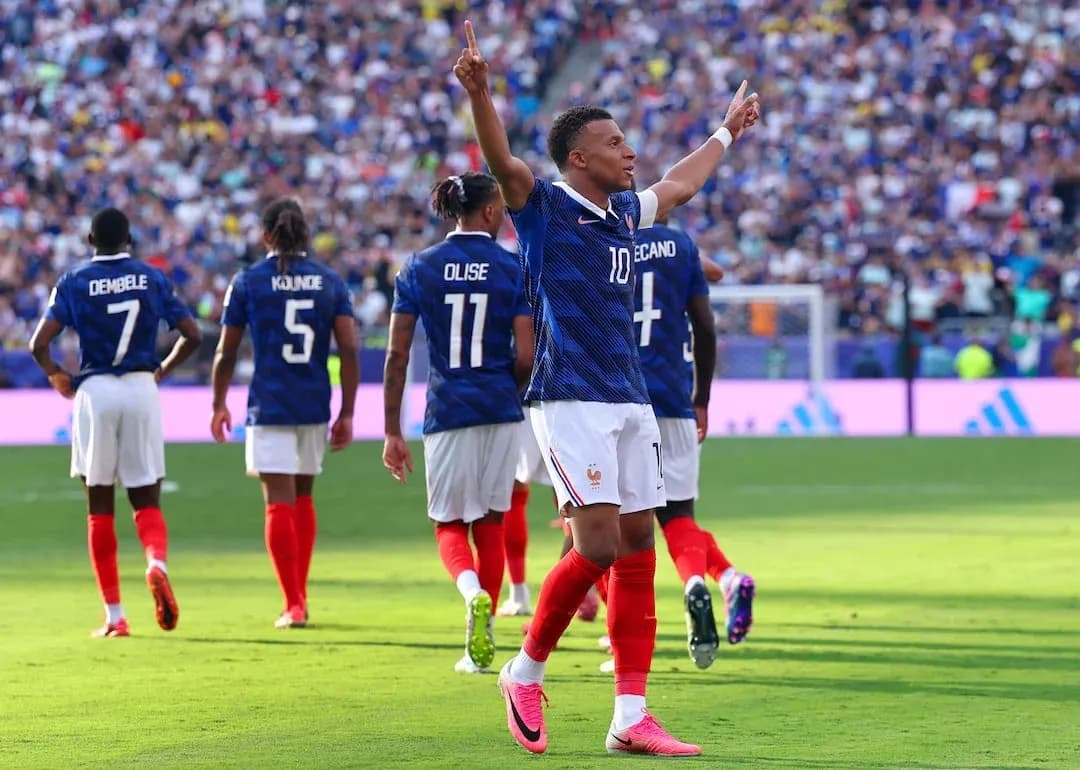
Deschamps’ selection made his intentions clear. France’s familiar 4-2-3-1 put M. Maignan behind a back four of J. Kounde, D. Upamecano, W. Saliba and L. Digne. In front, the double pivot of A. Tchouameni and A. Rabiot offered both circulation and cover, freeing a devastating band of three – O. Dembele, M. Olise and B. Barcola – to orbit around K. Mbappe as the lone striker. This was not just continuity; heading into this game, France had used the 4-2-3-1 in all 4 of their matches, a structural backbone that has underpinned their perfect record.
Graham Potter, meanwhile, shifted Sweden into a 4-4-2, a notable departure from the three-at-the-back shapes that had defined much of their campaign. J. Widell Zetterstrom started in goal, with a defensive line of D. Svensson, G. Lagerbielke, V. Lindelof and G. Gudmundsson. Across midfield, A. Elanga and E. Stroud flanked the central duo of L. Bergvall and Y. Ayari, while V. Gyökeres and A. Isak formed a physically imposing, mobile front pair. It was a structure that promised verticality and counter-attacking threat, but it also risked leaving their vulnerable back line exposed against the most complete attack in the tournament.
The tactical voids between the sides were not about absences – there were no confirmed missing players listed – but about structural fragility and discipline. France entered with a remarkably clean disciplinary record: only a single yellow card overall this tournament, and that coming between 61 and 75 minutes, with no reds at all. Sweden, by contrast, had accumulated their problems in waves. Overall, their yellow cards were distributed with 20.00% between 31–45 minutes, 20.00% between 46–60, 20.00% between 61–75 and a striking 40.00% between 76–90. It painted a picture of a side that frays as the pressure rises, particularly late on – precisely when France’s relentless tempo tends to suffocate opponents.
Key Players
Individually, the “Hunter vs Shield” duel tilted heavily blue. Kylian Mbappé came into this tie as the competition’s leading scorer with 6 goals and 2 assists from 4 appearances, averaging 19 shots in total with 13 on target, and a rating of 8.65. Around him, Ousmane Dembélé added 4 goals and 2 assists, while Michael Olise led the entire tournament in assists with 5, supported by 9 key passes and 211 completed passes at 87% accuracy. This was a front line that did not just finish moves; it engineered them relentlessly.
Sweden’s response lay in the twin spearheads of Isak and Gyökeres. Isak, with 1 goal and 3 assists, had been their primary creative conduit, while Gyökeres contributed 1 goal and 2 assists, winning 16 of 40 duels and drawing 7 fouls. Together they formed a physically dominant pairing capable of unsettling even elite centre-backs. Yet their productivity had been undermined by the team’s defensive record away from home: 9 goals conceded in 3 away matches, and their heaviest away defeat a 5–1 loss. Against a France side whose biggest away win was 4–1 and whose overall defence had allowed just 2 goals in 4 games, Sweden’s attack was always going to be punching uphill.
Midfield Battle
The “Engine Room” battle was equally instructive. For France, Tchouameni and Rabiot anchored a midfield that allowed Olise to drift into pockets, dictate tempo and progress play. Olise’s 34 duels overall, with 19 won, and his 4 tackles underlined a work rate that complements his creativity. For Sweden, Bergvall’s presence was double-edged. He arrived as one of the tournament’s most combative midfielders, with 3 tackles, 2 interceptions and 23 duels contested, but also as a disciplinary risk: 7 fouls committed and 1 yellow card, emblematic of Sweden’s tendency to foul under pressure. Against a French trio that thrives on quick combinations and dribbling – Mbappé with 18 dribbles attempted and 7 successful, Dembélé with 8 attempts and 4 successes, Olise with 11 attempts and 8 successes – that risk was always likely to translate into dangerous set-pieces and territory.
Statistically, the prognosis before a ball was kicked was stark. France’s overall record of 13 goals scored and 2 conceded across 4 matches pointed to a side whose attack and defence were both operating at near-elite efficiency. Their clean sheets overall (2, both at home) and the fact they had failed to score in none of their matches suggested a floor of performance that is unusually high for tournament football. Sweden’s overall 7 goals scored and 10 conceded, combined with 0 clean sheets and 1 match overall in which they failed to score, hinted at volatility rather than control.
Match Summary
On the MetLife pitch, that imbalance translated into a controlled French domination. The 1–0 half-time advantage reflected their ability to break Sweden’s first line and pin back the full-backs, while the second-half surge to 3–0 aligned almost perfectly with Sweden’s historical late-game disciplinary and defensive drop-off between 76–90 minutes. Following this result, France’s campaign narrative hardens: they are not merely winning, they are systematically overwhelming opponents in both penalty areas. Sweden depart having shown flashes of attacking promise, especially through Isak and Gyökeres, but their away defensive frailty and late-game discipline ultimately turned this Round of 32 tie into a one-sided tactical demonstration.