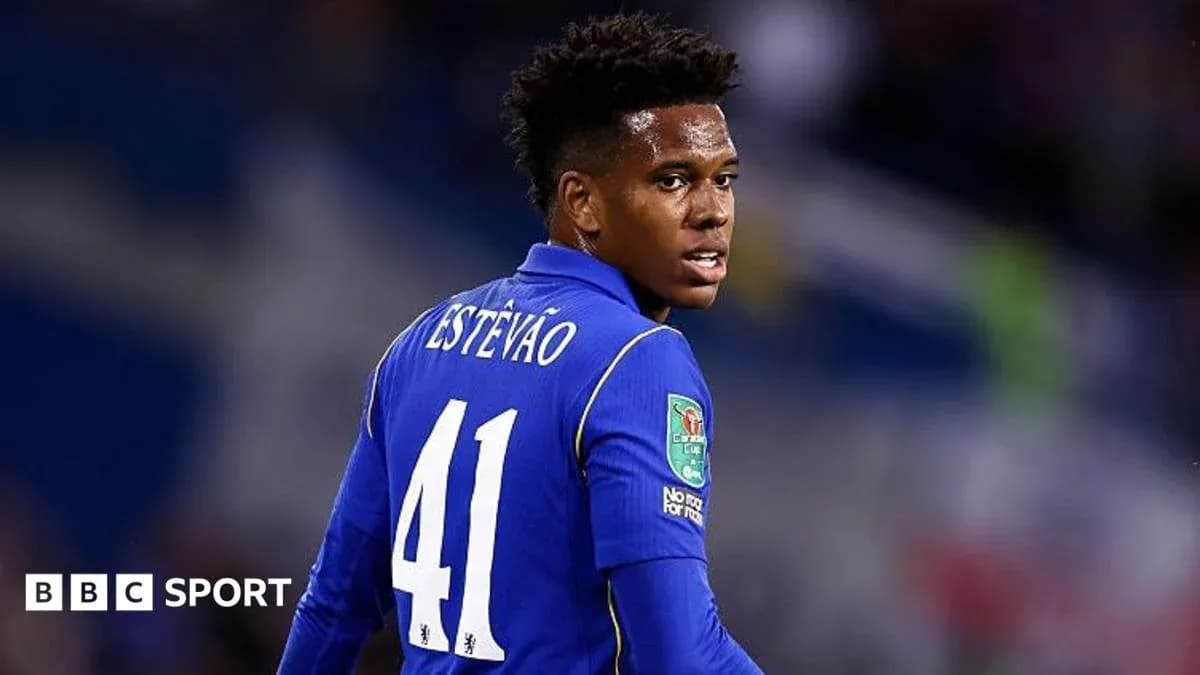
Estevao Willian: Chelsea’s £51m Talent Awaiting Opportunities
The shot curled, the away end held its breath, and David Raya’s fingertips kept Arsenal in front.
Estevao Willian’s late effort at the Emirates did not change the result, but it did something else. It jolted Chelsea’s season-long subplot into focus. The 19-year-old Brazilian, £51m of raw, attacking promise from Palmeiras, is barely playing – yet every rare touch hints at why the club refuse to even entertain the idea of letting him go.
A £51m talent waiting his turn
So far, Estevao’s Chelsea career has been reduced to fragments. Ninety-six minutes in total this season. Eighty of them in the Carabao Cup against League One Luton Town. The rest – 16 minutes – scattered across cameos against Fulham and Arsenal.
He did not leave the bench in the tight win over Brighton. For a player billed as one of Brazil’s brightest young wingers, that is a thin slice of action.
His path is blocked by weighty investments and established form. Chelsea broke their transfer record to bring in Morgan Rogers from Aston Villa for £117m. Cole Palmer has become the creative heartbeat. Joao Pedro is trusted and productive. In Alonso’s hierarchy, the attacking slots are crowded and fiercely protected.
Reports from Brazil have painted a picture of frustration, hinting that Estevao is unhappy with his lack of minutes. Inside Stamford Bridge, that narrative is being firmly pushed back.
People close to the player and sources at the club insist the mood is very different: no agitation, no demands, only a shared excitement about Chelsea’s new-look front line – Rogers included.
‘Este is ready’
Xabi Alonso’s stance is clear. Asked directly if Estevao’s limited involvement meant there was a problem, he cut it off.
No, Este is ready, training well. The other day he had a great impact,” Alonso said. “He is fully involved with a very good attitude every day. I count on Este 100% because of his potential. He is so young but he is learning and adapting quickly. The season is long.
Chelsea see him as part of a protected core. Inside the club, Estevao sits in a small group of “untouchables” alongside Palmer, Joao Pedro and Moises Caicedo. There is no intention to sell. Quite the opposite: he is central to their long-term plan.
Early conversations have already taken place over a new contract, with the club eager to reward key figures in this new era. Joao Pedro has already had his terms improved; Estevao is in the queue.
His slow start also has a physical backdrop. Late last season he suffered a serious grade-four hamstring tear and missed the World Cup. Chelsea always expected this campaign to be about building him up, not burning him out.
System, roles and a tactical squeeze
At Arsenal, Estevao was thrown into an unusual role. He replaced Pedro Neto, who has been operating as a wing-back in Alonso’s new system, as Chelsea chased an equaliser.
It is hard to imagine many other scenarios where the Brazilian would be asked to patrol that flank. The job is brutal: long runs, repeated duels, defensive concentration. It does not naturally suit a slight, creative 19-year-old still adjusting to the Premier League’s pace and physicality.
His preferred zone is further up and inside, off the right, in the number 10 pocket. That is exactly where Palmer operates.
When Alonso has used a back four, Estevao and Palmer have shown flashes of chemistry together, dovetailing in those tight inside channels. The catch? That shape has only appeared once – against Luton in the Carabao Cup.
Dislodging Palmer in league games is another problem entirely. Alonso sees him as a leader in the dressing room and a pillar of his attack. For now, Estevao’s route into that area looks more like a long-term succession plan than a short-term reshuffle.
Alonso has also resisted heavy rotation. With no European football on Chelsea’s calendar, he has treated the early Carabao Cup rounds almost like league fixtures, fielding near full-strength line-ups to fast-track his tactical ideas.
A big squad, not enough minutes
Estevao is not the only one feeling the squeeze. Chelsea’s squad is 27-strong, and the calendar is thin.
If Leeds United knock them out of the Carabao Cup at Stamford Bridge on Wednesday, there will be no more cup football until the FA Cup in January. Quietly, that makes this midweek tie far more significant than it looks on paper. It is not just about progress; it is about keeping a large, ambitious group engaged.
Up front, Palmer and Rogers have started every game. Joao Pedro has opened all three league matches. Danny Welbeck led the line against Luton. That pecking order has left Emmanuel Emegha, signed from Strasbourg, with only one appearance on the bench.
At the back, Aaron Anselmino is still waiting for a debut and has been named in just one matchday squad, though both he and Emegha are managing fitness problems.
Other young attacking options have barely had a look-in. Geovany Quenda has played eight minutes all season, Jamie Gittens just 10. Quenda, signed in 2024 despite strong interest from Manchester United, has already been left out of two of Alonso’s squads entirely.
Even midfield, where injuries have bitten, is tight. Caicedo and Jordan Henderson’s fitness issues have opened a small window, but summer signing Valentin Barco has still only managed one start and one substitute appearance. Right-back Malo Gusto has even been used in midfield instead. Wing-back Marco Palestra is out injured.
If everyone were fit, Chelsea would have to leave six outfield players out of every matchday squad. Eleven starters, nine substitutes, and several frustrated faces in the stands.
History favours a tight core
This is not unique to Chelsea. When clubs play once a week, managers tend to lean on a tight inner circle.
Leicester City’s shock title win in 2015-16 came with just 14 players making more than 15 appearances in all competitions under Claudio Ranieri. The following season, Antonio Conte’s Chelsea won the league without European distractions; only 13 players passed the 1,500-minute mark.
Even in the five-substitution era, the pattern holds. When Newcastle United qualified for the Champions League in 2022-23, only 14 of their players played more than 1,500 minutes.
The closest comparison for this Chelsea side might be Manchester United last season. They finished third without European football and saw only 13 players exceed 1,500 minutes, exiting both domestic cups early.
The message is blunt. If you are on the fringes of a non-European squad, you need a long cup run to turn cameos into real auditions.
A season that could open up
That is where Estevao’s story sits now. A teenager with a World Cup missed, a serious injury behind him, a record fee on his shoulders and a manager who insists he is “ready” – but who rarely has space for him in his best XI.
Chelsea’s hierarchy are calm. They see him as untouchable, a future cornerstone rather than a short-term project. Alonso talks about a long season, about learning and adapting, about trust.
The question is what the calendar will give him.
Beat Leeds on Wednesday and the Carabao Cup becomes a runway – more games, more rotations, more chances for Estevao to turn late flourishes like the one at Arsenal into something heavier, something that forces Alonso’s hand.
Lose, and that Emirates snapshot might have to sustain him, and Chelsea, for a long time.