
England’s World Cup Victory: Morning After in Texas and Beyond
In the half-light of a Texas morning, England’s World Cup win over Croatia was still doing its work.
Not in a stadium this time, but on a grey roadside outside Durham.
Morning after the night before
Rush hour drivers were waved over at random, engines ticking as officers leaned in with breathalysers. No flashing lights, no drama – just a blunt reminder that the party from England’s 4-2 victory can linger in the bloodstream long after the songs fade.
Durham Constabulary launched the roadside operation on Thursday, armed with a worrying statistic: collisions rise by around 20% on England match days. With World Cup games in North America kicking off later for UK viewers, the concern is simple and stark – late-night drinking, early-morning driving, and a legal limit quietly breached.
None of the drivers stopped while the Press Association watched actually failed the test, but one was left stunned to discover they were close to the threshold. That, for the officers, was the point.
Sergeant Sarah Manser spelled it out: the alcohol doesn’t vanish just because the final whistle blows. “We’ve had a couple this morning already who haven't blown over the limit, but they have had alcohol in the system. Please just don’t and drink-and-drive, it’s just as simple as that."
On the roadside, some motorists welcomed the interruption. Louis Renwick, who blew clear with no alcohol in his system, backed the clampdown. “There’s too many deaths on the roads through drink-driving,” he said.
The celebrations, as it turned out, had been vast.
A Texas pub turns into an English cauldron
In Dallas, the Londoner Pub became a little slice of England – and then something the authorities decided was too much of one.
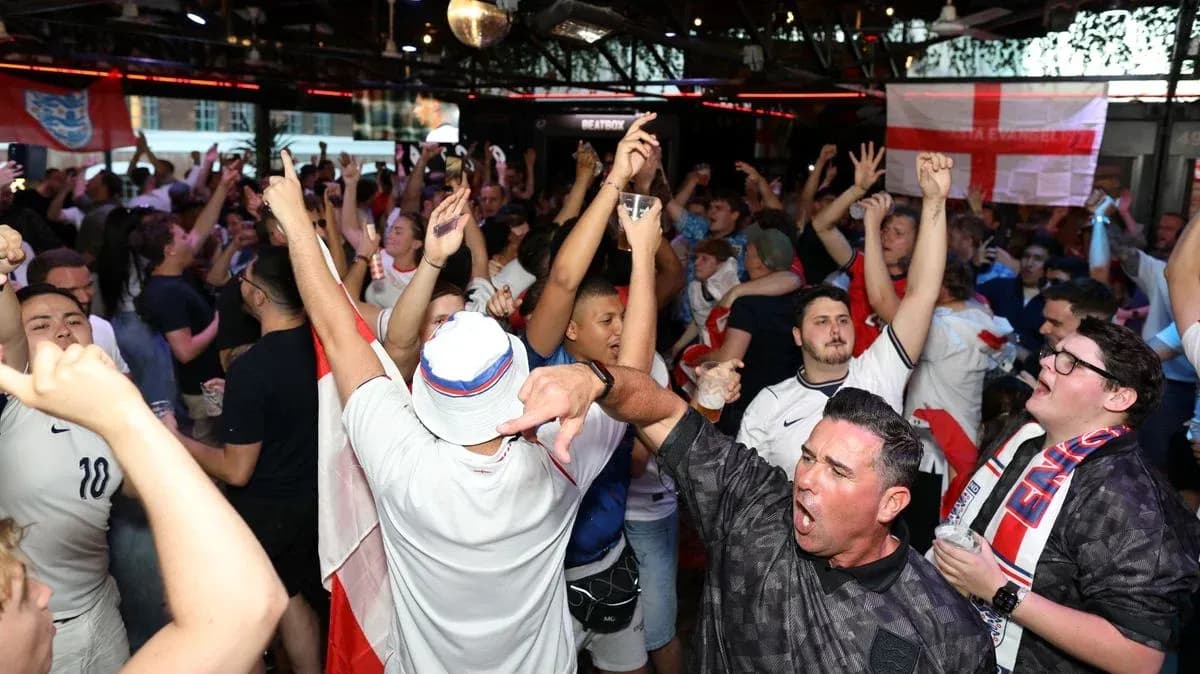
The venue, which had advertised a later closing time than its rivals, was swamped by England fans for the 4-2 win over Croatia. Hundreds packed inside, buying 2,352 bottles of beer and more than 5,000 drinks in total. The till rang up over £30,000 in a single night.
The atmosphere tipped from lively to unmanageable. Police moved in at the start of the match, with video showing officers ordering fans out even as they belted out the national anthem. The pub had hit maximum capacity, with only two security guards on duty.
By Wednesday, the Londoner was shut down for the rest of the day on the orders of the fire marshal. In a statement, the pub spoke of the “mayhem that descended upon us”, insisting the headline sales figures didn’t reflect the cost of damaged property and landscaping. Staff stressed they were operating in a mixed complex of businesses and residences at Mockingbird Station – and that the balance had clearly snapped.
The World Cup had landed in Dallas with force. Inside the stadium, it felt just as wild.
“Palace in Dallas”: chaos, karaoke and a statement win
England’s opener against Croatia, staged in a gleaming arena dubbed the “Palace in Dallas”, was part FA Cup tie, part Super Bowl, part mass karaoke.
For long spells it was chaos. England twice led and twice were pegged back before half-time, a breathless 45 minutes that left fans on tenterhooks. Then came the turn. A vastly improved second-half display, Jude Bellingham and Marcus Rashford on the scoresheet, and a 4-2 win that felt bigger than the scoreline.
By the time Rashford lashed in the fourth in the 85th minute, the place had turned into a travelling English singalong. “Hey Jude”, “Wonderwall”, “Sweet Caroline” – and then, with the result finally safe, a booming “Football’s Coming Home” rolling around the stands.
Among the noise, an American fan, Jessica Long, shook a reporter’s hand, eager to talk about the World Cup coming to her home city. A former London Marathon runner, she’d once pounded past that same reporter’s flat in London. Now she stood in Dallas, surrounded by England shirts and flags.
“This is brilliant, what an amazing day,” she said. “The World Cup is fantastic – look at everyone coming together.”
Bookmakers noticed, too. Betway cut England’s odds to win the tournament from 8/1 to 13/2 after the victory. Spokesperson Lewis Knowles called it “a real statement win” and said there was “a real belief that football might actually come home this summer.”
If the bookmakers were impressed, the players were even more convinced – especially by the man in the dugout.
Tuchel’s touch: “Go on, make a change, do something”
Thomas Tuchel’s fingerprints were all over England’s second-half transformation. The German coach, so often lauded for his tactical sharpness at club level, showed on the biggest stage why players trust him to tilt games.
England went in at half-time at 2-2, rattled after a “shaky end” to the first period. Tuchel used the break to reset everything.
Harry Kane revealed the message inside the dressing room. “He told us to take the shackles off, calm down and let's go. He said what's the worst that can happen? Show the world who we can be.” England came out “full gas”, as Kane put it, and Croatia couldn’t live with the shift in tempo and control.
Kyle Walker, writing in The Sun, drew a stark comparison with former manager Gareth Southgate. Tuchel, he said, isn’t afraid to act.
“When I look back at the tournaments I played under Gareth Southgate, there is a difference compared to how Thomas Tuchel operates,” Walker wrote. Against Croatia, Tuchel made substitutions “at the correct time and brought fresh legs on”. Southgate, he suggested, tended to stick with the XI he trusted, even when change was needed.
Walker admitted that, as a regular in that old XI, the status quo suited him. But he also captured the frustration many players feel in tight games: “Sometimes when you’re on the field, you’re thinking ‘go on, make a change, do something’ and Thomas got that right.”
When Bukayo Saka, Morgan Rogers and Marcus Rashford entered the fray with around 20 minutes left, Walker argued, “it would scare any team in the world.” Croatia certainly looked rattled.
Kane, the “full package”, chases history
On a night of big performances, Kane’s stood tallest. His first-half brace dragged England through the turbulence and drew him level with Gary Lineker’s 10-goal record as the country’s top World Cup scorer.
Thomas Tuchel called his captain “the full package” and went further, highlighting the work without the ball. He picked out one moment in extra time – Kane throwing himself in front of a crucial shot after a set piece – as the perfect snapshot.
“Complete performance, absolute leader and he is all in – he's all in physically, he’s all in mentally, and he's all in,” Tuchel said.
Kane’s personal duel with the game’s other great forwards is already simmering. Kylian Mbappé and Erling Haaland both scored braces in their opening matches. Lionel Messi hit a hat-trick for Argentina against Algeria. Kane watched, then answered with his own double in Dallas.
“I saw the guys scoring their goals,” he admitted. “I don't like to concentrate on other people, but it is natural as a sportsman and athlete to want to reach the highest level. Those guys started in a great way.”
“As a striker myself, I just want to get on the scoresheet as quickly as possible. In the back of my mind that competition helps me to push my levels. That is what the World Cup is for, to push myself at the highest level, so it is nice to get a couple.”
He is chasing history: no man has ever won the World Cup Golden Boot twice. Kane, having done it in 2018, is openly hunting a second.
Bellingham: the chip on his shoulder, the change in perception
If Kane set the tone, Jude Bellingham gave the performance that shifted the narrative.
At 22, he is already playing in his fourth international tournament. His talent has never been in doubt; his temperament has often been questioned. Tuchel himself had previously said his mother found Bellingham’s behaviour “repulsive”, and doubts lingered over whether the midfielder would buy into the manager’s “brotherhood” after missing the September and October camps through injury.
There were even debates over whether he should start this opener, with Morgan Rogers pushing hard for the same role.
Tuchel backed him. Bellingham repaid him.
He struck England’s vital third goal, two minutes into the second half, the moment that finally tilted the match their way. He then drove the game with the authority of a veteran, not a player still technically in the early stages of his career.
Tuchel kept his assessment sharp. “A very good player, he deserved to start, and that's what he needs to do to fight for his place,” he said.
Bellingham himself spoke of playing with a “chip on my shoulder”. Talking to BBC Sport, he said it had been “nice to put some of the noise aside” and show his country and team-mates “how committed I am to help us try to win football matches.”
“It has been a tough season for me but I am feeling fresh and sharp and stronger. I have got a little bit of a chip on my shoulder. That helps me a lot to find that focus early in the game and to find that intensity.”
He didn’t shy away from criticism either. “I know that it's part of being a footballer and I don't hold a grudge against anyone who says bad things about me because sometimes I do deserve it. Today, it was nice to try to show people and remind people what I'm about.”
The conversion of his doubters is already under way. Dietmar Hamann, covering the game for RTE, admitted he had not always liked what he saw from Bellingham during his Borussia Dortmund days. “Some of the things he did I didn't like at all,” the former Germany midfielder said.
But Hamann pointed to Bellingham’s Champions League triumph in his debut season at Real Madrid and the display against Croatia as proof of his evolution when he plays within a team structure. “Tonight he looked like a team player. When he does play for the team, when he does work for his team-mates, we know he's an excellent player.”
Rashford’s reward and the battle for places
Marcus Rashford’s role under Tuchel has been another live debate. The forward did not start against Croatia but came on to devastating effect, sealing the game with England’s fourth.
Tuchel revealed he had held a detailed conversation with Rashford on Tuesday, praising his attitude in camp and his tactical sharpness. “I'm very, very impressed with his last 16 days – how he was in camp, how he pushes on the field,” Tuchel said.
“He is totally invested in every meeting. He is very, very fast in translating a meeting onto the pitch, what we want tactically. He pushes on a very respectful level with Anthony Gordon on the position, so at the moment he's in a very good place.”
That internal competition – Rashford with Gordon, Bellingham with Rogers, Saka waiting to explode – is exactly what Tuchel wants. Kane’s words about taking the shackles off were matched by a squad playing like men who know a bad day can cost them their place.
Away from England: drones, drama and Ronaldo doubts
The World Cup’s storylines stretched far beyond Dallas.
In Mexico, the military shot down a drone flying near South Korea’s training camp. Using specialised equipment, they detected what they described as an “unregistered drone” close to the team’s base ahead of their Group A clash with Mexico.
Coach Hong Myung-bo called the incident “unfortunate” but said it came just before the squad began to work on tactical drills, so their preparations were not compromised. Even so, the timing – “the most important” part of their build-up, he stressed – left a sour taste.
On the pitch elsewhere, Cristiano Ronaldo’s sixth World Cup campaign began with frustration. The Democratic Republic of Congo held Portugal, with Yoane Wissa scoring the equaliser and Ronaldo largely anonymous.
He had two half-chances from pull-backs but never looked like deciding the game. On 5 Live, Chris Sutton accused Portugal boss Roberto Martínez of lacking the courage to take his star off.
“That is embarrassing,” Sutton said. “Are we all watching a different game to Martinez? He is scared to take him off. He is not the manager. He might score the winner, but the game has passed him by. He is a brilliant player. He was once the playmaker, but now he is the poacher. He is not only the poacher, but he runs the estate.”
The words will sting. So will the performance.
The road ahead
Day seven is in the books. Day eight brings a different kind of pressure.
Czech Republic face South Africa at 5pm UK time, both already beaten once and unable to afford another misstep. Switzerland meet Bosnia-Herzegovina at 8pm in a Group B that is suffocatingly tight, all four sides locked on a single point. Canada play Qatar at 11pm in the same group, where every tackle and mistake now carries extra weight.
In the early hours, Mexico meet South Korea in Group A, with a win for either likely to seal a place in the knockouts.
And somewhere in the background, in Durham lay-bys and Dallas pubs, the echoes of England’s opening statement will still be heard – in the songs, in the betting markets, in the way drivers think twice before turning the key.
The World Cup has only just begun. England have thrown down their marker. The real question now is whether this surge of belief, this mix of chaos and control under Tuchel, can last all the way to a night when those songs are no longer just about coming home, but about finally arriving.




