
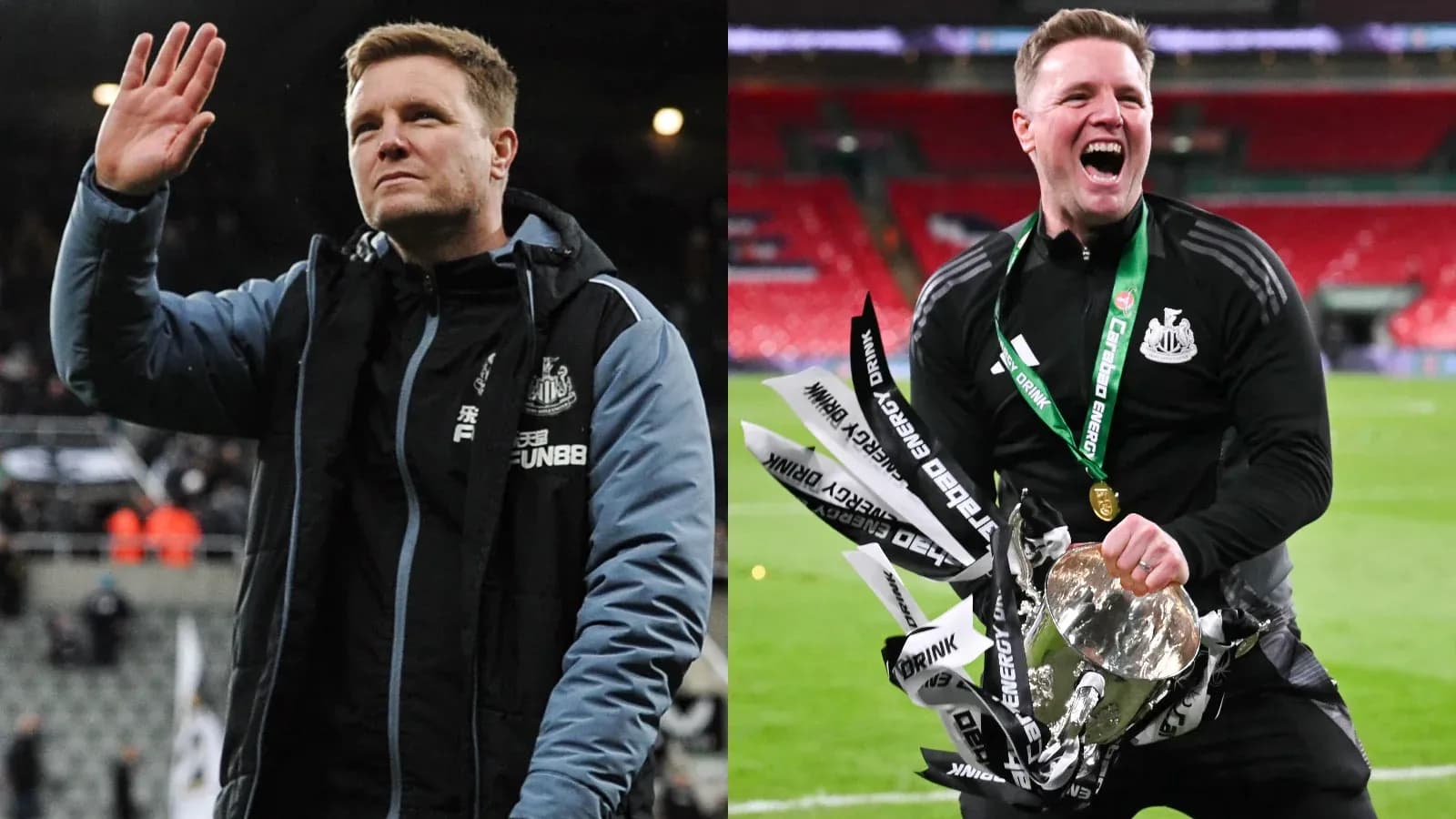
Eddie Howe's Newcastle Transformation and Departure
Eddie Howe’s Newcastle reign is over. Almost five years after walking into a relegation fight at St James’ Park, he walks away having dragged the club into a different universe.
Appointed in November 2021, just weeks after the Saudi-led takeover, Howe inherited a team stuck in the bottom three, five points from safety and drifting. Newcastle were nervous, flat, and staring down the barrel.
He changed that quickly.
From Relegation Scrap to Champions League Nights
Taking over from Steve Bruce, the former AFC Bournemouth manager set about jolting the club back to life. The first job was survival. He did far more than that.
By the end of the 2021/22 season, Newcastle were nowhere near the drop. They finished 11th, a mid-table position that barely hinted at how deep the transformation had gone. Training standards went up, intensity went up, belief came back. So did the noise around St James’ Park.
The real statement came a year later. In Howe’s first full season in charge, Newcastle finished fourth in the Premier League, muscling into the Champions League places and elbowing their way back to Europe’s top table for the first time in 20 years. The club that had fretted about survival suddenly found itself swapping trips to Burnley for nights under the lights against Europe’s elite.
They did not just make up the numbers. Last season, Newcastle reached the Champions League round of 16, the first time in the club’s history they had gone that deep into the competition. It felt like a new era, not a one-off.
Ending a 56-Year Wait
If there is one image that will define Howe’s time on Tyneside, it is silver.
In 2025, Newcastle finally ended their long, aching wait for a major trophy. A 2-1 win over Liverpool in the EFL Cup final delivered the club’s first piece of silverware in 56 years. Generations of frustration, near-misses, and what-ifs washed away in one afternoon.
For a club that had worn its longing like a second skin, Howe gave them something tangible to hold onto.
The numbers back up the emotion. Howe leaves with more Premier League wins than any other Newcastle manager in the competition’s history: 84 victories from 179 games. His win percentage in the league – 46.9 per cent – is bettered only by the late Kevin Keegan’s 51.2 per cent. In the modern era, with the pressure, the money, and the scrutiny, that is an elite return.
Only Keegan, with 83 wins from 162 matches, sits alongside him in that statistical company. Names like Sir Bobby Robson, Glenn Roeder and Alan Pardew trail behind on the win-percentage list. Howe’s impact is not just a feeling; it is written into the record books.
Why Howe Walked Away
The decision, though, is his.
“After a period of personal reflection, I have decided that now is the right time for me to step away from my role as head coach of Newcastle United," Howe said. After nearly five years, he spoke of giving his “life, heart and soul” to the club, of the need to “step away, recharge and take a break”.
He framed it as a choice made in the best interests of both himself and Newcastle, stressing that he had always put the club first. “It has been the privilege of my lifetime to have been the manager of Newcastle United," he added.
The club, for their part, accepted his decision and praised his “extraordinary contribution”. There was no public friction, no late-night drama. Just a line drawn under an intense, transformative spell.
But this is not just about one man. There is a wider reset happening on Tyneside.
A Changing of the Guard
Two key players have already gone. Anthony Gordon has joined Barcelona. Sandro Tonali has moved to Tottenham Hotspur. Those departures strip away some of the team’s established core and hint at a squad being retooled for the long term.
Newcastle’s recruitment this summer underlines that shift. The club have doubled down on youth: winger Bazoumana Toure from Hoffenheim, midfielder Sean Steur from Ajax, goalkeeper Ewen Jaouen from Reims, and defensive midfielder Alhadji Bamba from Monaco. The average age of those four signings is just 19.5.
This is not a group built for a final push with a veteran coach. It looks like the start of a new cycle, and the timing of Howe’s exit fits that storyline. A younger, developing squad. A manager who has poured everything into the job for nearly half a decade. A natural moment to hand the project to someone else.
Howe’s last game in charge, a 4-1 pre-season defeat away to Bristol City on 29 July, now reads as a footnote. The real legacy lies in the standards he leaves behind.
The Next Man Up
Newcastle insist the search for a successor is already well advanced. The club say the process to recruit a new head coach is at an “advanced stage” and that updates will follow soon.
Among those under consideration is 38-year-old German coach Matthias Jaissle, currently in charge of Al-Ahli. His résumé is striking: back-to-back AFC Champions League titles with a squad that includes former Premier League names Ivan Toney and Edouard Mendy, and previous work with Riyad Mahrez and former Newcastle favourite Allan Saint-Maximin in Saudi Arabia.
Before that, Jaissle dominated in Austria, leading Red Bull Salzburg to consecutive Bundesliga titles and an Austrian Cup, having cut his teeth with their reserve side, FC Liefering. He fits the profile of a coach comfortable with young players, high-intensity football, and the demands of a club expecting to compete for honours.
Whoever comes in will not have long to settle. Newcastle still have four pre-season friendlies before the campaign begins: Valencia away on 8 August, Everton at a neutral venue on 12 August, then back-to-back home games against Bayer Leverkusen and Strasbourg on 15 and 16 August.
The Premier League season starts for them on Sunday 23 August, with five fixtures to navigate before the first international break of 2026/27. There will be no gentle introduction.
Howe leaves behind a club unrecognisable from the one he found: from relegation fears to Champions League football, from a trophy drought to a cup in the cabinet, from drift to direction. The question now is simple and brutal.
Can Newcastle’s next head coach live with that standard?




