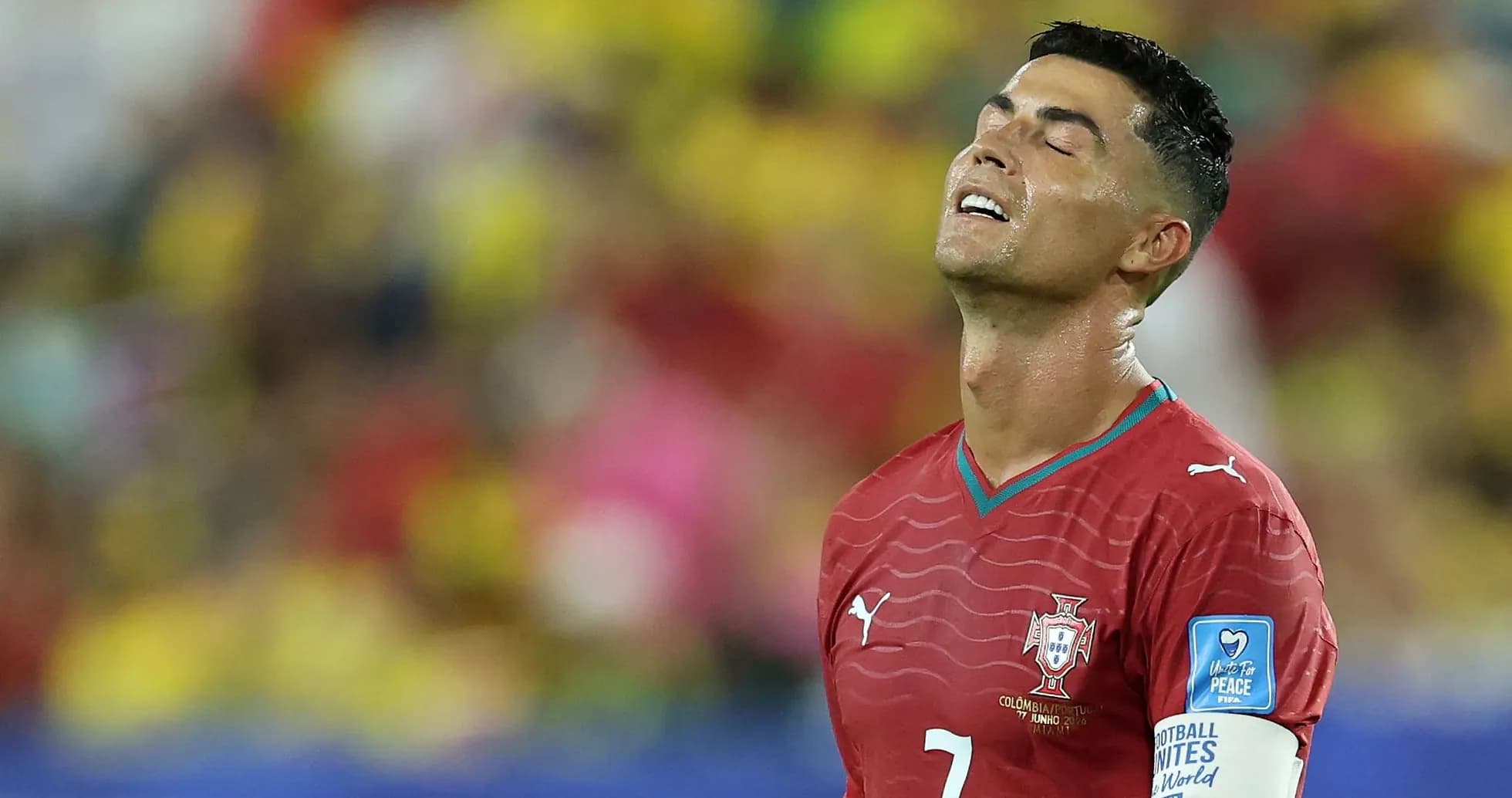
Diego Forlan on Cristiano Ronaldo's Impact on Portugal
Diego Forlan has never been afraid of a hard truth in the penalty area. Now he’s delivered one for Cristiano Ronaldo.
Speaking on ESPN’s La Casa del Kun, the former Manchester United forward and 2010 World Cup Golden Ball winner broke down Portugal’s biggest tactical dilemma with the blunt clarity of a striker who’s lived it: Ronaldo’s presence as a fixed No.9 is helping himself, but hurting the team.
“He ends up conditioning Portugal”
Forlan didn’t dance around it. From a centre-forward’s perspective, Ronaldo’s evolution into a largely static penalty-box predator is making life far too comfortable for opposition defences.
"I'm speaking as a striker, the problem is that Cristiano is in the center, he is who he is, he is there as a No.9, and he stays there to take advantage of the goal because he no longer goes out to look for the ball, but he ends up conditioning Portugal," Forlan explained.
That one word – “conditioning” – cuts to the heart of the issue. Ronaldo still lurks where goals live. He still punishes mistakes. But by staying central and high, he becomes a fixed reference point. For defenders, that’s a gift.
"It's the typical situation where we used to say, 'I'm staying here because I'm close to the goal to score,'" Forlan continued. "But you don't understand that you end up hurting your team because both center backs stay there, you don't move. The center backs stay put, one becomes a reference point and the other is left out. You have no one who can get to you because you start closing down that space."
In other words: Ronaldo’s static positioning locks the defence in place, but it also locks Portugal’s attack into a narrow corridor. The box is crowded, the central lanes are clogged, and the team’s most gifted creators are forced to operate in traffic.
A Ferrari attack stuck in first gear
This is where the tension really bites. Roberto Martinez has a squad packed with technicians and runners who thrive on space and movement. Bruno Fernandes between the lines. Bernardo Silva drifting, probing, combining. Rafael Leao exploding into gaps.
On paper, it’s an attack built to stretch the pitch and pull backlines apart. On the grass, Forlan sees something different: a funnel.
With Ronaldo anchored in the middle, Portugal’s attacks tilt, narrow, and ultimately slow. The ball gravitates to him, defenders stay set, and the rest of the forwards are left trying to create in ever-tightening pockets.
“Move, get out of there”
The advice to his former Old Trafford teammate was as simple as it was pointed.
"If he moved a little to the wings, the others could get in and he could be involved," Forlan said. "That's where Portugal falters because they don't explode because everything ends up going to one side, which is actually a funnel. I wouldn't say it's a problem, it's about making him understand. Telling him: 'Move, get out of there so you can do something'."
This isn’t nostalgia for the Ronaldo who hugged touchlines as a teenager. It’s a call for just enough movement to unhinge a defence. Drift wide, drag a centre-back with you, open a lane for a Bruno Fernandes run or a Leao cut inside. Stretch the pitch, even briefly, and Portugal’s talent can rush into the gaps.
The message is clear: Ronaldo doesn’t need to reinvent himself. He just needs to stop being the fixed point around which everything – including the opposition – comfortably orbits.
Martinez under pressure, Ronaldo at a crossroads
All of this lands as Portugal step into the knockout rounds, where every flaw is magnified and every pattern is studied to death. They’ve done their job in the group phase, safely reaching the round of 32 and setting up a meeting with Croatia. The stakes now spike.
Ronaldo has already shown he can still find the net. His penalty-box instincts remain sharp, his name alone still bends defensive game plans. But against elite opposition, predictability is poison. The “bottleneck” Forlan describes becomes more than a tactical quirk; it turns into a clear route for top sides to smother Portugal’s attack.
That reality heaps pressure on Roberto Martinez. Managing a legend is never straightforward, managing a legend who still scores is even harder. Does he demand positional sacrifice from his captain? Does he subtly redesign the system around Ronaldo’s current profile? Or does he gamble that individual brilliance will override structural issues?
Forlan’s view leaves little room for ambiguity: the adjustment has to come from Ronaldo himself.
The five-time Ballon d'Or winner has rebuilt his game more than once across an extraordinary career. Now, with another major tournament on the line and Croatia looming, the question is brutally simple: is he willing to move just enough, just often enough, to give Portugal the space their creators are crying out for?
Because if he isn’t, the country’s greatest-ever player might find that his presence at the centre of everything is exactly what stops this team from going all the way.