Declan Rice: England's Essential Midfielder Faces Fitness Challenge
Aaron Cresswell calls Declan Rice “a freak of nature”. It sounds like a throwaway line, the sort of dressing‑room compliment that gets lost in the noise of a long season. Until you see the number: 360 games since the start of 2020‑21. Six, sometimes seven matches a week in Cresswell’s imagination; in reality, a workload that would break most players long before a World Cup summer in Florida.
For club and country, Rice has been the constant. The engine for West Ham’s European runs in 2022 and 2023. The anchor of Gareth Southgate’s England. The heartbeat of Arsenal’s Premier League and Champions League pushes since his move to north London. When managers look at the team sheet, they start with his name and build outwards.
But on Wednesday in England’s wild 4-2 win over Croatia, the machine flickered.
A rare off-day for England’s constant
This was Rice’s 63rd appearance of the 2025‑26 season. It showed. The 27‑year‑old, usually so assured, looked strangely dulled. England’s midfield shape sagged. The gap between Rice and Elliot Anderson yawned open in a ragged first half, with Luka Modric gleefully dragging Rice out of position and into areas he did not want to go.
Rice dropped too deep, then found himself chasing shadows. England’s structure bent with him. Thomas Tuchel will look at the video and see a unit that lost its reference point.
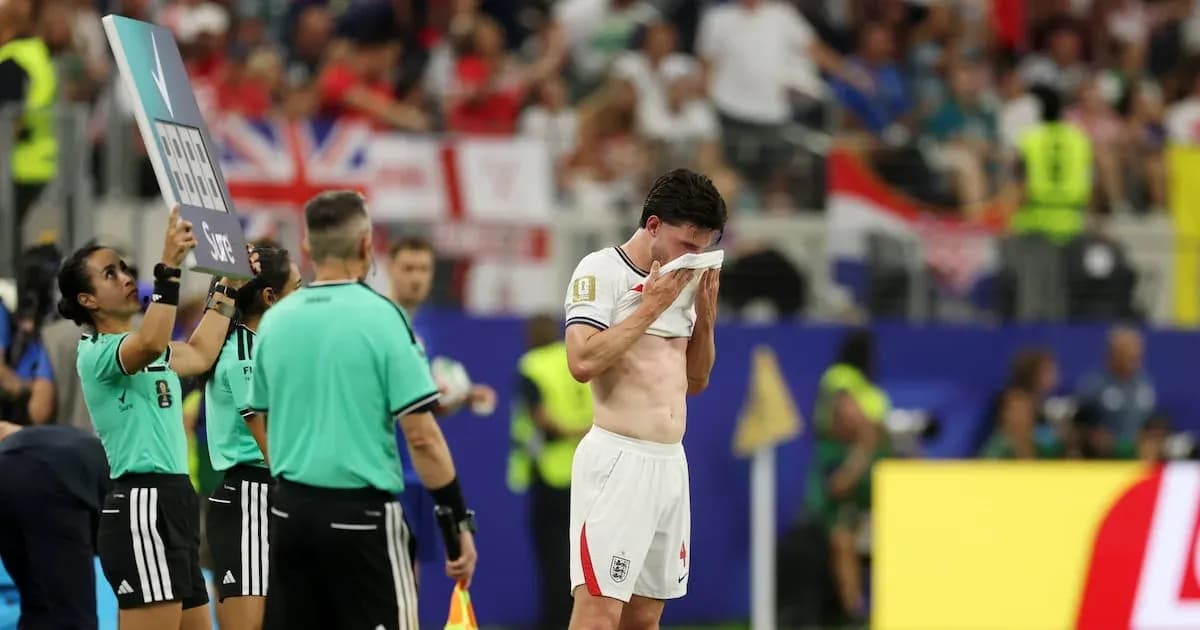
Those tactical flaws can be fixed. They usually are at this level. What shook England more was the sight of Rice trudging off in the 72nd minute, with England clinging to a 3-2 lead. This is the moment when Rice normally tightens the screw, when his ball‑winning and calm on the ball smother an opponent’s late surge. Instead, he signalled that something was wrong.
Tuchel revealed it as “discomfort” in Rice’s lower back and upper hamstring. The England head coach called the change precautionary. Rice, predictably, insisted he will be available to face Ghana on Tuesday.
England cannot simply take him at his word.
A dependence laid bare
Tuchel’s assessment of Rice’s performance was telling. “Declan had some unusual ball losses,” he said, choosing diplomacy over alarm. Yet the message underneath was clear: this was not the Rice England know. And if this is what England look like with a diminished Rice, what happens if he is not there at all?
The recent history is damning. England have rarely convinced without him over the past six years. They do not have another midfielder who combines his defensive instincts, physicality, leadership and set‑piece delivery. There is no like‑for‑like option hiding on the bench.
Kobbie Mainoo offers elegance in possession and a brave passing game, but he does not yet have Rice’s frame or his aerial presence. Jordan Henderson brings experience and voice, but at 36 he was overlooked when England needed to maintain a high tempo against Croatia. If Tuchel truly trusted him for that role, he would have appeared on Wednesday night. He did not.
So Tuchel experimented.
When Rice went off, Jude Bellingham dropped deeper. On paper, it made sense: Bellingham has the range to operate as a No 8, even a deep‑lying playmaker. On grass, it almost cost England. Croatia surged, England lost control, and within eight minutes Tuchel ripped up the plan.
Then came something more interesting.
Reece James, the unexpected answer?
Djed Spence entered for Bellingham. Reece James stepped away from right back and into midfield, a role he has grown into at Chelsea over the past 18 months. Suddenly, England had a different profile at the base of midfield: a defender’s instincts, a midfielder’s technique, and a captain’s presence.
It is not an experiment plucked from thin air. James played in midfield on loan at Wigan in 2018‑19. He has spent much of his senior career at right back or wing back, but Enzo Maresca’s spell in charge of Chelsea changed the conversation. Maresca pushed James inside, absorbed the early criticism, and was rewarded when Chelsea beat Paris Saint‑Germain in last year’s Club World Cup final with James thriving in the middle.
Tuchel, who once managed James at Chelsea, had been one of the doubters. He publicly framed him as a right back in his England plans. But Maresca’s success forced a rethink. James is powerful, reads the game well, tackles cleanly and passes with purpose. He is not just a converted full‑back filling a gap; he has started to look like a genuine midfield option.
The evidence has stacked up. James dominated when he partnered Moisés Caicedo in Chelsea’s 3-0 win over Barcelona last November. Five days later, he outplayed Rice himself when Arsenal came to Stamford Bridge. Those performances linger in a manager’s mind.
“Reece James can play in the 6 because he does on a high level for Chelsea,” Tuchel said when he named his World Cup squad, using that logic to justify leaving out Adam Wharton and Alex Scott. Versatility mattered. Tuchel wanted players who could solve multiple problems.
If Rice’s minutes need to be rationed, James looks the most convincing solution.
The cost of versatility
Tuchel has built a squad that can change shape quickly. If James steps into midfield, he has cover at right back. Spence can slot in. So can Ezri Konsa and Jarell Quansah. One option is to use Konsa as a third centre back alongside John Stones and Marc Guéhi, with Nico O’Reilly surging from left back, giving England a hybrid back three and the freedom to push numbers into midfield.
On a tactics board, it works. On the pitch, one question keeps intruding: can James’s body cope?
His history with hamstring injuries is long and well documented. The latest setback came in March and kept him out for almost two months. Chelsea have had to manage his minutes carefully, picking their moments to unleash him. Asking him to start every game at right back and then shoulder extra responsibility in midfield for England feels like a gamble with a familiar downside.
Tuchel’s options at full back have already been hit. Tino Livramento’s calf injury forced a late call‑up for Trevoh Chalobah. The season has taken its toll across the squad. James is first choice at right back, but he cannot be the solution to every problem. Not at this intensity. Not with his medical file.
So England stand on a tightrope: protect Rice without breaking James, or lean again on the midfielder who has already carried a season’s worth of strain.
The bill for endless minutes
Fitness has stalked Tuchel’s thoughts for months. England’s early arrival in Florida for a pre‑tournament camp in the sun was designed to sharpen conditioning and acclimatisation. Yet even that plan had its wrinkle. Rice joined late after playing for Arsenal in the Champions League final. Another final, another high‑stakes 90 minutes on already heavy legs.
He never stops. That is part of his greatness, and part of the problem.
If England go all the way to the World Cup final and Rice plays every possible game, he will finish the season on 70 appearances for club and country. Seventy. For a midfielder who covers more ground than almost anyone else on the pitch, who is asked to screen, press, pass, lead and deliver at set pieces, the demands border on brutal.
Tuchel cannot wish that away. He cannot simply trust Rice’s insistence that he is fine and hope the numbers do not catch up with him. The sight of England wobbling with a half‑fit Rice against Croatia should serve as a warning, not a footnote.
England have built a team around a “freak of nature”. Now, deep into another draining season, they must decide how to protect him – and whether their World Cup hopes can survive even a single match without him.