Canberra United's New Era: Owners Promise Men's Team by 2028-29
Canberra United finally has what it has been crying out for: certainty, cash, and a plan.
Australian Sports Group (ASG) has bought the club’s licence from Capital Football, ending two years of doubt over the A-League Women side’s future and locking in a long-awaited push towards an A-League Men team in 2028-29.
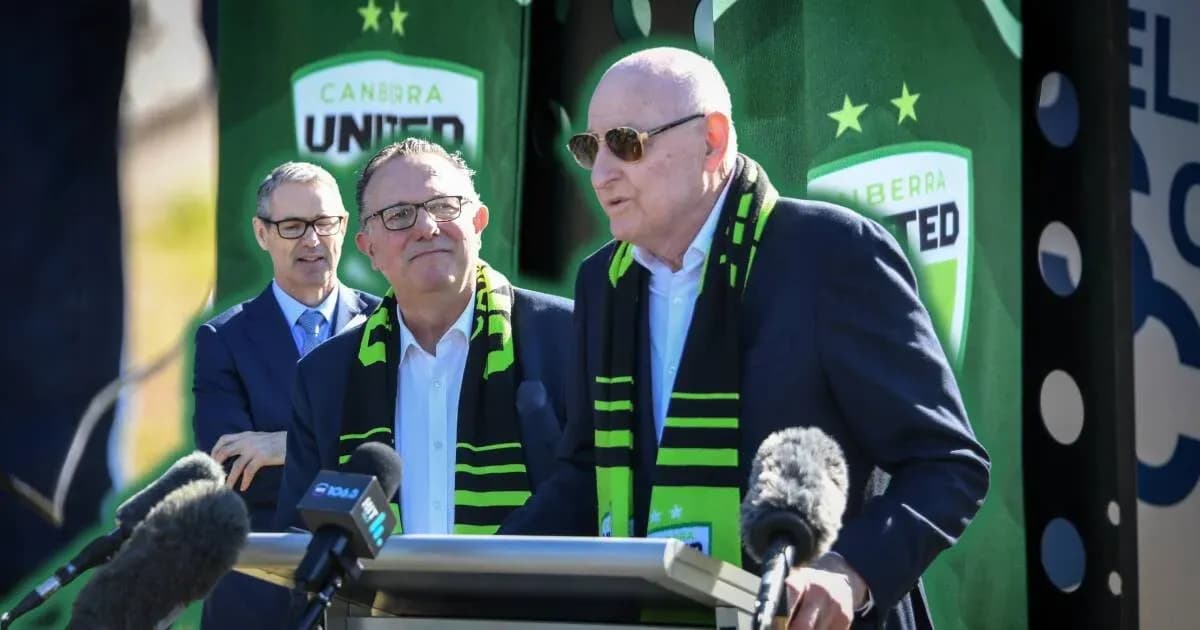
On Friday, ASG executives stood on the grass at McKellar Park and did what no one in Canberra had been able to do for years – guarantee United’s place in the national competitions, and talk about growth rather than survival.
McKellar stays home – and could become something more
McKellar Park, the club’s “spiritual home”, will remain Canberra United’s match-day base. ASG wants it to be much more than that.
Chief executive Theo Fotopoulos confirmed the club is exploring a permanent training base on the six-hectare site, with ASG also taking office space at the neighbouring Belconnen Soccer Club, which he described as a “strategic partner”.
The move comes after Capital Football and the ACT government’s plans for a dedicated facility at the Throsby Home of Football collapsed under financial strain. ASG has stepped into that vacuum and is already sounding out options across the city, with McKellar clearly at the front of the queue.
“It’ll come down to what we can get approved in terms of the facility here,” Fotopoulos told The Canberra Times. “It’s one of the few private grounds in Canberra. I’ve spoken to the relevant people, so it looks very positive what we can do here. But football needs a home and it’d be great to be able to develop that here.”
The message was clear: Canberra United will not be a club living week to week. It will have a base, an office, and a footprint.
Coaching call and contracts on the clock
The new owners have wasted no time on football matters either.
They have already met with coach Antoni Jagarinec, who has taken United to the finals in each of the last two A-League Women seasons, and want the coaching situation resolved quickly with pre-season just six weeks away. The league draw lands next month, with the season to kick off on October 16.
“That is our priority to get that finalised,” Fotopoulos said. “We had some recent meetings with the coach. I believe the PFA are also working with all the players at the moment and we’d like to get that wrapped up quicker than later. We feel very confident with the reaction we’ve had so far from the players that that will happen in haste.
“It’s never a no-brainer, but yeah, look, I think [Jagarinec’s] results speak for themselves. We’re looking for continuity and consolidation. We’ll have those announcements out pretty soon.”
The clock is ticking, but for once in Canberra the rush is about preparation, not rescue.
Men’s team: option now, deadline set
The other headline is the one the capital has waited nearly two decades to hear with any real conviction: a men’s team is on the way.
ASG holds an option, not yet a full licence, for an A-League Men side to enter in the 2028-29 season. After 18 years of false starts, shifting timelines and political wrangling, the three-season wait raised eyebrows. The expectation in some quarters had been that a men’s team would follow just a year after the women’s handover.
Fotopoulos did not blink.
“Well, we’re here today, so that’s your best guarantee,” he said. “That is part of our twin strategy. When we started speaking to the APL … that was part of our mix. We believe the strength comes from both. It would be almost discriminatory not to work with the men. It’s always been part of our plans.”
The Australian Professional Leagues has already endorsed the move. APL chair Steve Conroy thanked the ACT government and local football community and hailed ASG’s arrival as “an exciting next step for professional football in the ACT”, pointing to the growth potential of the Canberra market.
For Canberra bid leader Michael Caggiano, who has spent eight years pushing for an A-League Men side and watched Auckland leapfrog the capital into the competition, ASG’s entry could finally close the book on the city’s long, frustrating chase.
United in name – but Canberra to choose the identity
One thing will not change: the name.
“You’ve got 18 years of Canberra United. Why would you change it?” Fotopoulos said. The brand will stay for both the women’s and future men’s teams.
What might change is what comes after it. Fotopoulos wants the city to help choose a nickname through a public campaign – potentially run through The Canberra Times – to give the club a sharper identity without discarding its history.
The Cosmos? Arrows? Greens? Lakers? Green Machine? He’s happy to listen.
“If the Canberra community want a nickname for their team, Green Machine, whatever they come up with, we’re happy to look at that and we’ll run a public campaign, possibly through your paper,” he said.
It is a small detail in the context of licences and millions of dollars, but it speaks to ASG’s desire to embed itself in the local fabric rather than impose a top-down rebrand.
New money, old experience
ASG’s leadership is not new to Australian football.
Chairman Morris McAlister comes from a commerce background and is governing director of Petron Plus 7 Australia and New Zealand, a company dealing in engine and machinery products such as lubricants and grease. He is also senior consultant at MEC Team Consultants, which connects Australian businesses with Chinese markets.
Fotopoulos is a marketing executive and chief executive of FOS Group Australia. The pair have long histories in the game: they were involved with Sydney Cosmos, where Fotopoulos served as chief executive, and with Newcastle Breakers in the old NSL, while Fotopoulos also held the CEO role at Sydney Olympic.
They now have two years to lay the foundations of a men’s side and, more immediately, to stabilise and grow one of the A-League Women’s strongest clubs.
From federation burden to private ambition
For Capital Football, the sale ends an era that began in 2008 when it launched Canberra United as a federation-run team. The model delivered one of the best-supported clubs in the women’s competition but became financially unsustainable.
The 2025-26 campaign was Capital Football’s last in charge. The following season’s participation was not guaranteed until ASG stepped in this week with a commitment believed to underwrite Canberra United to the tune of up to $3 million over multiple years. The broader deal, which also covers the men’s option, is understood to be worth around $15 million, although Fotopoulos declined to confirm the licence price.
The A-Leagues will formally announce ASG as Canberra United’s new owner, confirming the club’s place in the 2026-27 ALW season and ending the immediate threat of Canberra disappearing from the national women’s stage.
For a fan base that has watched uncertainty drag on and academy pathways disappear, that alone is seismic.
Pathways rebuilt, infrastructure promised
Fotopoulos has already moved to address one of the most contentious decisions in recent ACT football history: the axing of Canberra United’s academy three years ago by Capital Football.
He has pledged to re-establish those pathways and tie them into a broader investment in football infrastructure in the capital.
“Canberra is home to a thriving football community – a huge participant and passionate supporter base who have made Canberra United one of the most strongly supported A-League Women teams for the last 18 years,” he said.
“We’re thrilled to be leading the next generation of professional football in Canberra, taking on the ownership of the Canberra United women’s team with a renewed focus on growth and investment, and progressing towards an integrated professional club with the introduction of an A-League Men’s team in season 2028-29.
“We’re excited to be part of growing the A-Leagues and building a strong club focused on community engagement, football excellence, commercial growth, new infrastructure and strengthening the football development pathways for boys and girls in the territory and the capital region.”
Around McKellar Park, aspiring young players watched Friday’s announcement from the sidelines. For them, the promise of restored academies, a secure women’s team and a future men’s side is not a press release – it is a potential career ladder.
Canberra has its club back, a plan on paper and owners willing to spend. The next question is simple and far more interesting than the ones the city has been asking for years: how high can United climb now that survival is no longer the ceiling?