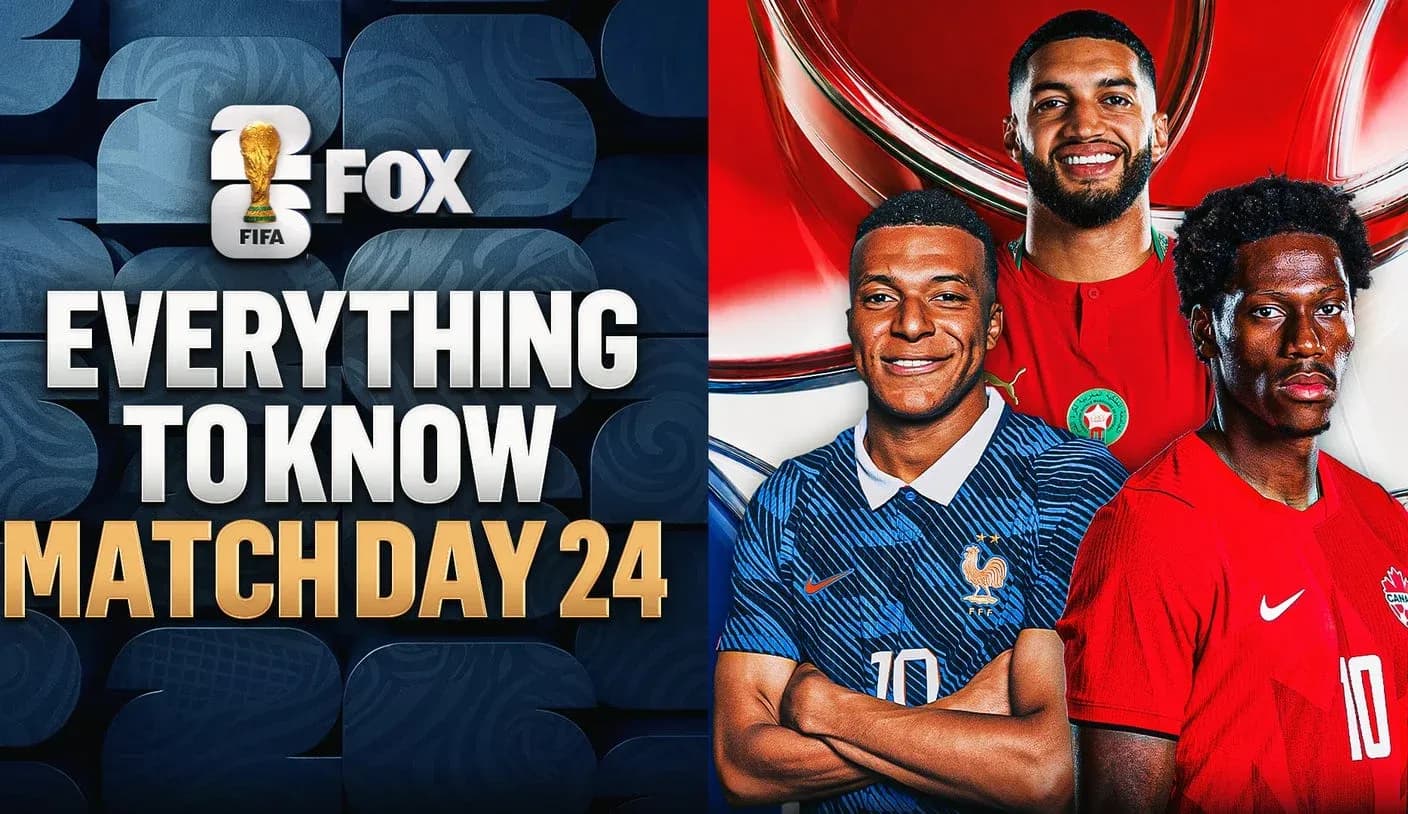
Canada Faces Morocco in World Cup Showdown
The fireworks in the United States won’t wait for nightfall on July 4. The round of 16 at the 2026 FIFA World Cup crashes into the holiday with a doubleheader that feels perfectly scripted: a rising host-nation co-tenant in Houston, then a heavyweight in Philadelphia, just down the road from the birthplace of the country itself.
Canada against Morocco to start. France against Paraguay to close. History, ambition and a few genuine title contenders jammed into one long, hot American Saturday.
Canada’s Moment of Truth Against Relentless Morocco
Houston gets the first act, and it’s a rematch with a sting.
Canada and Morocco last met on this stage in the 2022 group phase in Qatar, a 2-1 Moroccan win that helped launch the North Africans’ unforgettable run to the semifinals. Four years later, Morocco return as something more than a fairytale. They look like a team built to win this thing.
Canada arrive with a very different story. Before this tournament, the Canadians had lost all six World Cup matches in their history. The idea of them playing knockout football at a home World Cup would have sounded like a marketing line rather than a realistic target.
Then Jesse Marsch showed up, and the arc began to bend.
A semifinal run at the 2024 Copa América hinted at a new ceiling. This World Cup has confirmed it: Canada not only escaped their group, they also claimed their first-ever World Cup knockout win to reach the round of 16. It hasn’t been smooth, but it has been stubborn.
They stumbled out with a flat draw against Bosnia and Herzegovina. With pressure rising, they responded by tearing Qatar apart 6-0 to clinch a knockout spot. Confidence seemed to wobble again with a deflating defeat to Switzerland in the group finale, only for Canada to dig in and edge South Africa 1-0 in the round of 32, Stephen Eustáquio delivering late when the tension was suffocating.
That resilience has become their calling card. It will need to be.
Because across the halfway line stands a Morocco side that has carried its 2022 momentum straight into 2026 and then upgraded it. They opened with a statement: a 1-1 draw against Brazil in which they were the better side for long stretches. Then came a controlled 1-0 win over Scotland and a 4-2 victory over Haiti that showed they can both manage and overwhelm a game.
Their round of 32 clash with the Netherlands was pure tournament drama. The Dutch snatched the lead against the run of play, only for Morocco to refuse the script. Deep into stoppage time, central defender Issa Diop – who only switched allegiance from France to Morocco just before the squads were finalized – surged forward and grabbed the equalizer. Morocco had bossed most of the match; they finished the job in the shootout.
This is no Cinderella. This is a squad thick with top-tier talent and hardened by deep runs.
Ismael Saibari, fresh off sealing a move from PSV Eindhoven to Bayern Munich, hit three goals in the group stage and looks like a forward ready for the sport’s top table. Achraf Hakimi remains one of the best right backs in the world, a constant menace down the flank for Paris Saint-Germain and now for his country. Brahim Díaz brings Real Madrid flair from the wing, while teenage midfielder Ayyoub Bouaddi has emerged as one of the standout young players of the entire tournament, dictating tempo with a composure that belies his age.
Canada’s attacking weapons are not insignificant. Jonathan David, Cyle Larin and Tajon Buchanan can all hurt teams, but they’ve flickered rather than burned through this tournament. Marsch needs them to hit their highest level in unison, not in moments.
Then there is the Alphonso Davies question.
The Bayern Munich star finally returned from a hamstring injury in the round of 32, coming on in the 75th minute against South Africa for his first minutes of the tournament. His pace and directness instantly changed the feel of the match, but his fitness remains uncertain. If he’s not ready to start or not close to full throttle, Canada lose their most explosive outlet on the left and their best answer to Morocco’s own right-sided threat.
That right side is where Hakimi lives. The Paris Saint-Germain full back has played every minute of Morocco’s four matches and has been outstanding – a constant outlet on the overlap, aggressive in duels, and ruthless when space opens up. If Davies is missing or limited, Hakimi will see the open field in front of him and attack it over and over.
Morocco are heavy favorites, and with reason. They have the pedigree, the form, and the depth. Canada, by failing to win their group, surrendered the chance to play this in a more familiar northern setting. Yet Houston will still feel like a shared stage; expect a sea of red in the stands to push them through every duel.
For Canada, this is the assignment: produce the biggest upset in their footballing history on the day the host nation celebrates its own. For Morocco, it’s about confirming that 2022 was the beginning, not the peak.
Paraguay’s Iron Wall Meets France’s Blistering Firepower
By the time the second game kicks off in Philadelphia, the heat will be hanging over the stadium like a curtain. A place steeped in American history now hosts a very different kind of reckoning: France, the pre-tournament favorite, against the most stubborn underdog left standing.
Paraguay are not supposed to be here. That’s the point.
They opened their World Cup with a 4-1 beating by the USA that seemed to confirm the worst fears. Under Gustavo Alfaro, though, this team has learned how to suffer, reset and then strangle games on their own terms.
Their response has been remarkable.
Down a man for the entire second half against Türkiye in the group stage, Paraguay dug in, stayed compact and stole a 1-0 win. Then came the shock of the tournament so far: a round of 32 victory over Germany, sealed in a shootout after a 1-1 draw over 120 minutes.
Germany had the ball. Paraguay had the plan.
They sat in their structure, denied space between the lines and refused to panic. Die Mannschaft probed and passed but rarely pierced. Paraguay’s discipline, their willingness to slide, block, and chase every second ball, turned a mismatch on paper into a coin flip from the spot.
The spine of this team has carried them. In midfield, Matias Galarza has been outstanding, driving transitions and showing the nerve that big tournaments demand. His loan at Atlanta United ended during the World Cup, but his performances have only grown. He assisted Julio Enciso’s goal against Germany, converted his penalty in the shootout, and scored the winner against Türkiye. Every time Paraguay have needed a big moment, Galarza has been close by.
Behind him, the back line has been relentless. José Canale, Gustavo Gómez, Juan Cáceres and Júnior Alonso, anchored by goalkeeper Orlando Gil, have turned defending into an art form. Clearances aren’t just hoofed; they’re targeted. Lines move as one. Mistakes are rare.
Now they face something entirely different.
France have rolled into the round of 16 looking every inch like a champion-in-waiting. Every line of the team is loaded with elite talent, but the attack has been something else.
Kylian Mbappé is chasing history with the kind of cold efficiency that makes records feel inevitable. Six goals already, delivered in three separate braces. In the one match he didn’t score – against Norway – he simply shifted gears and created, picking up two assists.
The headlines follow him, and they should. His pursuit of Lionel Messi’s World Cup goals record has become a storyline of its own. But France have become truly terrifying because Mbappé is no longer carrying the attack alone.
Ousmane Dembélé has finally arrived on this stage.
Before the second group game against Iraq, he had never scored at a World Cup. That statistic is now obsolete. Dembélé broke through with a goal and an assist against Iraq, then ripped Norway apart with a hat trick. In the round of 32, he turned provider again in a 3-0 win over Sweden, adding another assist to his tally.
Once Dembélé started running at defenders with conviction, the geometry of France’s attack changed. Opponents can no longer overload Mbappé’s side and hope to survive.
Then there is Michael Olise, who has quietly been one of the tournament’s most influential playmakers. From midfield, he threads passes into tight gaps, drifts into pockets and dictates tempo. Five assists tell only part of the story; his vision has been the platform for Mbappé and Dembélé to thrive. Bradley Barcola has added yet another layer, stretching defenses wide and attacking full backs with pace and skill.
Paraguay know what awaits them. They will sit deep again, stay compact, and trust that their structure can hold out long enough to frustrate France and tilt the night toward chaos – set pieces, counters, maybe penalties again. They will need to defend even better than they did against Germany, and they will need the breaks that every giant-killer eventually requires.
The heat could help. A sweltering East Coast evening might slow the tempo, sap legs, and turn this into a battle of concentration rather than pure speed. It introduces just enough uncertainty to keep a door slightly ajar.
But that door will be under constant pressure.
If anyone can pick the lock on Paraguay’s low block, it is Olise. His passing has carved open packed defenses all tournament long, and he will again be the one pulling strings, looking for the one lapse, the one mistimed step, the one run Mbappé or Dembélé can exploit.
By the end of the night in Philadelphia, we’ll know if Paraguay’s defiance can stretch into another round – or if France, on a historic American holiday, simply march on toward a destiny that has felt theirs from the start.