Burnley vs Aston Villa: Tactical Analysis of a 2-2 Draw
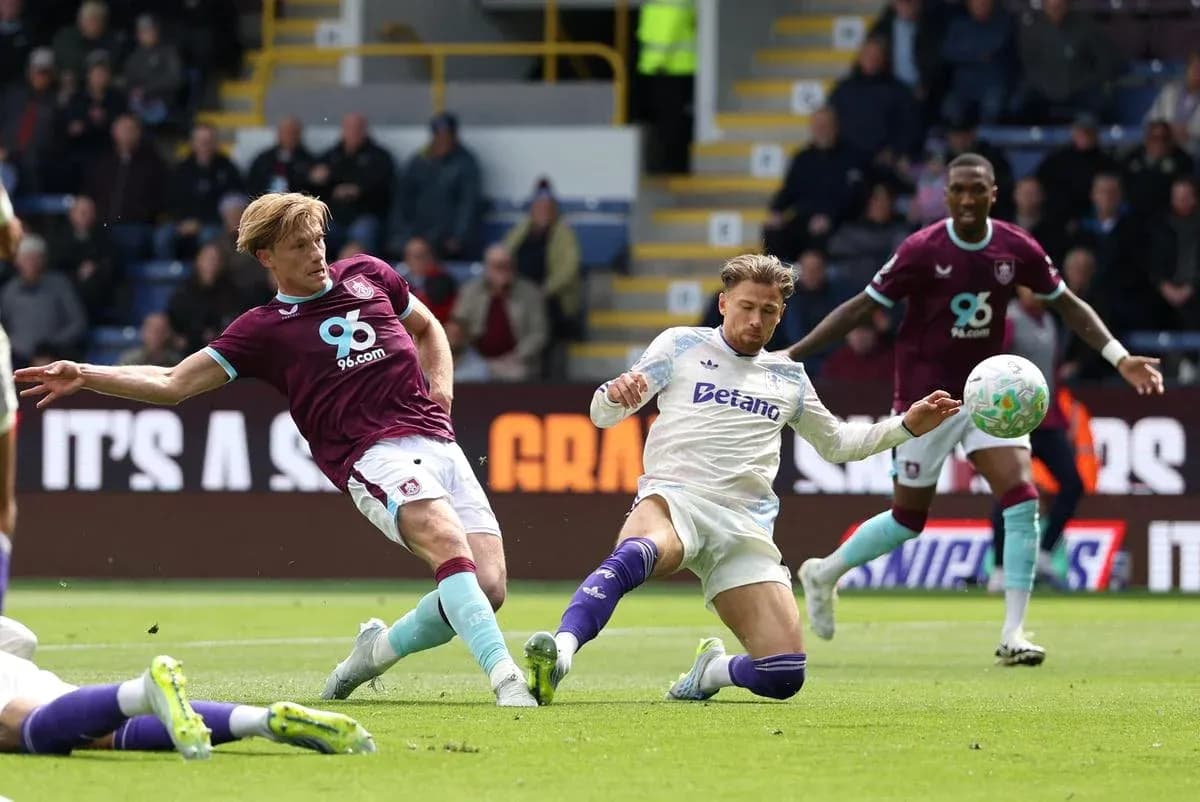
Burnley and Aston Villa shared a 2-2 draw at Turf Moor in Round 36 of the Premier League, a match that tactically split into two distinct halves. Burnley, under Mike Jackson, leaned into a compact 4-2-3-1 and direct transitions, while Unai Emery’s Aston Villa controlled territory and possession but had to fight back from an early deficit. The scoreline matched the underlying balance: Burnley’s more vertical threat and Villa’s sustained control produced a game where both sides alternated momentum, with neither quite able to turn their structural strengths into a decisive edge.
Executive Summary
Burnley struck first through Jaidon Anthony and then, after falling 1-2 behind, rescued a point via Zian Flemming. Villa’s territorial dominance (66% possession, 510 passes) was offset by Burnley’s incisiveness and set defensive block. Both goalkeepers conceded twice with almost identical xG profiles against them, and a disallowed potential goal for Ollie Watkins via VAR proved a key inflection point in the first half. Ultimately, the draw reflected Burnley’s resilience and Villa’s capacity to manipulate the ball but not fully break a disciplined mid-to-low block.
Scoring Sequence & Disciplinary Log
The match opened with Burnley executing their game plan perfectly. On 8', Jaidon Anthony (Burnley) scored a Normal Goal, capitalizing on early direct pressure and quick support from the three behind the striker. Villa thought they had a route back on 40' when a potential goal by Ollie Watkins was disallowed by VAR at 40', halting what would have been an early equalizer and underlining Burnley’s narrow escape.
Villa adjusted quickly. On 42', Ross Barkley (Aston Villa) converted a Normal Goal, assisted by John McGinn, exploiting the half-spaces between Burnley’s double pivot and back four. That made it 1-1 at the 45' mark, the halftime score reflecting Villa’s growing control of possession and Burnley’s fading early press.
After the break, discipline and duels intensified. At 49', Tyrone Mings (Aston Villa) received a yellow card — Foul — a direct product of Burnley’s attempts to counter quickly into the channels and Mings stepping in late to halt a transition.
Villa then turned their dominance into a lead. On 56', Ollie Watkins (Aston Villa) scored a Normal Goal, assisted by Emiliano Martínez, a classic Emery pattern: progression from the back, drawing Burnley forward, then exploiting space behind. Burnley responded almost immediately. On 58', Zian Flemming (Burnley) equalized with a Normal Goal, assisted by Hannibal Mejbri, arriving from the No. 10 zone to punish a brief disorganization in Villa’s midfield screen.
Burnley’s only card came at a key emotional moment. At 60', Zian Flemming (Burnley) was booked — Persistent fouling — as he repeatedly engaged in aggressive pressing and duels between the lines.
Card log (all cards):
- 49' Tyrone Mings (Aston Villa) — Foul
- 60' Zian Flemming (Burnley) — Persistent fouling
Totals: Burnley: 1, Aston Villa: 1, Total: 2
From 69' onwards, substitutions reshaped the tactical landscape but did not alter the scoreline.
Tactical Breakdown & Personnel
Burnley’s 4-2-3-1 was built on a clear defensive identity: a compact mid-block with Florentino Luís and Lesley Ugochukwu screening the back four. The full-backs, Kyle Walker and Lucas Pires, were relatively conservative, allowing Loum Tchaouna and Jaidon Anthony to stay high and be immediate outlets. With only 34% possession and 255 passes, Burnley accepted long stretches without the ball, focusing on verticality once possession was regained. Their 15 total shots (6 on goal) from just 1.77 xG show a side that created reasonable quality chances from fewer phases of controlled possession.
Zian Flemming was central to this approach. As the lone forward on paper, he often dropped between the lines to link with Hannibal Mejbri, creating temporary 4-4-2 or 4-4-1-1 shapes in possession. His goal at 58' epitomized Burnley’s best attacking sequences: quick progression into the No. 10 space, one-touch combinations, and a direct finish before Villa’s block could reset. His yellow for Persistent fouling reflected his dual role: first defender in the press and key attacking reference.
Defensively, Burnley’s back four of Maxime Estève and Axel Tuanzebe centrally, with Walker and Pires wide, were tested by Villa’s rotations. Despite conceding 18 shots and allowing 1.42 xG, they forced a significant share of Villa’s attempts from outside the box (9 shots), a sign that their box defending and central compactness largely held. Burnley’s 17 fouls versus Villa’s 8 underline how much of their defending was based on disrupting rhythm rather than dueling on equal terms in open spaces.
Villa’s 4-2-3-1 under Unai Emery was possession-dominant and methodical. Victor Lindelöf and Youri Tielemans formed the double pivot, both stepping into higher positions to overload Burnley’s midfield line. Full-backs Matty Cash and Ian Maatsen provided width, while McGinn and Barkley attacked the half-spaces, with Morgan Rogers tucking in to connect with Ollie Watkins. With 510 total passes, 439 accurate (86%), Villa’s Overall Form in possession was strong: patient circulation, frequent switches, and consistent occupation of the final third.
Yet, their Defensive Index was less dominant than the possession suggests. Burnley still managed 6 shots on target from limited ball share, and Villa allowed 1.77 xG — slightly more than they created. Tyrone Mings’ yellow for Foul was emblematic of moments when Villa’s high line and aggressive rest-defense were exposed by Burnley’s direct balls into Flemming and the wide midfielders.
Goalkeeper reality was symmetrical in outcome. Max Weiss (Burnley) made 5 saves, Emiliano Martínez (Aston Villa) made 4. Both conceded 2 goals with similar xG against (Burnley allowed 1.42 xG, Villa 1.77 xG). The negative goals prevented figure for both (-0.16 each) indicates each keeper conceded marginally more than the xG of the shots they faced, suggesting that neither produced a standout overperformance, and that finishing quality slightly exceeded average on both sides.
Substitutions were largely about energy and control rather than systemic overhauls. For Burnley:
- 69' Lyle Foster (IN) came on for Hannibal Mejbri (OUT)
- 79' Josh Laurent (IN) came on for Lesley Ugochukwu (OUT)
- 79' Zeki Amdouni (IN) came on for Zian Flemming (OUT)
- 87' James Ward-Prowse (IN) came on for Florentino Luís (OUT)
- 87' Jacob Bruun Larsen (IN) came on for Jaidon Anthony (OUT)
These changes freshened the press and added set-piece quality (Ward-Prowse) while shifting Flemming’s workload to Amdouni and Foster, but Burnley’s structural 4-2-3-1 remained intact.
For Villa:
- 74' Lucas Digne (IN) came on for Ian Maatsen (OUT)
- 74' Emiliano Buendía (IN) came on for Victor Lindelöf (OUT)
- 80' Douglas Luiz (IN) came on for Ross Barkley (OUT)
- 80' Lamare Bogarde (IN) came on for Matty Cash (OUT)
- 85' Leon Bailey (IN) came on for John McGinn (OUT)
Emery progressively shifted from a double pivot to a more attacking midfield mix, with Buendía and Douglas Luiz offering more creativity and Digne/Bailey providing width and crossing threat. Structurally, Villa tilted toward a 4-1-4-1/4-3-3 in the closing stages, but Burnley’s deep block absorbed the pressure.
The Statistical Verdict
Statistically, Villa’s control is undeniable: 66% possession, 510 passes, 439 accurate (86%), and 18 total shots. Burnley, with 34% possession and 255 passes, 186 accurate (73%), leaned into efficiency and directness. The xG split — Burnley 1.77 vs Villa 1.42 — subtly favors Burnley, suggesting their chances were marginally better in quality even if fewer in volume.
Defensively, Burnley’s 17 fouls and single yellow for Persistent fouling (Flemming) reflect a disruptive, contact-heavy approach, while Villa’s 8 fouls and one yellow for Foul (Mings) point to a more controlled, position-based defense that was nonetheless vulnerable when broken. Both keepers’ identical goals prevented (-0.16) and similar save counts reinforce the sense of a tactically balanced contest where each side imposed its own identity without fully subduing the other. A 2-2 draw, in this context, is less about missed dominance and more about two contrasting game models cancelling each other out over 90 minutes.