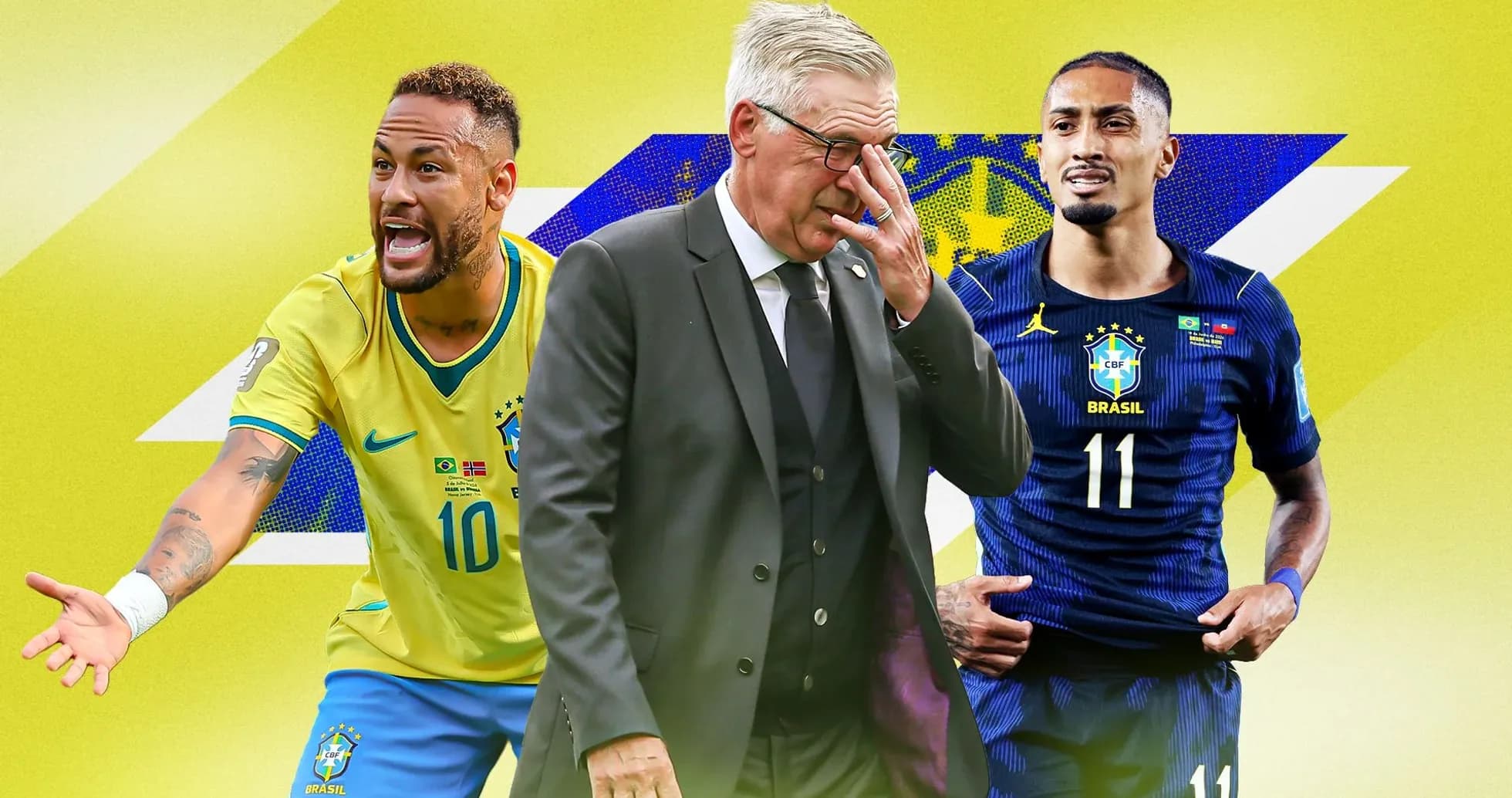
Brazil's World Cup Collapse: A Team Sheet to Remember
Brazil’s World Cup collapse did not begin with a missed penalty or a defensive lapse. It began with a team sheet.
Carlo Ancelotti, the man hired to restore order to the five-time champions, doubled down on experience and paid for it with a campaign that felt tired long before the final whistle against Norway.
An old team in a young tournament
Everywhere you looked, Brazil looked weighed down by years, not lifted by them. The three goalkeepers: 33, 32 and 38. The defenders: an average age of 31, with Danilo and Alex Sandro – once elite full-backs at Juventus – now resembling echoes of a different era.
In midfield, the spine creaked. Casemiro, 34, again asked to anchor a tournament as if time had stood still. Fabinho, 32, heavily involved as well. Reliable servants, yes. But in a World Cup defined by speed, intensity and vertical football, Brazil walked while others sprinted.
There were glimmers of tomorrow. Bournemouth’s 19-year-old Rayan and Botafogo’s Danilo, 25, hinted at a new generation trying to force the door open. Ancelotti admitted after the exit that Brazil cannot keep pretending the future will sort itself out.
“We need some young talent, we need some high-level players coming into Brazilian football,” he said. The message was clear: this cycle is at its limit.
Neymar: the last roll of the dice
No decision framed the tension between past and future more than Neymar’s recall.
At 34, with his last cap back in October 2023 and a body that has betrayed him too often, his inclusion was driven as much by emotion and external pressure as by logic. He remains Brazil’s record goalscorer, still a symbol, still a commercial and cultural giant. Ancelotti took the gamble anyway.
The script unraveled almost immediately. On the eve of the World Cup, Neymar picked up a calf injury and was ruled out for “two to three weeks”. He missed the first two group games, then scraped together just 14 minutes against Scotland in Miami – a cameo that felt like a testimonial, not a triumphant return. The touches were rusty, the tempo beyond him.
Ancelotti’s trust evaporated. Neymar stayed on the bench for the dramatic last-32 win over Japan. When Brazil chased the game against Norway in the round of 16, he finally entered with more time to work, but the impact never came. A late consolation penalty padded his numbers, not his influence. For all the noise around his recall, this was almost certainly his international farewell – and it drifted away quietly.
The Joao Pedro question that won’t go away
Neymar’s injury turned one selection call from curious to indefensible.
Chelsea’s Joao Pedro, 24, was the obvious modern No.9 option: mobile, versatile, and fresh off a debut season at Stamford Bridge with 29 combined goals and assists. He looked nailed on not just to make the squad, but to challenge for the starting role.
Instead, he watched the World Cup from home.
Ancelotti even admitted at the squad announcement that Joao Pedro “probably deserved to be on this list.” That made his omission feel less like a marginal call and more like a calculated risk that backfired.
As Brazil crashed out, the backlash was immediate. Ronaldo Nazario, a man who knows something about leading the line for his country, didn’t hold back.
“I have to be honest, I think this elimination begins with the decisions from the bench,” he said. “I still don’t understand why Joao Pedro was not part of this squad. He has had an exceptional season, he is in form, and Brazil needed a striker who could offer something different.”
That word – different – is the one that will sting. Brazil looked predictable, short of variety, and burdened by names rather than lifted by them.
Midfield left exposed
The cost of that loyalty to veterans showed most starkly in midfield.
Ancelotti went into the tournament with just five central midfielders, one of them Lucas Paqueta, who is naturally a No.10. Only when right-back Wesley dropped out injured did Manchester United-bound Ederson come in as an extra option.
Bruno Guimaraes was asked to do almost everything. Create, dictate, press, cover. He responded with four assists and a performance level that never really dipped, but he could not carry an entire department alone. Ederson and Danilo barely saw the pitch, a clear sign the coach did not truly trust his depth.
After the loss to Norway, Ancelotti did not hide where he felt the structural fault line lay.
“We have to think about the future, but it is very evident that in the midfield, I think that we have to move some players,” he said. For Brazil, that is more than a tactical tweak. It’s a generational shift.
Data, pressure and a decisive penalty
The defining moment of the campaign may not have been a goal conceded, but one not scored.
In the first half against Norway, Brazil won a penalty. With the game still in the balance, many expected Vinicius – their standout attacker at the tournament and leading scorer – to take responsibility.
He didn’t. Bruno Guimaraes stepped up instead, and his effort was saved. Brazil later fell behind and never found a way back.
The decision was not emotional, Ancelotti explained. It was mathematical.
“We did statistics for the players and according to that, Raphinha was the best option [as penalty-taker],” he said. “The best person would be Raphinha and then Neymar [who weren’t on the pitch], and after that, Bruno Guimaraes. After Bruno, it would be [Gabriel] Martinelli, so we chose Bruno Guimaraes as we felt he would be the best.”
The logic was clear. The outcome was brutal. In a World Cup, numbers meet nerves, and Brazil paid the price for backing the data over the man in form.
Injuries and the thinness of the squad
Ancelotti is far from blameless, but he did not inherit a perfect hand.
Key absences stripped Brazil of depth and dynamism before a ball was kicked. Eder Militao, Rodrygo and Estevao Willian were all ruled out in advance, robbing the Selecao of their starting right-back and two wide players who could have changed games from the bench or the XI.
The bad luck continued once the tournament began. Neymar’s calf issue was almost predictable, yet still damaging. Raphinha then pulled his hamstring in the first half of the second group match against Haiti and did not play again. Paqueta followed, forced off at half-time in the knockout tie with Japan.
One by one, the players capable of injecting tempo and unpredictability disappeared. The squad, already skewed towards experience, suddenly looked painfully short of high-level alternatives.
Ancelotti’s new reality
For Ancelotti, this World Cup will sit uncomfortably on a glittering CV built on club triumphs. International football is a different landscape: fewer games, less control over recruitment, and no transfer window to fix what’s broken.
He tried to frame the failure as a beginning, not an end.
“A defeat is the beginning of a new adventure,” he said. “We have to keep improving, to find new ideas. It is not an end, it is the start of a new cycle.
“We will manage this defeat by bringing a fresh impetus to our work and the assessment of the players. We will try to improve and look for new ideas. The same as we did this year.
“I think the work we've done has been good. Football is like this; sometimes you have to manage the sadness of a defeat. I am used to this.”
The words are calm, almost serene. The reality around him is anything but.
Brazil now stand at a crossroads. Keep clinging to the comfort of familiar names, or finally trust the players who represent where the game – and the country – is heading. The next squad list will tell the world which path Ancelotti has chosen.