
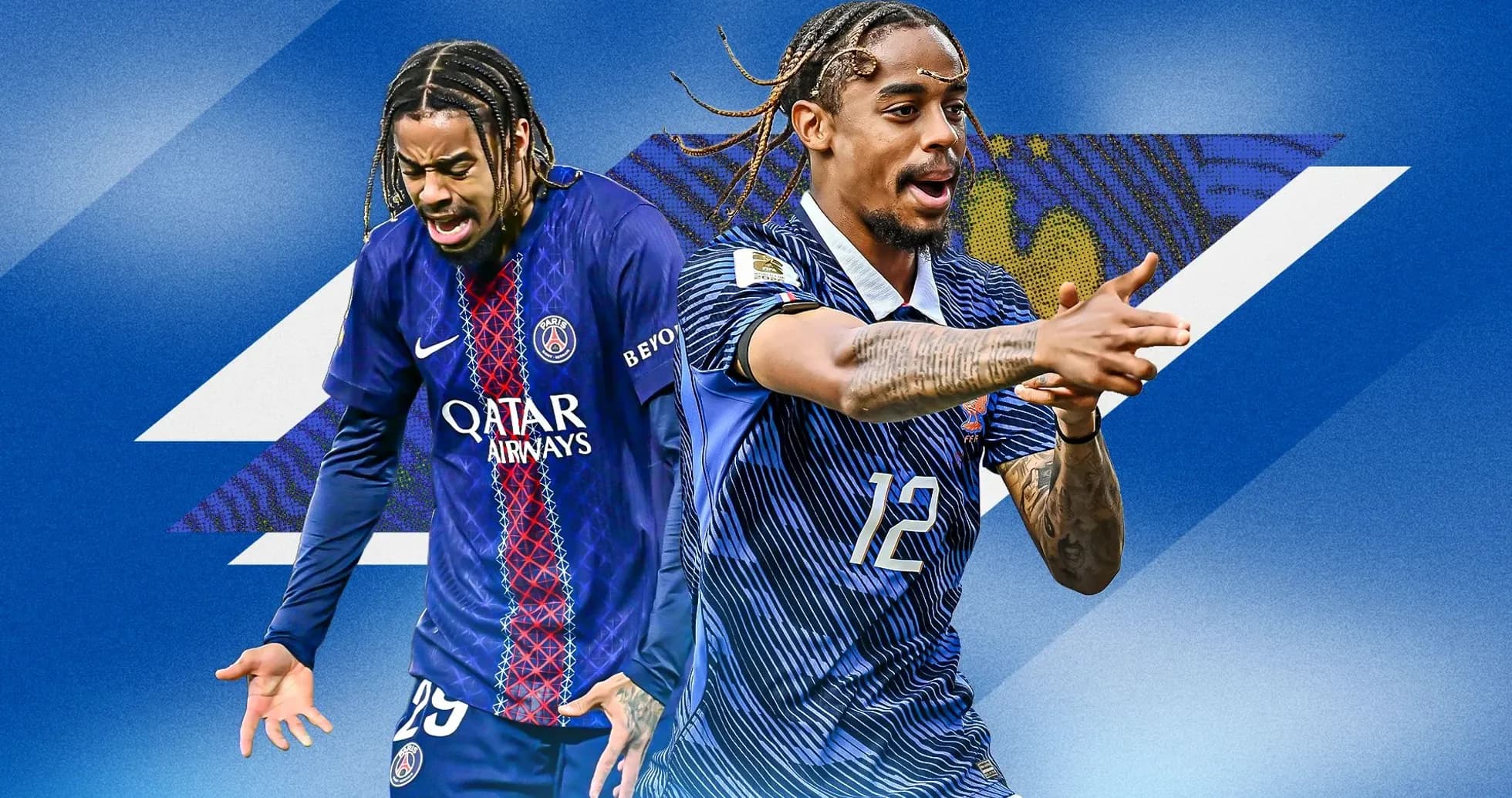
Bradley Barcola's PSG Journey: From Rising Hope to Transfer Speculation
Three years on from his leap from Lyon to Paris, Bradley Barcola should have been walking out at the Parc des Princes as an undisputed star. Instead, he is living the strange half-life of a nearly man: too good to ignore, never quite trusted when it matters most.
From rising hope to rotation piece
Barcola’s first full campaign in Paris was encouraging enough. Fourteen goal contributions, flashes of the winger who had lit up Ligue 1 at Lyon, and the sense that once Kylian Mbappé moved on, the left flank would be his.
PSG had other ideas.
After Mbappé’s departure, the club doubled down on that side of the pitch. Desire Doue arrived in the summer of 2024, another precocious left-sided talent. Then came the real jolt: Khvicha Kvaratskhelia in January 2025, a blockbuster signing who instantly changed the hierarchy.
Barcola responded in the only way a forward truly can – with numbers. His 2024-25 season was spectacular on paper: 21 goals and 21 assists. Yet the trust never quite matched the output. He sat out key fixtures, watched from the bench as others were chosen for the biggest nights, including the Champions League final against Inter. When he did start, he rarely saw out the full 90 minutes.
The pattern hardened a year later. In 2025-26 his production slumped to 13 goals and seven assists, and Luis Enrique’s selection habits told their own story. The coach routinely preserved his main men for Europe, but when Champions League knockout ties rolled around, Barcola was nowhere near the centre of the plan. No starts in the quarter-finals, semi-finals or final of another victorious campaign. Unused in marquee Ligue 1 clashes with Lyon and Monaco. A luxury option, not a pillar.
A World Cup in flashes
The national team offered no escape route. If PSG had blocked his path to becoming a club talisman, France have done the same on the international stage.
At this World Cup, the 23-year-old has lived on the margins again. Didier Deschamps left him out of the starting XI for the opener against Senegal, only for Barcola to stride off the bench and decide the game within two minutes, scoring the winner in a razor-sharp cameo.
That should have been a springboard. Deschamps rewarded him with a start against Iraq on matchday two, but the winger failed to grab the game by the throat. Back to the bench he went for the final group match against Norway.
Once more, he made his point from the shadows. Introduced with 25 minutes left, he bent in a perfect cross for Doue’s late header, adding gloss to the scoreline and sharpening the debate around his role.
Deschamps handed him another chance from the outset in the last-32 meeting with Sweden. This time, Barcola delivered. Fed by a sparkling Michael Olise display, he lashed home a fine second-half finish and looked, briefly, like the man France could build around on that flank.
He finally kept his place for the round-of-16 tie against Paraguay. Then came another dip. In a fractious 1-0 win, Barcola drifted to the fringes of the contest, barely leaving a mark. As France prepare for a quarter-final against Morocco, his place is once again under threat. Impact substitute or starter? The question still hangs over him.
Contract doubts and a shifting PSG stance
All of this is unfolding against a tense backdrop in Paris. Barcola’s contract runs until 2028, but negotiations over an extension have stalled. The winger is unconvinced by his standing in the squad and wary of being nudged further down the pecking order.
Not long ago, PSG’s message was uncompromising. Barcola was “not for sale” and, according to reporting, valued at a figure well above the £116 million Manchester City recently paid Nottingham Forest for Elliot Anderson. The European champions were prepared to dig in.
That tone has changed.
Transfer specialist Fabrizio Romano summed it up bluntly on his YouTube channel: until last week, Barcola was “untouchable”. Now, he said, “the reality is that Barcola is not untouchable. Barcola has serious possibilities to leave Paris in the summer transfer window.”
PSG’s softening position is not happening in a vacuum. It is tied directly to one of the most coveted youngsters in Europe.
Diomande, the market shock, and a door opening
For months, Liverpool looked primed to win the race for RB Leipzig and Ivory Coast sensation Diomande in a deal around €100m. Then the ground shifted. The 19-year-old’s preference, it emerged, is Paris. He sees Luis Enrique’s project as the clearest path to trophies and, potentially, the Ballon d’Or.
Leipzig, though, are driving a hard bargain. Their valuation stands at an eye-watering €130m, a figure that would test even PSG’s financial muscle and force them to think carefully about outgoing business.
Goncalo Ramos has already left for AC Milan. Lee Kang-in is on his way to Atletico Madrid. To push for Diomande at that price, Paris may need at least one more significant sale. If Barcola already fears reduced minutes, the looming arrival of another high-profile attacking talent only reinforces his concerns.
He may not just accept a move. He may demand one.
Liverpool’s opening
If Diomande ends up at the Parc des Princes, Liverpool’s consolation prize could be anything but. A deal for Barcola would make sense for all parties.
At Anfield, the Frenchman would walk into a very different environment. Mohamed Salah has gone, the attack is being rebuilt, and the club need a new headline act. Victor Munoz is already in the door, and new manager Andoni Iraola must carefully manage the development of prodigy Rio Ngumoha, who does not turn 18 until late August.
Barcola, by contrast, is ready-made. He has lived with Champions League pressure for several seasons, delivered serious numbers across a campaign and proven he can affect games off the bench and from the start. His direct running and creativity look tailor-made for Iraola’s high-intensity, front-foot football.
Liverpool also need a statement. A player who can soften the emotional and tactical blow of losing Salah. On this market, there are not many realistic options who combine star power, age profile and elite-level experience. Barcola is one of them, and, crucially, he would arrive with fewer unknowns than the younger, less tested Diomande.
A career at a crossroads
If anyone doubted that a move is now firmly on the table, Barcola himself dispelled that notion at this World Cup. Speaking before the Paraguay game, he cut through the speculation with a simple admission.
“Right now, I’m really focused on the World Cup,” he said. “But regarding what happens afterward, honestly, I don’t know at the moment.”
For PSG, the equation is brutal but clear. Diomande’s potential arrival threatens to squeeze an already crowded attack and push Barcola even further towards the margins. For the player, the picture is just as stark: stay and risk becoming a permanent supporting act, or walk away and try to reclaim the starring role his talent demands.
The clock is ticking on that choice. The next move he makes will define whether Bradley Barcola remains a gifted nearly man in Paris – or finally becomes the leading figure he was supposed to be, somewhere else.




