
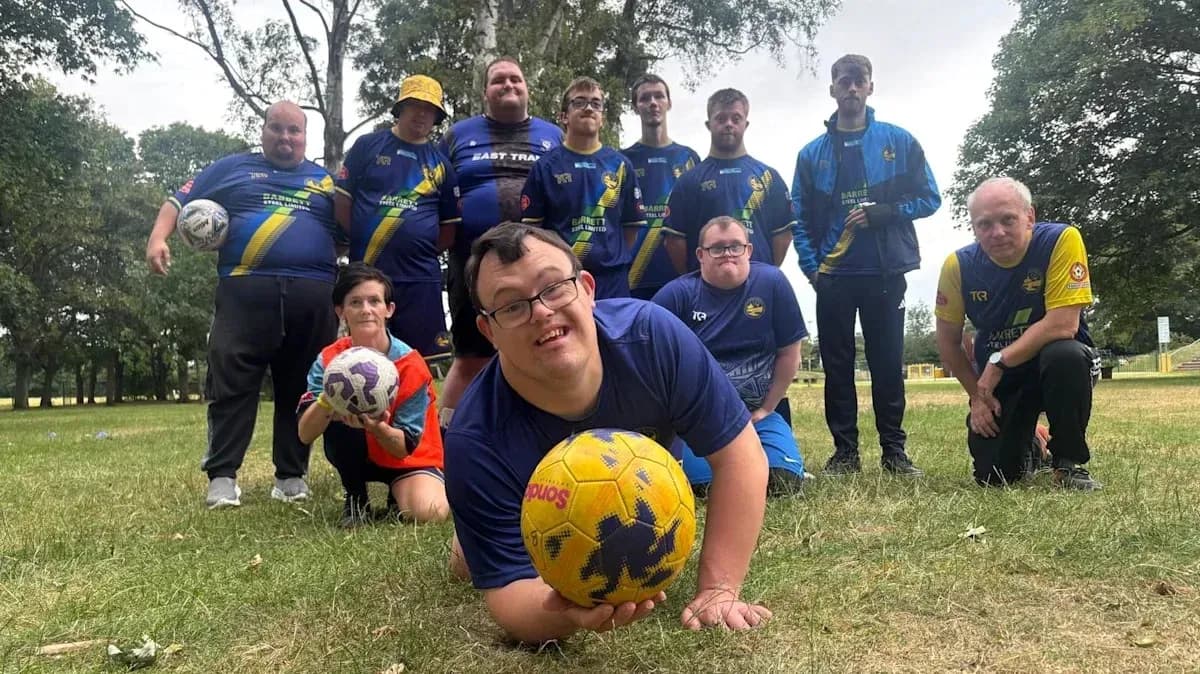
Bottesford Town’s Disability Team Prepares for Special Olympics
In the week England chase a World Cup final in New York, another squad is grinding through its own summer of dreams in a very different Central Park.
Not Manhattan. Scunthorpe.
Under the trees in the heart of the North Lincolnshire town, on a hot July evening, a group of players with disabilities are being driven through sharp passing drills, shooting practice and set-piece routines. The shade offers a little relief. The intensity of the session does not.
This is Bottesford Town’s disability team, a side born a decade ago for young adults with Down’s syndrome and now expanded to include players with a range of intellectual and learning disabilities – autism, ADHD and more. The badge on their chests is familiar. The journey they are on is anything but ordinary.
They are not just training for fitness or friendship anymore. They are tuning up for the Special Olympics GB National Summer Games at Alexander Stadium in Birmingham, a four-day festival of sport from 26 to 30 August. This time, they arrive not as curious newcomers, but as genuine contenders.
From shy steps to national stage
When the squad first came together at Bottesford Town FC, the goals were modest. A safe place to play. A chance to belong. A way to build confidence, on and off the ball.
Back then, the progress came in tiny strides: a player speaking up in the huddle for the first time, a successful pass under pressure, a smile that lingered long after training ended. Now the same players arrive in full club colours, bags slung over shoulders, talking tactics and medal targets.
Jake is one of them. He has Down’s syndrome, takes corners for the team and has been here from the early days. Ask him how he feels about heading to Birmingham and the answer is simple.
“I feel happy,” he says. He explains how he likes to “wrap” the ball into the net from the quadrant, curving it in with purpose. He has been here before, leaving the 2017 Special Olympics with a silver medal. This time, he has set his sights higher: two goals, and gold.
Special Olympics GB exists for players like Jake – and for the estimated 1.5 million people with intellectual or learning disabilities across Great Britain. It runs year-round community sport, but the National Summer Games carry a different weight. Walk into that stadium in Birmingham and you know you are part of something bigger.
A mother’s push, a club’s embrace
Jake’s mum, Sue, has been the quiet engine behind much of this. She has organised fundraising, handled transport, and watched the team grow from a handful of hopefuls into a proper squad.
Her younger son, Aiden, also has disabilities and is learning to coach, helping shape the next phase of the project.
The whole thing started with a simple problem. Jake loved football but could not keep pace in mainstream teams. The tempo, the demands, the social gaps – they all added up.
“He found it too difficult and couldn’t keep up with the team,” Sue explains.
So she went to Bottesford Town FC and asked for a chance. A pitch. A session. A crack at the game on his terms.
“For Jake to be able to play football was just such a big thing for him,” she says. “It’s his passion. He loves football and he wanted to be able to play it.”
The club said yes. From there, the project took shape. What began as a Down’s syndrome team widened to welcome players with autism, ADHD and other learning disabilities. The group did not just sharpen their first touch or defensive shape; they built friendships that stretched far beyond the touchline.
For Sue, that was always the point.
“When your child is born and you find out they have a disability, it’s a complete unknown,” she says. “But my commitment was always that my boys would access as much as possible in their lives.”
Bottesford Town backed that promise. The players train in a sports hall, then step out onto a 4G pitch that gives them a consistent surface all year round. No churned-up mud. No frozen ruts. Just a flat, fast canvas to learn on.
Setbacks, sacrifice and a £10,000 hurdle
The route to Birmingham has not been smooth.
The team were accepted into the Special Olympics in 2021, only to see the Games cancelled as the Covid-19 pandemic ripped through the sporting calendar. For a squad that leans on routine and structure, that loss hurt.
“It set quite a few of them back,” Sue admits. Jake was one of those who struggled, the sudden absence of a clear target leaving a hole in his week.
The Games eventually returned, but with them came a different obstacle: money. To send two teams to Birmingham – covering travel and accommodation – they needed to raise £10,000. For a grassroots disability side, that is a mountain.
They set about climbing it anyway. Raffles, collections, community events. Every pound chipped away at the total. Every donation kept the dream alive.
Training ramps up, ambitions rise
Now, with the Games in sight, the football side of the operation has taken over again.
Manager Michael Potts talks about training “ramping up”. Sessions are sharper, more focused. The players know what is coming and what it demands. The 4G pitch has been a quiet ally, allowing them to refine their game with a reliable bounce and a true roll of the ball.
With the squad now including players with a range of intellectual disabilities, the coaching team has had to adapt. Instructions are clearer. Drills are tailored. Support is individual, not one-size-fits-all. The goal, though, is the same for everyone: give each player the tools to compete.
Mason stands in goal, the last line of that effort. He describes his defence as “rock solid” and says it with the certainty of a keeper who trusts the players in front of him.
Asked what advice he would give England’s men as they chase their own trophy this summer, he does not hesitate. Train hard. And for the goalkeeper? Get the basics right. Focus on “throwing the ball out” properly, starting attacks with precision rather than panic.
Mason saved a penalty at his last competition. That moment still fuels him. Like Jake, he is going for gold.
Taylor, another long-serving member of the squad, has been here a decade and now anchors the defence. He talks about training going well and, with the confidence of a defender who enjoys venturing forward, predicts scoring four goals at the Games.
Eyes on Birmingham, hearts in Scunthorpe
As the sun dips behind the trees in Central Park and the session winds down, the picture is clear: this is no token exercise. The cones, the shouts, the repetition – it all carries the edge of a team preparing for something real.
Shirts cling with sweat. Instructions fly. Laughter cuts through the graft, but the focus never really drops.
Walk away through the park and the sounds of the session fade, yet the impression lingers. A group of players once unsure of their place in the game now stride around like they have always belonged. A club that opened its doors has watched its badge travel to the national stage. Families who once feared the “complete unknown” now pack bags for Birmingham.
When the whistle blows at Alexander Stadium next month, medals will be won and lost. But for this Bottesford Town squad, the bigger question hangs beyond the final scoreline.
If they have come this far in ten years, how many more of their dreams will they have ticked off by the time Central Park in Scunthorpe hosts their next send-off?




