Athletic Club vs Valencia: Tactical Battle at San Mamés
San Mamés under a grey May sky has seen its share of bruising La Liga nights, but this 0–1 defeat for Athletic Club against Valencia felt like a tactical arm-wrestle that slipped away from Ernesto Valverde’s side by inches rather than by design. In a season where both clubs have lived in the crowded middle of the table, this fixture — part of the Regular Season - 35 slate — was less about grand narratives of Europe or relegation and more about identity, control, and who could bend the game to their preferred rhythm.
Heading into this game, the standings framed the contest as a duel of flawed equals. Athletic sat 9th with 44 points and a goal difference of -11, built on 40 goals scored and 51 conceded over 35 matches. At San Mamés they had been solid if unspectacular: 9 wins, 2 draws and 7 defeats, with 21 goals for and 20 against. Valencia arrived in Bilbao 12th on 42 points, their own goal difference at -12 (38 for, 50 against). On their travels they had been fragile: 4 away wins, 4 draws and 10 losses, scoring 15 and conceding 29.
Tactical Setup
Both coaches mirrored each other on the tactical board, deploying 4-2-3-1 systems that told very different stories. Valverde’s version was familiar: Unai Simón behind a back four of A. Gorosabel, Yeray Álvarez, Aymeric Laporte and Yuri Berchiche, a double pivot of M. Jauregizar and A. Rego, and an attacking band of R. Navarro, Oihan Sancet and Nico Williams supporting centre-forward Gorka Guruzeta. It was a structure built to dominate territory, press high and use the wings as launchpads.
Carlos Corberán, by contrast, used the same formation as a shield. S. Dimitrievski anchored Valencia’s resistance, with Renzo Saravia, C. Tárrega, Eray Cömert and José Gayà forming a compact, disciplined back line. Ahead of them, Pepelu and G. Rodríguez sat as a screening pair, allowing D. López, Javi Guerra and Luis Rioja to shuttle between pressing lines and transitions, with Hugo Duro as the lone outlet up front.
Key Absences
If there was a quiet subplot to the afternoon, it lay in who was missing. Athletic’s midfield options were thinned by the absences of U. Egiluz (injury), B. Prados Díaz (knee injury) and Iñigo Ruiz de Galarreta (personal reasons), while M. Sannadi was omitted by coach’s decision. The loss of Ruiz de Galarreta, one of La Liga’s more combative and industrious midfielders this season, mattered: across 31 appearances he had contributed 1 goal, 2 assists, 58 tackles and 4 blocked shots, with 10 yellow cards underlining his role as the side’s competitive edge in the engine room. Without him, Valverde had to trust Jauregizar and Rego to control tempo and second balls.
Valencia were even more patched up at the back. L. Beltrán (knee), J. Copete (ankle), M. Diakhaby (muscle injury), D. Foulquier (knee) and T. Rendall (muscle injury) all missed out, leaving Corberán to lean heavily on Cömert and Tárrega in central defence and on Gayà’s leadership down the left. Gayà’s season profile — 67 tackles, 7 blocked shots, 6 yellow cards and 1 red — hinted at both his defensive value and his disciplinary edge. This match demanded that he walk that line without overstepping.
Discipline and Card Profile
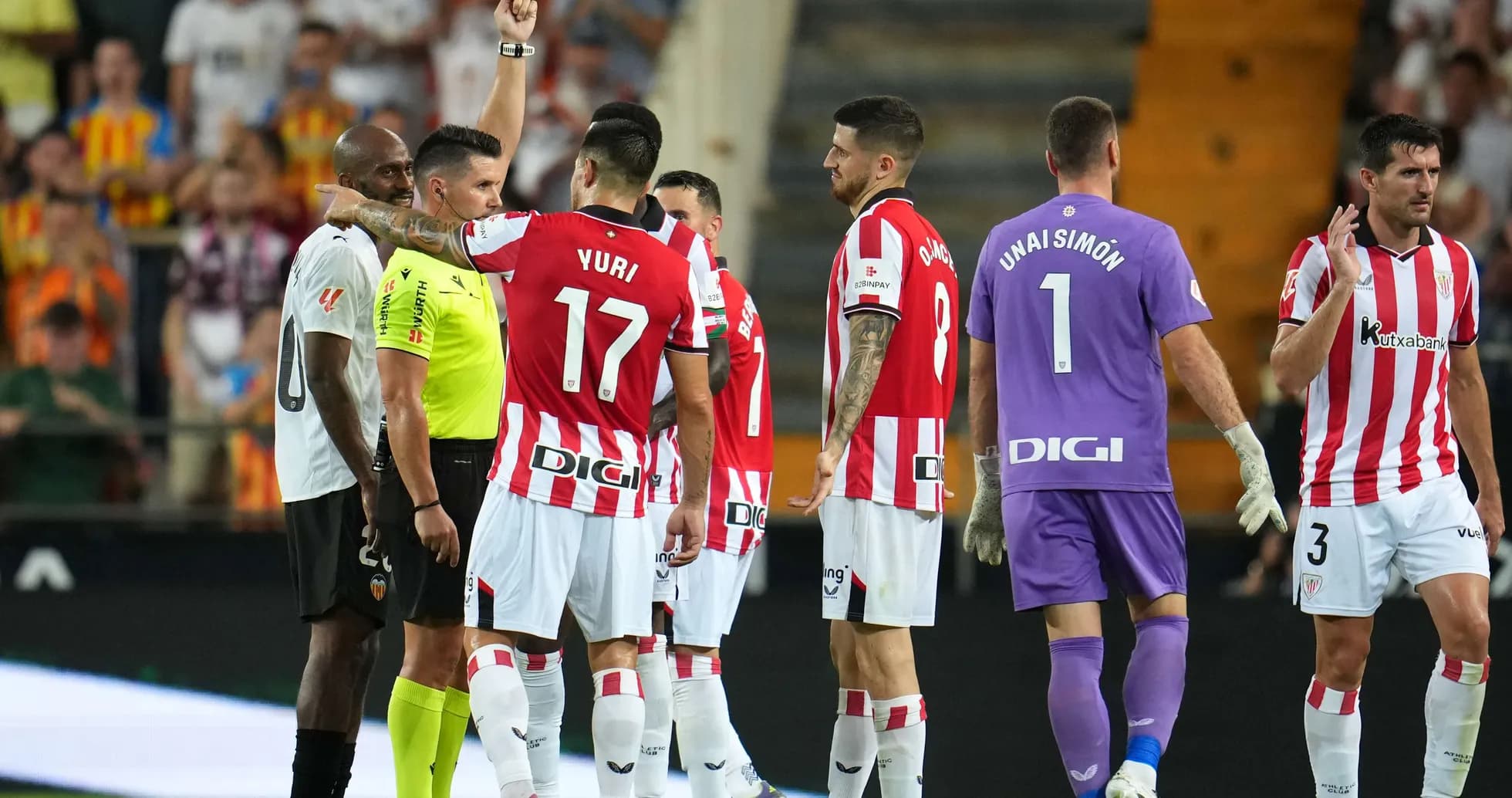
Discipline, in fact, was always likely to shape the rhythm. Over the season, heading into this game Athletic’s yellow-card profile skewed heavily towards the middle and late phases: 18.42% of their bookings between 46–60 minutes and 22.37% between 61–75, before a late-game surge of 14.47% from 76–90 and a further 17.11% in added time. Valencia’s yellows peaked even later, with 23.19% of their cautions arriving between 76–90 minutes and 15.94% in stoppage time. It set the stage for a second half of rising temperature and fragmented flow — the kind of environment where a single mistake or lapse in concentration can decide a match.
Match Dynamics
The “Hunter vs Shield” duel was more abstract than individual. Athletic’s attack at home had averaged 1.2 goals per game, while Valencia’s away defence had been conceding 1.6 on their travels. On paper, San Mamés should have tilted towards the hosts. Yet Valencia’s clean-sheet record away — 5 shutouts from 18 — suggested that when their defensive block held, it could be stubborn. Dimitrievski, protected by a double pivot and a narrow back four, was the final piece of that shield.
In the “Engine Room”, the balance of power was subtle. Without Ruiz de Galarreta, Athletic’s central axis of Jauregizar and Rego lacked some of the veteran’s bite and vertical passing. Across the season, Athletic’s overall goals-for average of 1.1 and goals-against average of 1.5 painted a team that often needed to outfight opponents in midfield to avoid exposing a defence that has already conceded 51 times. Valencia’s own averages — 1.1 goals scored and 1.4 conceded overall — pointed to a more conservative, risk-managed approach, especially away from home where they averaged just 0.8 goals for.
Decisive Phases
The late phases of matches were always likely to be decisive. Athletic’s card spikes between 61–75 and into added time hinted at fatigue and overcommitment in pursuit of goals, while Valencia’s late-booking pattern suggested a willingness to foul and disrupt transitions as the clock wound down. In a game that finished 0–1, that story feels consistent: Athletic pushing, Valencia fouling, breaking rhythm, and then striking at the one moment when the hosts’ structure loosened.
From a statistical prognosis perspective, the result aligns more with Valencia’s best version than with their average away self. To come to San Mamés and keep a clean sheet against a side that had only failed to score at home 5 times all season heading into this fixture is a statement of defensive control. Athletic, who had scored 21 and conceded 20 at home across 18 matches, were held below their usual attacking output and punished in a contest of margins.
Tactical Clarity
Following this result, the table’s midsection tightens further, but the deeper story is about tactical clarity. Valencia’s 4-2-3-1, often a secondary choice behind 4-4-2 this season, looked like a made-to-measure away structure: compact, disciplined, and built to maximise the work of Pepelu and G. Rodríguez in front of the centre-backs, while allowing Javi Guerra and Luis Rioja to carry the ball out of pressure. Rioja’s season as a creative reference — 6 assists, 35 key passes, 60 dribble attempts with 34 successful — again underpinned Valencia’s ability to turn rare possession into meaningful territory.
Athletic, meanwhile, were reminded of the fine line their season walks. A team whose overall goal difference of -11 is the product of respectable attacking numbers and a leaky defence cannot afford to waste home dominance or lose their midfield anchor. Without Ruiz de Galarreta’s balance and with San Mamés unable to lift them over a disciplined block, they found themselves on the wrong side of a one-goal game that, on another day, might have mirrored their season-long xG profile more kindly.
In the end, this was a match where structure beat emotion. San Mamés roared, Athletic pushed, but Valencia’s shield held — and in a league defined by details, that was enough.