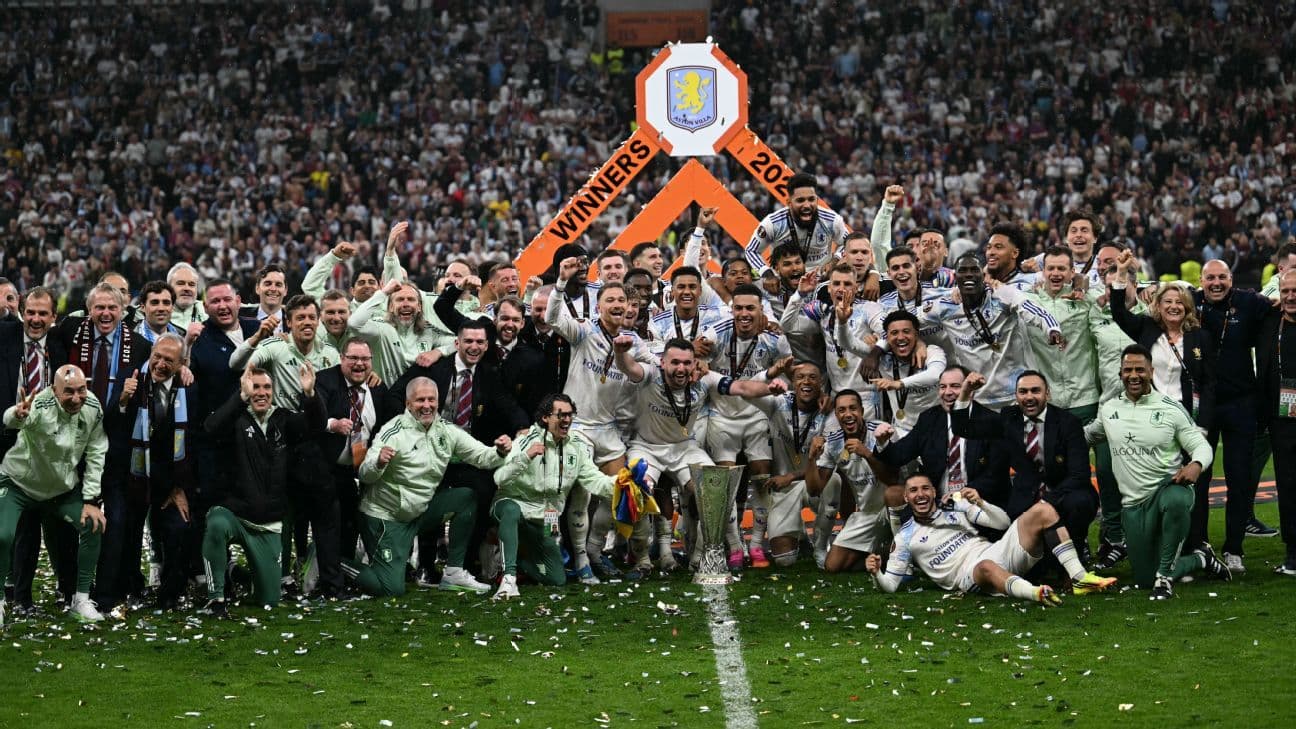
Aston Villa Triumphs in Europa League Under Emery
Forty-four years after Peter Withe and company stunned Bayern Munich, Aston Villa have climbed a European podium again. Different era, different city, same sense of disbelief. In Istanbul, under Unai Emery, they didn’t just win the Europa League. They owned it.
A 3-0 dismantling of Freiburg, lit up by Youri Tielemans and Emi Buendía before Morgan Rogers added the gloss, delivered Villa’s first major trophy since the 1996 League Cup. For a club that dropped out of the Premier League in 2016, this was more than a cup win. This was a line in the sand. A new high-water mark in modern Villa history.
From Wembley grit to Istanbul glory
John McGinn has lived almost every step of the journey. From the grind of the Championship to a European final, the Scot has been the heartbeat of Villa’s revival. At Wembley in 2019 he helped drag them past Derby County to reclaim their Premier League place. In Istanbul, he walked up those steps as captain and raised a European trophy into the night.
That image – McGinn, arms aloft, claret and blue confetti in the air – belongs alongside the great Villa photographs. This is a squad that has done the hard miles: midweek away days at Preston, now replaced by showpiece finals on the Bosphorus.
Some faces have been there almost the whole way. Tyrone Mings. Tammy Abraham in that promotion season. Others arrived in the immediate aftermath: Ezri Konsa, Emi Martínez, Ollie Watkins, Matty Cash. Together, they became the core of a side that kept threatening something big without quite grasping it.
They went deep in Europe and fell short. A Conference League semifinal in 2024. A Champions League quarterfinal exit to eventual winners Paris Saint-Germain last season. Near misses that stung, but also hardened them.
In Istanbul, that experience showed. Villa kept Freiburg at arm’s length, refused to be dragged into chaos, and struck with ruthless clarity when the moments came. Three chances that mattered, three goals, no panic.
The 30-year wait for a trophy ended not with a nervy scrap but with a statement. On a night when Freiburg ran 2.5km more than Villa, it was Emery’s side who controlled everything that mattered. The names of Tielemans, Buendía, Rogers and McGinn now sit in the same folklore chapters as Paul McGrath and Withe. Different generation, same resonance.
Emery, the Europa League’s inevitable man
Unai Emery does not like the “king” tag. He said so again on the eve of this final. But the numbers keep arguing back.
Five Europa League titles. Four different clubs. Sevilla, Sevilla, Sevilla. Villarreal. Now Aston Villa. As far as major European competitions go, only Carlo Ancelotti – with his five Champions Leagues – can match that haul.
Thomas Tuchel once joked that UEFA might as well rename the trophy after him. Nights like this keep that line alive. On the banks of the Bosphorus, Emery lifted the 47kg trophy again, this time in front of around 11,000 Villa fans, a pocket of claret and blue that even included a future king in Prince William.
Four years ago, Villa were 17th in the Premier League. This season they didn’t win any of their first four matches and had to wait until late September for their first goal. From that mess, Emery has built a Champions League side and now European trophy winners. Not a specialist. A modern great.
He insisted his past finals meant nothing here. Yet his fingerprints were everywhere. The plan was clear: don’t get tangled in Freiburg’s press, go long to Watkins, play in their half, trust set pieces and quality in the final third. Once Tielemans detonated his volley, the outcome felt almost inevitable.
Tielemans and Buendía light the fuse
For 40 minutes, this didn’t look like a classic. Fouls broke up any rhythm. Neither side settled. Villa appeared sluggish, almost subdued.
Then the trap Emery and his staff had laid finally snapped shut.
From a Lucas Digne short corner, Austin MacPhee’s set-piece lab work paid off. Freiburg switched off, Digne rolled it short, Morgan Rogers took a touch, lifted his head and hung a teasing ball towards the edge of the box. Tielemans arrived like a hammer.
The Belgian’s volley tore through the air and past Noah Atubolu before the Freiburg goalkeeper could react. A thud, a net ripple, and suddenly the final belonged to Villa.
The goal unlocked something. Freiburg wobbled. Villa sensed it.
Their second was even more outrageous. Buendía, on his weaker left foot, curled a shot from the edge of the area that bent away from Atubolu’s desperate reach and kissed the side netting. A goal of pure technique, the kind that silences a stadium for a heartbeat before the roar kicks in.
Referee François Letexier barely let the replays roll. He blew for half-time almost immediately, as if acknowledging that nothing could top what Buendía had just done.
This has been Villa’s trick all season. Their underlying numbers suggested they shouldn’t score as many as they do. They ignored them. Time and again, they produced the spectacular when the moment demanded it. In Istanbul, two such strikes effectively settled a European final before the interval.
Rogers completes the procession
Rogers’ goal after the break didn’t have the same poster quality, but it carried its own significance. At 23 years and 298 days, he became the youngest Englishman to score in a major UEFA final since Steven Gerrard in 2001.
By then, the pattern was fixed. Freiburg pushed, covered more ground, tried to claw their way back. Villa stayed compact, picked their moments, and when the chance came, Rogers pounced to make it 3-0. Another Europa League final with a two-goal half-time lead, another 3-0 full-time scoreline – just like Atlético Madrid in 2012 and Atalanta in 2024.
On the touchline, Emery barely flinched. He has seen this film before.
Records, royalty and a new horizon
The numbers around this night will live long.
McGinn became the first Scotsman to captain a side in a major European final since Barry Ferguson led Rangers in the 2008 UEFA Cup, and the first Scot to do it for an English club since Graeme Souness with Liverpool in the 1984 European Cup.
Villa’s 44-year wait between major European finals is the third-longest ever, behind only Manchester City’s 51-year gap (1970-2021) and West Ham United’s 47 years (1976-2023).
Jadon Sancho added his own slice of history, becoming the first player to appear in the final of three different major European competitions in three consecutive seasons: Champions League in 2023-24, Conference League in 2024-25, Europa League in 2025-26.
And with Tottenham Hotspur lifting this trophy last year, English clubs have now claimed the Europa League/UEFA Cup in back-to-back seasons for the first time since the competition’s first two editions, when Spurs and Liverpool went back-to-back in 1972 and 1973.
For Villa, though, this is about more than trivia. This is about a club that once ruled Europe rediscovering what it feels like to matter on nights like this. About a manager who turns this competition into his personal playground. About a captain who has dragged his team from the Championship to the summit of the Europa League.
The question now is no longer whether Aston Villa belong on this stage. It’s what they do with this power as they walk into the Champions League with a Europa League crown on their heads.