
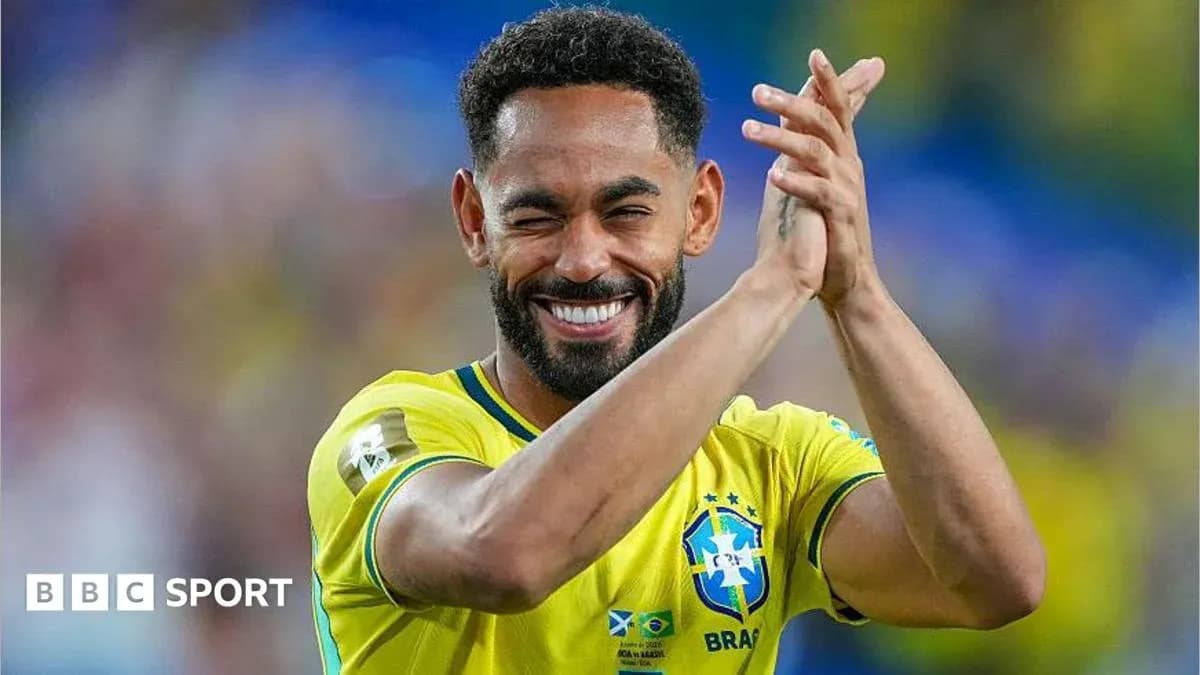
Brazil’s World Cup Evolution: Cunha as the Key Player
Brazil’s World Cup machine is beginning to purr – and, crucially, so is its centre‑forward.
Carlo Ancelotti appears to have settled on his strongest XI. The group stage has felt like a gradual tightening of screws: performances sharper, structure clearer, confidence rising with every game. Brazil look like a team arriving right on cue.
Japan await in the last 32. That will be a far sterner examination. But Brazil head into it with a clear identity and, unexpectedly, a new focal point in attack: Matheus Cunha.
Cunha, the ‘nine-and-a-half’ changing Brazil’s attack
For decades, Brazil’s number nine shirt has carried a very specific image. Ronaldo. Romario. Adriano. A pure finisher, living between the posts, the reference point for everything around him.
Cunha is something else.
He has three goals already at this tournament, so he cannot be labelled a simple facilitator. Yet he is not a classic penalty-box predator either. He operates as what you might call a “nine-and-a-half” – part striker, part playmaker – dropping off the line, linking moves, dragging defenders into places they do not want to go.
His movement constantly poses a question. If the centre-back follows him into midfield, space rips open for Vinicius Jr on one flank and Rayan on the other. If the defender holds his position, Cunha has time to receive between the lines, turn, and either slide passes into runners or go for goal himself.
There is a hint of Roberto Firmino in the way he plays. Always available. Always on the move. Always forcing the man marking him to think twice.
What makes Cunha so valuable to this Brazil side is his willingness to work without the ball. He happily initiates the press, sometimes dropping as deep as a number six in front of the midfield line, blocking passing lanes and triggering the team’s pressure. That defensive graft gives balance to an attack loaded with flair.
This was not the plan a few months ago. Brazil arrived at this World Cup without a nailed-on first-choice number nine, an almost surreal situation for a country so rich in strikers. Even up to the Scotland game, the role felt up for grabs.
Ancelotti tested them all: Cunha, Igor Thiago, Endrick, Joao Pedro, Richarlison. None was clearly ahead of the rest.
Then football’s old twist came into play: injury.
How an injury unlocked Brazil’s front line
Raphinha is a special talent, a player who loves to roam, pop up between the lines, or switch wings mid-game. In the opener against Morocco, he operated as a 10 behind Igor Thiago, and he can just as easily attack from either flank.
When he pulled up with a hamstring problem in that match, the change felt like a setback. It may turn out to be the turning point.
Rayan came on and, unlike Raphinha, stayed wide on the right. That simple positional discipline changed the geometry of Brazil’s attack. With Vinicius Jr stretching teams on the left and Rayan fixed high on the right, Cunha suddenly had exactly what he thrives on: space in the central pockets.
He often finds himself alone between the opposition midfield and defence, free to dictate combinations or spin in behind. The structure suits his hybrid game perfectly.
The picture can still shift. Igor Thiago brings a more traditional presence up front – a target man who can pin centre-halves, occupy them physically, and give Brazil a different route if they are chasing a result or facing a side that wants a fight in the box.
The key is that Ancelotti now has genuine options, each with a distinct profile. Back home, the debate is narrowing. More and more Brazilians are starting to believe Cunha is the answer. Opponents will study him, try to close his spaces, deny his freedom. But his intelligence on the pitch suggests he will keep finding new solutions.
Ancelotti’s Brazil: control without the ball
Much of this evolution flows directly from the man on the touchline. Ancelotti’s reputation often centres on his calm presence and his man-management, the way players speak about him with almost universal affection. It can obscure another truth: he is a sharp tactician.
One of the most striking traits of this Brazil side is its comfort without the ball. This is not a team obsessed with 70% possession or sterile domination. They are prepared to let the opposition have it, then punish them.
Against Scotland, that approach was clear. Brazil allowed Scotland to build, but only into areas Ancelotti’s side had already mapped out. They shepherded passes into traps, pressed at precisely chosen moments and with real intensity. The first goal came from that plan. So did the second, controversially disallowed but born of the same pattern.
Those sequences were not isolated incidents. Brazil scored similar goals in warm-up games against Panama and Egypt. They gave up the ball but kept control of the match. When the cue came, they sprang.
In an era where every team seems desperate to define itself as either a possession juggernaut or a pure counter-attacking unit, Ancelotti is happy to live in the grey area. His Brazil adjust to the opponent and to the moment. With players capable of shifting roles on the fly, he sees no reason to lock them into one rigid identity.
This is a different kind of Brazil.
A new shape, a steadier spine
The change is not just in attitude; it is on the tactics board too. Traditionally, Brazilian full-backs have flown forward, almost as wingers. Roberto Carlos, Cafu, Maicon, Marcelo, Dani Alves – the list is a highlight reel of overlapping chaos.
This time, the picture is more restrained.
With Douglas Santos and either Roger Ibanez or Danilo, the full-backs are more conservative. They choose their moments, rather than living on the front foot. That restraint has a purpose: it allows Vinicius Jr to stay higher, conserve energy, and be fresher when Brazil break. The back four looks more secure, the transitions less frantic.
Midfield has evolved as well. In the opening game against Morocco, Casemiro was left isolated at the base, exposed in acres of space. Criticism followed, but it missed the point. Even in his prime, Casemiro was never the kind of midfielder who could cover the entire pitch alone. At 34, asking him to be everywhere was unrealistic.
Ancelotti adjusted. Brazil shifted from a 4-2-3-1 to a 4-3-3. Now, when Bruno Guimaraes surges forward as planned, Casemiro has Lucas Paqueta close by, forming a double shield when needed. The distances are shorter, the gaps smaller.
The effect has been clear against Haiti and Scotland. Brazil have controlled the central areas far better, protected their defence, and still found ways to release their attacking talent. That structure will be vital against Japan, a far more fluid and dangerous attacking side than either of those group opponents.
The numbers tell their own story: one goal conceded, seven scored. Solid at the back, varied and threatening up front.
But in Brazil, numbers only matter if they lead to wins.
From anxiety to excitement – with Japan on the horizon
Before the first game, tension gripped the country. The uncertainty over the number nine, the tactical questions, the weight of history – it all fed into a sense of unease. After the opener, worry deepened.
Three games on, the mood has flipped. The performances, the goals, the defensive stability, the emergence of Cunha as a modern, shape-shifting spearhead – all of it has turned anxiety into excitement.
The World Cup is taking shape. So is Brazil. The real question now is whether this new version, less romantic in some ways but more adaptable and controlled, can carry that momentum through Japan and beyond.




