2026 World Cup: Messi's Magic and Rising Stars
The 2026 World Cup has finally caught fire. The big names have turned up, the underdogs have refused to play their assigned roles, and every night seems to produce another headline.
Lionel Messi has already written the opening chapter. Kylian Mbappe and Erling Haaland have followed with their own statements. Now Cristiano Ronaldo has walked onto the stage with a ruthless display against Uzbekistan. The expanded 48‑team format, once doubted and dissected, is suddenly delivering drama from all corners of the globe, with Cape Verde, Japan, Egypt and a cluster of lower‑ranked sides adding colour and chaos to the script.
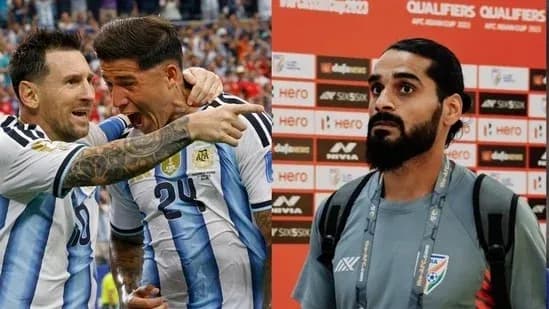
Watching it all with a defender’s eye is India stalwart Sandesh Jhingan, part of the Zee5 expert panel, who spoke to Hindustan Times Digital about a tournament that has quickly outgrown its early questions.
Messi at 39: joy, numbers and a sense of wonder
Messi is 39 and still bending the World Cup to his will. Five goals in two games, hat-tricks, braces, and the same familiar sense that the ball behaves differently when it reaches his left foot.
For Jhingan, the numbers only tell half the story.
“It’s incredible, first of all, to have that longevity and that consistency to keep doing well,” he said, speaking as someone who knows how hard it is just to stay at the top level. The greatest talent, in his eyes, is not a trick or a pass. It’s the ability to perform at a high level again and again, across years, across eras.
He lingers on the privilege of having watched Messi’s entire career unfold. A hundred-year-old fan in the stands became his reference point. Watching Messi, he said, makes you feel like a child again. If it can do that to someone who has seen a century, what does that say about the impact of one player? For Jhingan, Messi is not just effective. He is pure joy.
The wall behind the wizard
Messi’s magic, though, rests on a hard edge. Argentina have yet to concede a goal. They look mean, compact, and fully aware of their jobs.
Jhingan sees a coaching masterclass behind that clean sheet record. The key, he argues, is that Lionel Scaloni and his staff have built the system around the players, not around a rigid philosophy. Argentina can sit deep, they can hold a mid-block, they can squeeze space high up the pitch, but whatever the shape, they look organised and ready.
That structure is Messi’s oxygen. It allows him to stay high, to conserve energy for the final third, to operate in the zones where he decides games. The rest of the side understands the trade-off. Defenders and midfielders win the ball and move it to Messi as quickly as possible because they trust he will make something happen. That belief, Jhingan says, feeds the entire squad’s confidence.
Reliant on Messi? So what if you’re winning?
Lautaro Martinez’s performance against Austria summed up Argentina’s collective ethic. He chased back, linked play, ran channels, did the dirty work. Still, the noise outside the camp insists the champions lean too heavily on Messi and that the strikers are not scoring enough.
Jhingan shrugs off the criticism.
If he were Argentine, he says, he would not care about being called “reliant on Messi” as long as the team kept winning. And this is the crucial point for him: Argentina are not a one-man show. They are built on a robust system, on organisation and defensive discipline, on knowing exactly when to drop off and when to hunt the ball as a pack.
The forwards, he insists, operate inside that structure. Their value is not measured only by goals but by how well they help create the conditions for Messi and the other attackers to finish the job. The scoreboard, and Argentina’s early qualification for the next phase, is all the validation the coaching staff needs.
Mbappe and the weight of history
While Messi chases another World Cup, Mbappe is busy building his own legend. He has already turned two tournaments into his personal stage, and his output in front of goal is staggering for a player still in his late twenties.
“With his goals and his numbers, it’s incredible,” Jhingan said. Mbappe has achieved more by 27 or 28 than most players manage in a lifetime. Yet Jhingan senses that the French forward knows there is still a long road ahead.
The comparison with Messi and Ronaldo is unavoidable. They set the standard, the “pillars,” as Jhingan calls them. To join that bracket, Mbappe must do what they did: sustain greatness for close to two decades. Jhingan believes Mbappe has every tool – pace, finishing, mentality – but the real test will be motivation and fitness over time.
What stands out to him is Mbappe’s ability to elevate his level when the World Cup arrives. Russia 2018, Qatar 2022, and now 2026: every time the lights are brightest, Mbappe finds another gear. That, for Jhingan, is the true marker of a big player.
Lamine Yamal and the nightmare of the one-on-one
A different kind of threat is emerging in Lamine Yamal. He has not started every game or completed every minute, yet he has already stamped his presence on the tournament. A teenager whose first instinct is always to take on his man.
From a defender’s point of view, Jhingan sees trouble.
“If you’re in a one-on-one situation with Lamine, most of the time he’s going to get past you,” he admitted. Yamal is one of those players people pay to watch because of the sheer joy he brings to the game.
But Jhingan warns against thinking in purely individual terms. A defender can win duels all night and still lose the story to a single deflection or a single shot. The aim, he insists, is not to stop every dribble; it is to reduce the number of times Yamal can receive the ball in dangerous areas.
That means a collective response. Midfielders pressing, forwards working, the back line holding high and compact. Yamal will get chances. The job is to make sure they are as few as possible.
Ronaldo, the critics and the coach’s call
No World Cup is complete without a Ronaldo debate. This time the question is blunt: should he be benched because of his age and recent form?
Jhingan does not sit on the fence.
He calls the current debate a product of those who have never played professional football, or not enough of it. Opinions are fine, he says, but the only judgment that matters belongs to Roberto Martinez. If the Portugal coach thinks Ronaldo is good enough, he plays. End of discussion.
The scrutiny, Jhingan points out, follows both Ronaldo and Messi everywhere. If one scores and the other does not, the narrative immediately shifts to age, decline and supposed limitations. Lost in the noise is the fact that Ronaldo was the top scorer in the Saudi league and struck regularly in qualifying.
People forget the numbers, Jhingan says. They remember the misses.
Golden Boot shootout
The race for the Golden Boot is already taking shape. Messi has five in two games and an early lead. Mbappe is lurking. Haaland, too, is firmly in the frame.
Jhingan sees the contest running through those three giants of the modern game. He expects Ronaldo to join the conversation soon, predicting that the Portugal captain will “open his account in a big way” once again, as he so often does when doubts gather around him.
What matters for the neutral is simple: more goals, more fun, more chaos.
Backing Japan in a wide-open race
As for the trophy itself, Jhingan refuses to pretend he is neutral.
“I’m going to be biased,” he admitted. His heart is with Japan, an Asian team he wants to see go as far as possible. He knows Argentina and the usual heavyweights are there, looming over the bracket, but he is rooting for a different storyline.
It fits the mood of this World Cup. Messi and Ronaldo are still bending time. Mbappe is chasing history. Haaland is thundering into his first global show. Yamal is dribbling into the future. And somewhere in that mix, Jhingan is betting that a team from Asia might yet tear up the script.