VAR Blunder in Manchester Derby: Speed vs. Accuracy
“Quick, quick, quick, quick! Go, go, go, go, go!”
Matt Donohue’s voice crackled through the VAR hub at Stockley Park, the soundtrack to the moment the Manchester derby was decided. He thought he was chasing efficiency. Instead, he ran headlong into one of the most glaring VAR blunders the Premier League has seen.
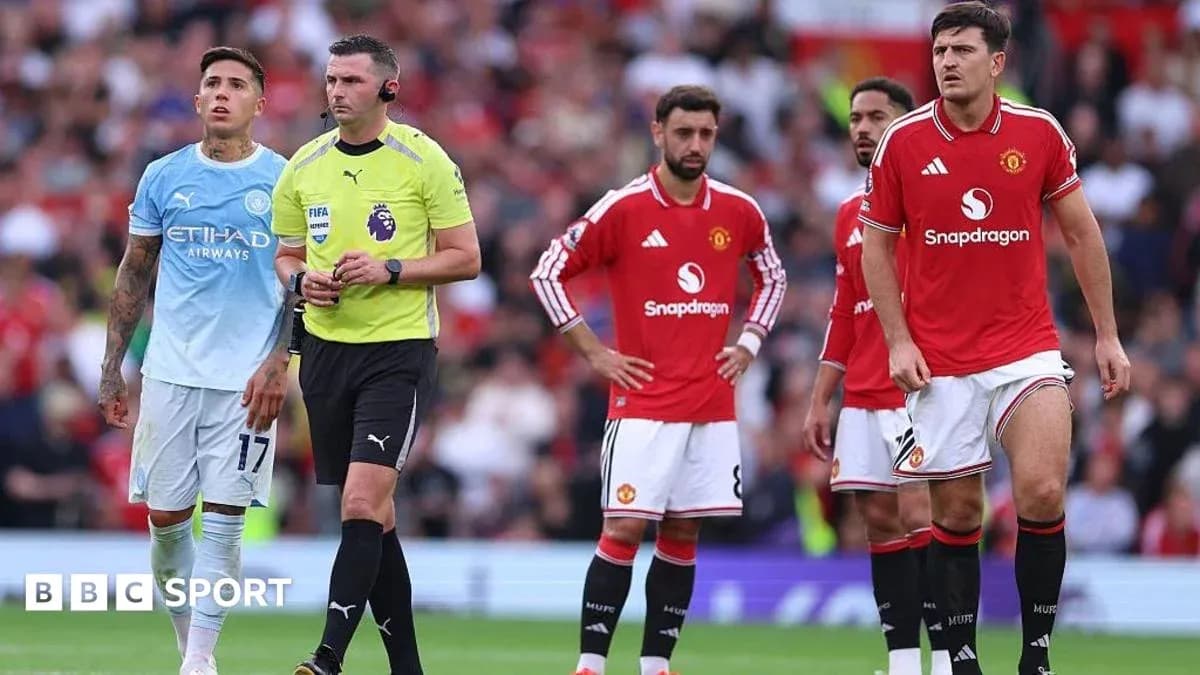
Seconds later, Erling Haaland’s winner stood. Manchester City 1-0 Manchester United. Derby settled. Title race nudged. And Enzo Fernandez, three yards offside in the build-up, somehow invisible to the officials with every camera angle in front of them.
This is the goldfish bowl referees live in now. Every angle, every freeze-frame, every decision replayed, dissected, ridiculed. VAR was supposed to help, to calm the chaos. Instead, the pressure has simply moved from the pitch to the screen.
When speed beats sense
The Premier League set its stall out before the season. One of its guiding “football principles”: make VAR more efficient, trim the delays, keep the game flowing. Quicker checks, fewer long stoppages, less frustration.
Has that obsession with tempo finally bitten back?
“Let’s go, let’s go, let’s go, let’s go!” Donohue urged, his words betraying a frantic urgency. This was not the cool, methodical voice you’d expect from the official with the power to overturn a goal. It sounded rushed. It sounded chaotic. And the decision that followed reflected it.
Officials hear it constantly. From stands. From managers. From pundits. From broadcasters. VAR has to be quicker. These long waits are killing the game. A Premier League stakeholders’ survey — managers, coaches, supporters — hammered home the same point: speed up the process.
That pressure seeps into the room. But it cannot excuse what happened here.
City manager Enzo Maresca, the beneficiary of the mess, still felt a twinge of sympathy.
“To make a decision in 10, 20 seconds is not easy for them,” he said. “Sometimes they make mistakes. I make mistakes, players make mistakes. It’s part of our job.”
Howard Webb, the referees’ chief, has tried to listen. The numbers say he has. Average VAR delays, including the time for the referee’s announcement to the crowd, have dropped from 46 seconds per game to 36 this season. On paper, that looks like progress.
But the other major VAR error this campaign — the failure to award Arsenal a penalty at Aston Villa — also came from an incident swept aside too quickly. The pattern is hard to ignore.
The crucial step they skipped
This wasn’t just about being fast. It was about being fast in the wrong way.
The most damaging mistake came before Donohue even tried to race through the attacking phase. As the ball left Josko Gvardiol’s foot for the cross, Donohue told the replay operator to stop the video on that first replay. From there, he went straight into the semi-automated offside technology.
That should never have happened.
The VAR team needed to watch the entire sequence: Gvardiol’s cross, Fernandez’s movement and attempted header, Haaland’s finish. Only that full picture would have flagged Fernandez’s position and influence.
They didn’t. They chopped the move into pieces, and the key piece — Fernandez straying three yards off — slipped through the cracks. By the time they revisited the action in the box, Donohue and his assistant VAR, Blake Antrobus, were fixated on a single question: did Fernandez touch the ball?
If he had, it would have created a new phase and put Haaland offside. That became their tunnel vision. The offside by Fernandez before that point, the one that should have killed the goal, never truly entered the discussion.
Antrobus’ role as AVAR is meant to be simple but vital: act as the second pair of eyes, the safety net, the person who spots what the VAR might miss. Instead, his only audible contribution to the whole review was “no, yeah” on the possible Fernandez touch — a second before Donohue declared, “final decision is goal, check complete.”
The checks and balances never materialised.
The shadow of a four-minute delay
Antrobus’ name had already been in the VAR conversation this season. He was AVAR for the only truly lengthy review of the campaign, when Dan Ballard’s goal for Brentford against Sunderland was chalked off for a subjective offside against Kevin Danso. That check took more than four minutes and drew heavy criticism in some corners of the media.
Did that experience sit in the back of his mind on derby day? Did the memory of that long delay nudge him towards silence rather than intervention?
We’ll never know. What we do know is that in that Brentford game, Antrobus helped guide VAR Tim Wood to the correct offside call on Danso. Slow, yes. But accurate.
On Sunday, speed won. Accuracy lost.
There was another layer of protection available too. The support VAR, stationed in the operations room next to the match hub at Stockley Park, can step in on protocol issues. They saw the review unfolding. They heard the urgency. No one stepped in.
Even after Haaland’s goal was given, the situation was still salvageable before United kicked off. It wasn’t taken.
Specialists under the microscope
Pro Ref has poured money, time and training into VAR. Workshops, simulations, technology upgrades — all in the name of making decisions both quicker and more accurate.
But when a mistake of this scale happens, all that investment feels irrelevant.
Some argue the answer is VAR specialists. Dedicated screen officials, not referees juggling both roles. Yet that is exactly what Donohue is, by the Premier League’s own standards.
Three seasons ago, Pro Ref invited officials to apply for a specialist VAR pathway. Candidates went through aptitude tests, then intensive training. Around 15 reached the final stage; 10 have now worked as VARs in Premier League matches.
Donohue is one of them. Sunday was his 65th top-flight outing as the video official. His progress has been such that he is now on the international list, trusted with Uefa club competition qualifying ties.
He has made mistakes before — almost every VAR has — which underlines how demanding the role is. Only two VARs have a clean record over the past two seasons: Nick Hopton and Neil Davies, both products of the same accelerated programme.
Convincing referees to give up the whistle and live full-time in the VAR room is not straightforward. Nor is it a guarantee of excellence. Lee Mason and Mike Dean, appointed as the Premier League’s only full-time VARs after retiring from on-field duties, were both dismissed by Webb within months because of repeated high-profile errors.
Look abroad and the picture doesn’t suddenly sharpen. Spain’s La Liga and its second division use a full team of officials who only work as VARs and never take charge on the pitch. The controversies keep coming. At the start of last season, the VAR there missed that a goalscorer was offside when the ball was played. Different league, same outrage.
Football’s own obsession
Pro Ref now faces searching questions. Not just about one decision in one match, but about its processes. About why a VAR in one of the biggest fixtures of the season sounded so desperate to rush through a review.
That urgency was nowhere to be found when West Ham’s stoppage-time equaliser at Arsenal last season went under the microscope. That check dragged on for more than four minutes. The crowd seethed. The decision, though, was right.
This is the tightrope VAR walks: get there fast, or get there right.
The Premier League’s drive for speed has trimmed the stoppages and soothed some tempers. But the derby at the Etihad showed the other side of that trade-off. When haste becomes the headline, it risks shredding the credibility of the entire system.
And that feels less like a failure of one man in a booth and more like a problem the whole of football has created for itself.