
US Soccer Triumphs Over Australia 2-0 in World Cup Match
Soccer was always going to win here. The United States just made sure it did so on the scoreboard as well.
On a bright, almost smugly perfect Friday in the Pacific north-west, the US beat Australia 2-0 in front of 66,925 fans, a sellout that sounded like far more. The result sends the hosts into the knockout rounds and may yet be enough to lock up top spot in Group D, depending on how Turkey and Paraguay sort themselves out later in the day.
This was not a group-stage dead rubber, not for two nations that treat every World Cup as a referendum on the sport’s future back home. In a country where “soccer” still fights for space on the marquee, and in another where the code competes with cricket, rugby and Aussie rules, both sets of players carried more than a match on their shoulders.
The stage reflected that weight.
Seattle Stadium throbbed with noise long before kick-off, three bold pockets of yellow-clad Australia fans battling a wall of red, white and blue. A quartet of military helicopters ripped across the sky as the US anthem ended, the timing so perfect it felt rehearsed in Hollywood, not on a training ground. The crowd roared, flags snapped, and for a moment the World Cup felt like a homecoming parade.
No Pulisic, no problem
The pre-game conversation had orbited almost entirely around Christian Pulisic. The US star had limped out of the opener at half-time with a calf problem and spent the week training away from the main group. When Mauricio Pochettino confirmed shortly before kick-off that Pulisic was unavailable, a murmur ran through the stadium. No talisman, no obvious game-breaker. Questions, suddenly, everywhere.
Australia had been fed a different kind of fuel. US pundits had spent the buildup describing the Socceroos as a “layup” and worse, dismissing a team that had impressed in its own opening match. Inside the US camp, the tone was very different. Players and staff lined up to praise Australia’s quality, almost chanting it as a mantra.
Within a minute, the Americans’ respect looked justified.
Alex Freeman coughed up a loose pass straight into the path of Mohamed Touré, who pounced, drove toward goal and forced Matt Freese into an early save from a tight angle. Chris Richards had done just enough to shepherd him wide, but the warning landed.
The US responded by taking the ball and refusing to give it back. They probed both flanks, stretching an organised Australian back line, testing the seams rather than tearing at the middle.
The breakthrough came from the space Pulisic might have occupied.
Antonee Robinson stepped forward and slid a pass into Folarin Balogun, stationed wide on the left. Balogun turned, burned Jacob Italiano for pace and whipped a low ball across the six-yard box. Defender Callum Burgess, caught in the wrong place with no time to think, could only deflect it into his own net.
Another early own goal for the US in this tournament, another early lead. Paraguay had crumbled when put under similar pressure. Australia did not.
Touré almost replied within two minutes, holding off a tight US back line before Mathew Leckie tried an audacious outside-of-the-boot effort from the top of the box. It sailed high and wide, but it underlined Australia’s intent: they would not be bullied into submission.
The physical edge both camps had predicted began to surface. Nishan Velupillay clattered into Tyler Adams right in front of the US bench, riling the home crowd. Jordan Bos collected the first yellow card for a hand to Weston McKennie’s face. Later, Alessandro Circati joined him in the book for clipping Malik Tillman’s heel as the American midfielder darted toward the box, a cynical intervention that prevented a more dangerous moment. The free-kick that followed was bravely cleared.
Freeman’s redemption arc
In the 39th minute, the match paused in a moment of concern. Freeman and Paul Okon-Engstler clashed heads, both players down and requiring treatment. Both stayed on, bandaged pride and all.
Moments later, Freeman swung the narrative.
The move began with Tillman, who fought Velupillay along the byline on Australia’s left, refusing to let the ball go out and eventually earning a dangerous free-kick. Robinson rolled it to the top of the box for Sergiño Dest, whose shot cannoned off a flying Harry Souttar. The ball dropped kindly, and Freeman reacted first, bundling it over the line.
The flag went up, the VAR check followed, and the stadium held its breath. The goal stood. The defender who had nearly gifted Australia an opener was suddenly the man doubling the US lead.
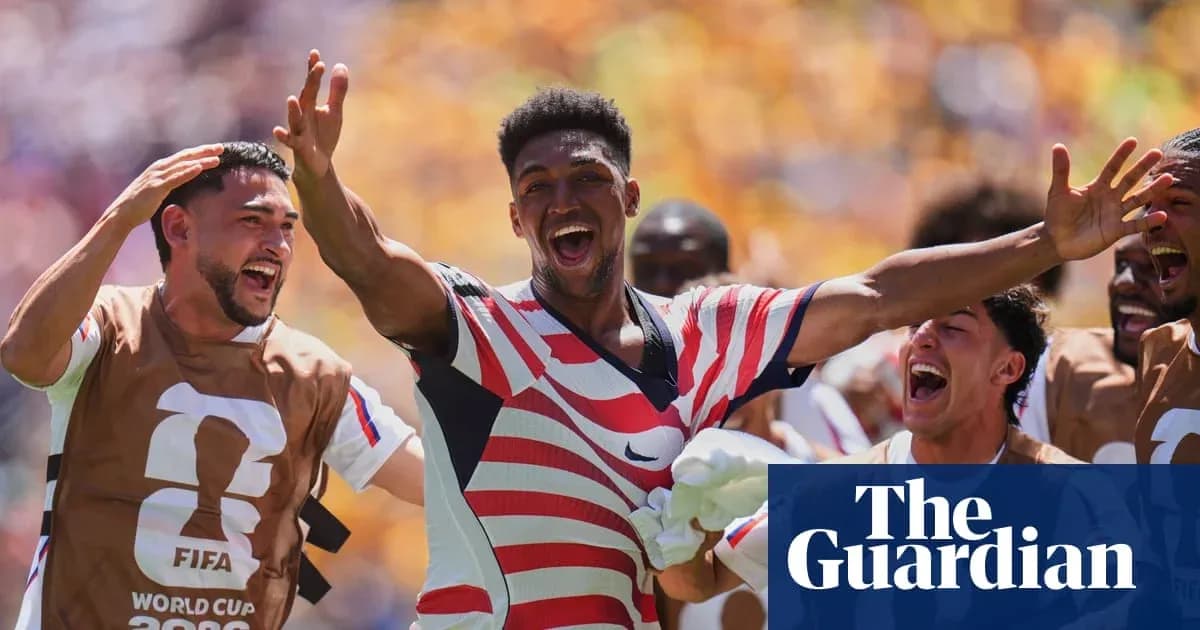
In the chaos of celebration, Freeman – by then back in his usual center-back position – ended up celebrating at the opposite end of the pitch from where he’d scored, swallowed by teammates sprinting from the bench. A messy goal, a cathartic one, and a 2-0 cushion the US had earned with their control.
Australia trudged to the interval knowing they needed more than tweaks.
Popovic rolls the dice
Tony Popovic answered the call with a scalpel and a sledgehammer. At half-time, Jason Geria replaced Burgess, while Nestory Irankunda and Connor Metcalfe – the two scorers from Australia’s previous game – came on for Touré and Velupillay. The shape morphed into a far more aggressive 4-3-3 in possession, snapping back into a five-man line without the ball.
The change opened the game instantly.
Seven minutes after the restart, McKennie seized on a loose ball in midfield and threaded Balogun through the middle with only Souttar chasing. Balogun drove at goal, but the giant defender did just enough, and the shot was blocked. A warning, loud and clear: Australia’s push for a goal came with a price.
The Socceroos kept leaning forward. Robinson picked up the United States’ first yellow card in the 56th minute, chopping down a developing move on his flank. It was a professional foul, a nod to the growing Australian threat.
Just past the hour, Cristian Volpato entered for Leckie and almost made an instant impact. Irankunda tore down the right, surged into space and cut the ball back. Volpato arrived in stride but lashed his shot over the bar from inside the box. Minutes later, Metcalfe found a pocket of space and fired low, only for Freese to smother with little fuss.
Popovic kept stacking the attack, sending on Jackson Irvine for Okon-Engstler to add more legs and late runs from midfield. Pochettino answered in the opposite direction, reinforcing the bulwark: Robinson, Dest and Ricardo Pepi made way for Sebastian Berhalter, Auston Trusty and Joe Scally, a clear tilt toward game management.
The shift in personnel tilted the pitch. Australia pushed higher, forced corners, and found half-chances. Circati went close amid a scramble, others snatched at near-misses. The US, deeper now, absorbed pressure, cleared lines, and trusted their structure.
The temperature rose again. Challenges grew heavier, the crowd louder. Chants of “USA” rolled around the stands as late yellow cards flashed for Souttar, Balogun and Italiano, some for niggly fouls, some for off-the-ball skirmishes that spoke to frayed tempers and fading legs.
Party at Soccer City, USA
Even the referee couldn’t escape the attrition. Felix Zwayer picked up a knock that briefly delayed the final whistle, adding a strange coda to a tense second half. He eventually carried on, limping through the closing minutes as Australia’s last hopeful balls were repelled.
With the atmosphere threatening to sag in the dying moments, Balogun turned showman, waving his arms and urging the crowd to raise the volume one last time. The response was instant. The stadium roared, a reminder that for one afternoon at least, this corner of the Pacific north-west was Soccer City, USA.
The US had managed the game, managed the occasion, and managed the absence of their brightest star. Australia had pushed, adjusted, and refused to fold, yet left with nothing.
The knockout rounds now await the hosts. The question is no longer whether they belong on this stage. It’s how far this team, and this sport in this country, are ready to go.




