Tottenham Women: A Historic WSL Campaign and New Beginnings
Tottenham’s women did more than play good football last season. They offered relief. While the men’s side spent months shamelessly courting relegation, the women quietly put together the best Women’s Super League campaign in the club’s history and reminded supporters what it feels like to enjoy a weekend.
The contrast was brutal. As the men spiralled, flirting ever more seriously with the drop, a familiar dread crept across the fanbase. WhatsApp groups of long‑suffering season-ticket holders turned into rolling therapy sessions. Why the endless passing around the box? Where were the signings to cover the injuries? At times, the only honest answer was a shrug.
Across London, a different Spurs story was unfolding.
A new heartbeat in N17
Three years ago, one family decision changed how a season would be lived. Inspired by England’s Lionesses reaching the World Cup final in 2023, a trip to Australia turned into something more. In Brisbane, after England edged Colombia 2-1 in the quarter-finals, Colombia fans – thousands of them – peeled off to shake hands with a tiny pocket of England supporters. Roughly 2,000 Colombia fans. Maybe 20 from England. The warmth, the respect, the sense of shared occasion: that felt like the kind of football environment worth passing on to a child.
So the family came home and bought season tickets for Tottenham Women.
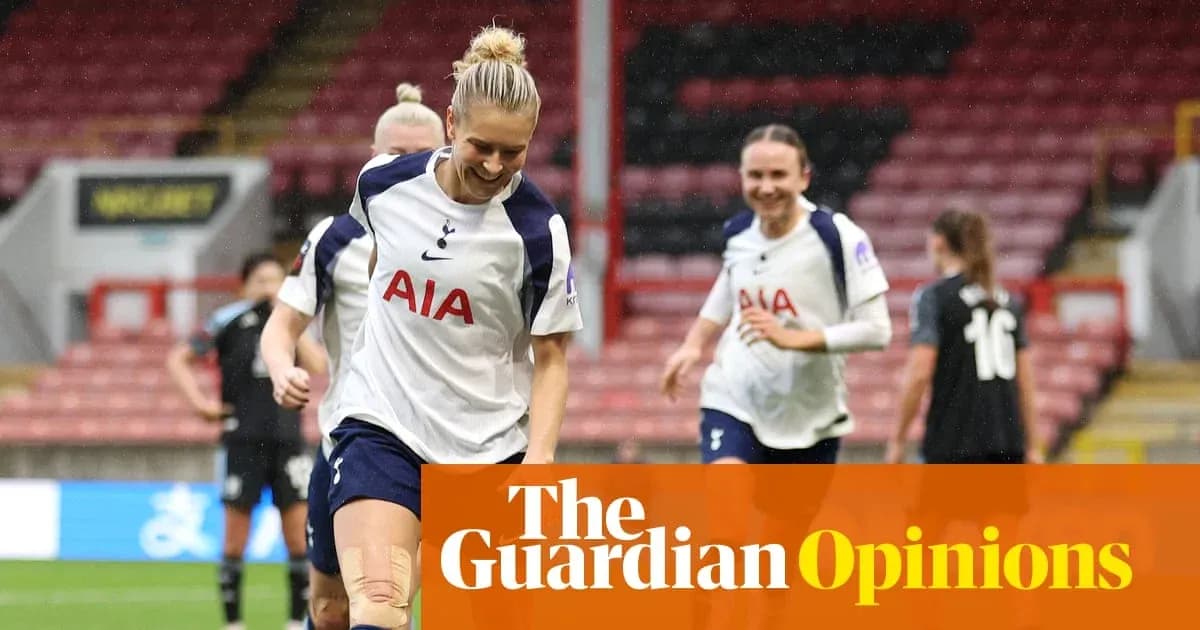
They picked a good time. While the men laboured, the women surged. Spurs racked up their highest WSL points tally, lit up the FA Cup and scored the sort of goals that live rent-free in a supporter’s mind.
There was the 7-2 demolition of Aston Villa, a game that felt like a statement as much as a scoreline. There was the FA Cup epic against London City Lionesses, a penalty shootout that descended into the surreal as the first 17 spot-kicks were buried with ruthless calm. And there was Cathinka Tandberg, thundering in a 40-yard screamer that seemed to bend both physics and expectation.
Tottenham Women became the antidote.
Martin Ho’s imprint
The transformation did not happen by accident. The club’s decision to appoint Martin Ho as head coach last year has proved pivotal.
Ho arrived with a solid pedigree: assistant at Manchester United, head coach at Norwegian side Brann. Inside the camp, the message is consistent – players like him, and more importantly, they respect him. That matters when you inherit a group that had badly underperformed. In 2024-25, Spurs finished just one place above relegation, a slide that ended Robert Vilahamn’s tenure.
Ho walked into that uncertainty and quietly rewired the team.
He has made a point of building bridges with supporters too. At Leyton Orient, where Spurs Women play most of their home matches, he can occasionally be found wandering through the Legends Lounge before kick-off, stopping for conversations that feel informal but meaningful. The real connection, though, comes on the pitch.
Tottenham now play with purpose. They attack with structure, defend with clarity and run as if every sprint has a destination. Players look sure of their roles and of each other. It shows.
Last season, Spurs won five of their first six games. Whatever Ho said behind closed doors to coax established players back to their best, it clearly worked. It certainly did not resemble the infamous Igor Tudor-style teardown that tells professionals they can’t attack, can’t defend and can’t run. Tottenham, very visibly, could do all three.
Eveliina Summanen set standards in midfield. Amanda Nildén and Clare Hunt brought authority and balance. Lize Kop offered assurance in goal. Drew Spence added bite and experience. Across the pitch, there was a sense of a team finally pulling in the same direction.
Chasing the heavyweights
Reality still bites in certain fixtures. Tottenham were thumped a couple of times by Manchester City, but then City have Khadija “Bunny” Shaw, a striker with a goals-per-game ratio that outstrips even Erling Haaland. City went on to win the league ahead of Arsenal, Chelsea and Manchester United – the four clubs who continue to dominate the WSL landscape.
Spurs finished fifth, right behind that elite pack. In this league, that is no small feat. For the first time, breaking into the top four feels less like a fantasy and more like a timeline. A year or two, perhaps, if the trajectory holds.
Recruitment suggests the club believes it can.
Within days of last season ending, Tottenham moved decisively. Caitlin Dijkstra, the highly rated Netherlands international defender, arrived from Wolfsburg to strengthen the back line. Germany’s Shekiera Martinez joined from West Ham, where she had stood out as a clinical forward in a struggling side. They were followed by proven quality: Kirsty Hanson from Aston Villa, Alice Sombath from OL Lyonnais. Each signing nudged the squad closer to the depth and profile required to sustain a top-four push.
Farewells that sting
Progress always has a cost, and at Spurs it has meant saying goodbye to two pillars.
Bethany England, the club’s record goalscorer, has gone, her departure tinged with confusion. Given her status and history, the decision not to offer at least a one-year extension jars. It feels like a loose thread in an otherwise coherent plan.
Ashleigh Neville has moved on too, leaving to be closer to home with a transfer to Leicester. That one makes emotional sense, even as it hurts the squad. Neville’s energy, commitment and versatility made her a fan favourite; losing that kind of presence is never just about minutes on the pitch.
The team that kicks off this season will look markedly different from the side that first drew a new wave of supporters three years ago. The shirts have changed, the names have shifted, the style has sharpened. One thing has not: the bond in the stands.
The culture around the club
Among Tottenham Women’s season-ticket holders, the knowledge runs deep. Many have followed both the men’s and women’s teams for years. They write blogs, host podcasts, and still drag themselves to West Ham away to stand in the rain and wind, because that’s what following a club sometimes demands.
Some remember the earliest days, when only a smattering of fans watched Broxbourne Ladies – as the team were then known – claw their way up the leagues. For them, every step into the WSL’s upper reaches carries a weight of history.
The matchday experience feels different too. Supporters do not hold back in showing frustration, and referees are still invited to consider whether a visit to a well-known high street optician might be wise. But the relentless swearing, the simmering anger that can poison men’s fixtures, rarely surfaces.
Before kick-off, banners go up around the stands: Spurs players framed by the Progress Pride flag. The message is not subtle – everyone is welcome. For some fans, that visibility has been a quiet revelation, a reminder of how football can act as a force for inclusion rather than division.
On the pitch, the game may be fractionally slower than the men’s, but it breathes differently. Matches flow. There is no VAR to halt celebrations or drain tension from the air. Occasionally, a refereeing decision will be dreadful, and everyone knows it. Yet most would rather live with the odd howler than stand for five minutes in baffled silence, waiting for someone in a remote booth to decide what they’ve just seen.
A club worth turning up for
As a new season looms, the hope is simple: more people in the ground, more voices joining in, more children growing up with this version of Tottenham as their reference point for what football can be.
Spurs Women are not yet part of the WSL’s established elite, but they are closer than ever, armed with a sharp coach, a strengthened squad and a fanbase that has grown alongside them. For those who have lived the journey from Broxbourne to fifth place, from sparse crowds to Pride-flagged stands, the question now is not whether this team belongs.
It is how far, and how fast, they can go from here.