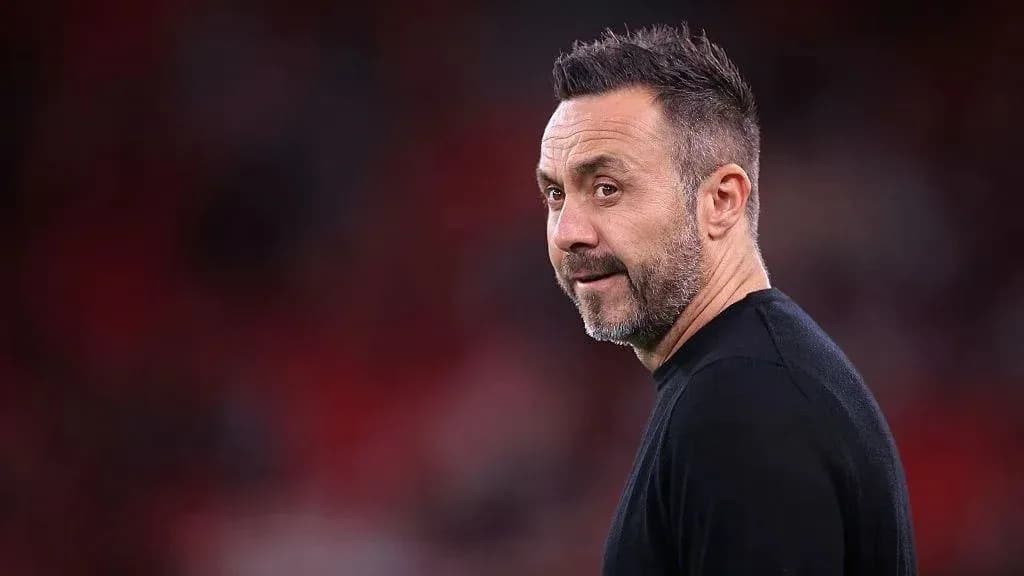
Tottenham's Struggle for Goals: De Zerbi's Vision in Progress
Tottenham are four games into the season, £320million into a rebuild, and still waiting for their first Premier League goal. Only Coventry City share that unwanted statistic.
For a club that spent heavily on attacking talent, this is not just frustrating. It is baffling. On the surface, Roberto De Zerbi has brought ideas that once turned Marseille into a 2.3-goals-per-game machine. Underneath, the moving parts are still grinding into place.
De Zerbi’s risk-first blueprint
The league De Zerbi has returned to is not the same one he left with Brighton in 2024, but his core beliefs have survived the journey.
His teams slow the game down on purpose. Centre-backs and the holding midfielder roll the ball backwards, invite pressure, almost tease the opposition into stepping higher. Then, when the press bites, they flip the switch. Vertical passes. Carried runs. Explosions into the space behind the first line of pressure.
As he put it in a 2020 coaching seminar: “The stronger the pressure of the opponent, the more vertical [our] action becomes. [The fewer opponents behind], the easier it becomes to go and score.”
We’ve already seen Tottenham forwards receiving the ball in big, open spaces with fewer defenders to beat. The structure is doing its job. Turning that into goals is where the whole machine is spluttering.
A 2-3-2-3 that looks simple on paper, anything but on grass
In possession, Spurs usually resemble a 2-3-2-3, even if the picture constantly morphs.
Two centre-backs. In front of them, Rodrigo Bentancur sits as the pivot, rarely straying far from that anchor role. That trio is the fixed spine.
Around them, though, the pieces spin. Wingers, full-backs, and central midfielders rotate zones, trading places to keep the shape intact. If one vacates a space, another must fill it. The geometry matters as much as the individual.
On top of this positional framework come De Zerbi’s principles: tempt the press, play centrally, then attack the space that opens up. It was devastating at Marseille between 2024 and 2026. The numbers there prove it.
At Tottenham, the pattern is visible, but the execution is still half a step off.
Central corridors: the route Spurs must trust
De Zerbi wants his teams to play through the middle, not around it.
When Spurs’ centre-backs have the ball, that central focus drags opposition forwards and midfielders higher. Pockets appear between the lines. Attacking midfielders can receive on the half-turn. From there, one clean action can rip a defensive block apart.
There is a second effect. As the opposition narrows to protect the centre, space opens wide for direct wingers and overlapping full-backs to attack. The plan is clear: draw them in, then punch out.
But for those central passes to work, the receiver has to accept the ball under pressure, in tight spaces, with bodies flying around them. Not everyone thrives in that chaos.
Sandro Tonali, for instance, is more dangerous when he can face forward in bigger spaces. De Zerbi has adjusted by rotating him with Archie Gray, who starts at right-back but often moves inside. It is not Gray’s natural position, yet the 20-year-old has coped, showing he understands the tactical demands.
The imminent full return of James Maddison, back from a shoulder injury in the Carabao Cup tie at Liverpool, should sharpen this area. Maddison is built for those pockets, for taking the ball in traffic and stitching attacks together. He can help Spurs reach the final third more often, and with more control.
But even with better individuals, the approach relies on habits. And habits take time to rewrite.
Under Thomas Frank at the start of last season, Spurs largely avoided the central lane in build-up, funnelling play down the flanks to minimise dangerous turnovers. De Zerbi is asking the same players to do the opposite: risk the ball in the most congested part of the pitch. That kind of bravery cannot be installed overnight.
The pass that never comes
Spurs are actually reaching promising positions. They are breaking lines, getting behind midfields, and catching opponents mid-press.
The problem is what happens next.
Three things have to align: the player in possession must spot the best option, the movement ahead of him has to be sharp, and the final ball must be executed with precision. At the moment, the biggest blockage is in that first and third step.
Too often, Tottenham players either don’t see the through ball in behind or choose not to play it.
Omar Marmoush has made the right runs repeatedly, peeling into channels and darting beyond the last line. The ball rarely arrives. Gray has tried to feed passes down the line, but centrally those brave, defence-splitting passes have been scarce.
The return of Pedro Porro could change that dynamic. For Spain at the World Cup, he operated more centrally in possession and showed exactly the kind of vertical passing De Zerbi craves. His natural instinct to look forward, to slide runners in, fits this system.
If Porro adapts quickly and leans into those tendencies, Spurs’ chance creation should spike. De Zerbi’s forwards at Marseille feasted on that sort of service.
Learning the runs that unlock the box
While Porro plays catch-up with fitness and rhythm, others are still learning the off-ball patterns that make this style hum.
At Marseille, wide attackers often started on the last line and cut diagonally inside, timing their runs to meet vertical passes. It was a simple idea, but devastating when everyone read the same script. Igor Paixao’s goal in a 2-2 draw with Toulouse last season showcased it perfectly: a crisp forward pass, a diagonal run, and a finish into space.
Against Liverpool in midweek, Destiny Udogie offered a glimpse of that at Spurs. He repeatedly surged into dangerous positions on the left as the game stretched. Andy Robertson has been excellent this season, but Udogie’s power and timing gave Tottenham a different outlet, especially when Liverpool’s shape became ragged.
Those runs dragged Spurs into crossing positions against a scrambling defence. The platform was there.
Final ball, final touch, missing goals
When an attacking team accelerates, defenders usually respond by racing back towards their own goal. That retreat leaves gaps at the top of the box for late-arriving midfielders or clever strikers who drop off.
Marmoush has tried to exploit that, stepping away from the line to receive cut-backs. Again, he has not always been picked out.
Some of this is chemistry. Players still learning each other’s movements, still calibrating weight and angle of pass. Some of it is technical. Savio, a left-footed right-winger, is far more comfortable driving to the byline than pulling the ball back on his weaker foot.
On the opposite side, the left-footed Udogie and Robertson have created clearer chances with their crosses. They can naturally cut the ball back with their stronger foot. At Marseille, both right winger and right-back were happy to do that on their right, constantly feeding the six-yard box.
Those deliveries were maximised by the movement of Pierre-Emerick Aubameyang, who, even at 37, attacked space in the area with ruthless timing. Spurs do not yet have that same level of penalty-box craft.
Look closely, though, and the pattern is familiar. Tottenham are reaching the byline. They are getting into pull-back positions. The final detail – the cut-back angle, the run, the finish – is what’s missing.
Close, but not close enough… yet
This is not a system that will click into perfection overnight. It is also not one that can hide behind theory if the finishing quality is not there. Marseille’s forwards were clinical, and they loved open grass.
Tottenham are still trying to become that kind of team.
But the framework is in place. The rotations are emerging. The runs are being made, even if the ball doesn’t always arrive. The goals are not coming yet, but the routes to goal are increasingly visible.
If Spurs sharpen those small details – the courage to play the killer pass, the timing of the diagonal run, the conviction on the cut-back – the drought should break. The real question is not whether they will score.
It’s how quickly this group can turn “almost” into a scoreboard that finally reflects De Zerbi’s ambition.