Tottenham's New Era Faces Reality Check After 3-0 Defeat
Tottenham’s season did not just start badly. It started with a jolt to the system.
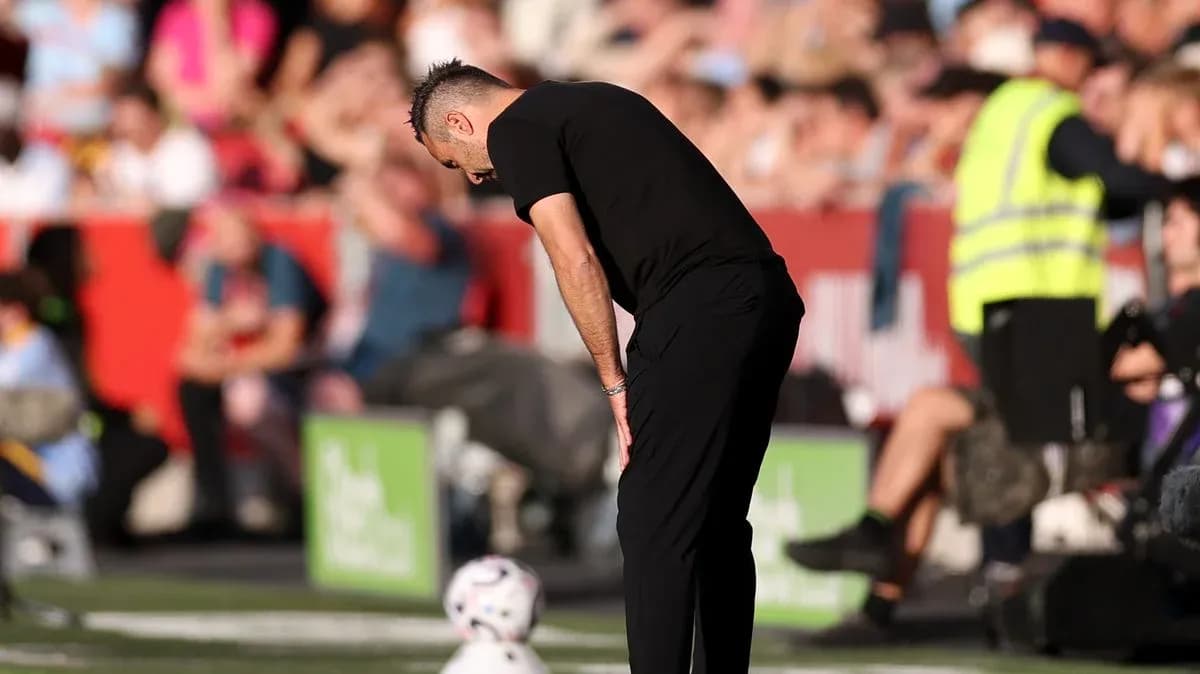
A 3-0 defeat at Brentford on opening day left Roberto De Zerbi facing the cameras at the Gtech Community Stadium with no place to hide and no appetite for excuses. He had warned that Spurs were late in their preparation. Brentford exposed exactly how late.
Brentford punish a fragile Spurs
The tone was set early. In the 12th minute, new Brentford signing Mamadou Sangare drifted into the Spurs box with alarming ease. He had time, he had space, and he had options. He chose the simplest one: a square ball to Keane Lewis-Potter, in even more room, who calmly side-footed home. Tottenham’s defensive shape was nowhere.
The second goal was worse. It wasn’t about tactics, it was about basics.
Richarlison failed to hold the ball up, Lucas Bergvall followed with weak play, and suddenly Mathias Jensen was driving at goal. Antonin Kinsky pushed out the shot, but only as far as Vitaly Janelt, who tapped into an unguarded net. Self-inflicted damage, twice over.
Any hope of a reset after the break vanished almost immediately. Within four minutes of the restart, it was 3-0. Sangare’s shot through a crowd was blocked by Kinsky, but the loose ball dropped to Michael Kayode, who reacted quickest and lashed it into the roof of the net. Spurs’ opening day had turned into a full-blown embarrassment.
It could have been worse. Rodrigo Bentancur brought down Kevin Schade in the box and Brentford had the chance to add a fourth from the spot. Igor Thiago stepped up and slammed his penalty against the left post, the rebound spinning away to safety. A rare reprieve on a day when Tottenham received almost none.
“We are not a team yet”
De Zerbi did not sugar-coat what he had seen.
“For many reasons. I think we are not a team yet,” he said. “Before becoming a team, we can't say what we can do.”
He pointed to fitness issues, disrupted preparation after the summer’s international commitments and travel, and the sheer volume of change. But he refused to dress them up as alibis.
“They are the normal situation when you are building a new project, a new process. I don't want time, but we have to pass through these problems.”
The Italian repeatedly returned to one central idea: this is a project in its infancy, and right now it looks exactly like that.
He admitted Spurs are “not in the right point in physical condition”, referencing players who arrived late after the World Cup and a pre-season tour in Australia where, in his words, “we couldn't work in the right way”. The consequence was laid bare in west London.
Tottenham lost duels all over the pitch. They were second to every loose ball. They mistimed their pressing. They barely laid a glove on Brentford.
“We lost too many duels, we made too many mistakes in the timing when we wanted to push the pressure higher. We arrived second for the second ball, we didn't win one second ball, one duel, one tackle, and it's tough.”
Youth, risk and the cost of learning
De Zerbi was not blind to the inexperience in his line-up. He namechecked the ages: players born in 2007 and 2006 on the pitch in a Premier League opener. He singled out Bergvall, whose error helped gift Brentford their second, but did so with a long-term lens.
“I think he didn't play bad today, even if I substituted in the half-time,” De Zerbi said. “But Lucas Bergvall in the next two years, he will not lose that ball in that moment of the game. But there are steps to become better.”
The same applies across the squad. He spoke about Mikey Moore, Mathys Tel and Archie Gray, and pushed back at the idea that the answer is simply more experience in attack.
“No, no, for the attacking area,” he insisted. The issue, as he sees it, runs deeper than one department of the pitch.
He contrasted last season’s settled defensive line – Pedro Porro, Kevin Danso, Micky van de Ven and Destiny Udogie – with the new-look back four at Brentford: Archie Gray, JP Van Hecke, Marcos Senesi and Andy Robertson. Four new faces. Two new midfielders as well, with Bergvall preferred to Bentancur in the starting XI because the Uruguayan had joined pre-season late.
“At the beginning of the season, at the beginning of the new project, it was good, it was right to play with Lucas Bergvall,” De Zerbi said. He knew the risks. “I knew before the game, Lucas Bergvall, in this type of game, maybe he could suffer more than Rodrigo Bentancur, nine years older, and Lucas, 20.”
He framed it as a choice: build for today, or build for today and tomorrow.
“We go, and we try to build something good for the club. We need also Archie Gray, we need also Lucas Bergvall, or we work for today. And tomorrow, I don't know.”
Soul, style and a brutal reality check
If there was a theme to De Zerbi’s words, it was that Tottenham are missing two elements he considers non-negotiable.
“To become a team, in my home, there are two big conditions. The soul and the style of play,” he said. “And today, we didn't show the soul, and we didn't show the quality of the play. With the ball and without the ball.”
He believes that once those arrive, Spurs “can become dangerous for everyone, every team”. Until then, he accepts there will be days like this.
“Until we don't arrive, we don't reach these conditions, we have to suffer. And today, I think it's important for us, this defeat, because maybe we woke up stronger than we thought, maybe.”
The question put to him was whether this result might at least keep feet on the ground after a summer of optimism. His answer made clear he never felt they were ready to declare lofty targets anyway.
Yesterday, before a ball was kicked, he had already told reporters he could only talk about objectives once Tottenham had actually become a team. Brentford underlined why.
Archie Gray, roles and responsibility
With Djed Spence gone, Archie Gray’s role this season is a live topic. De Zerbi sees versatility, but also a player whose performance at Brentford did not reflect his true level.
“Archie Gray can play as a full-back, as a midfielder. But I think he's much better than his performance today,” he said. “But not just Archie Gray, also JP Van Hecke, Sandro Tonali, Richarlison, everyone. We didn't play a good game.”
He was clear: one bad afternoon does not alter his view of any of them.
“We can't change our idea on Archie Gray for today, or for Richarlison or Mathys Tel.”
Time, but not an open cheque
So how long will this take? Supporters will not enjoy the word De Zerbi keeps repeating, but he does not duck it.
“We need time,” he said, before adding a pointed caveat: “but I think we are much better than we showed today. So from Wednesday we can show our qualities, and we can show who we are.”
He expects a reaction in midweek and against Newcastle next weekend. He also insists that even if those games bring wins, the bigger job will still be in progress.
“Even if we win Wednesday or next Saturday, we need time to become a team. Because to become a team we need time. We need time, we have to analyse the situation, we have to understand the situation. The improvement we have to do, every one of us, because we lose and we win together.”
The message is consistent: the club is committed to a project, and he believes in it.
“I believe in my players, I believe in my club, I believe in myself. I think we are working well, but in this moment… we are late for the start of the Premier League. But it's a step, we have to improve quickly.”
Set-pieces and steel
One of Tottenham’s great strengths last season came from set-pieces, with Cristian Romero and João Palhinha key figures in both boxes. Both are now missing, and the question came: how do Spurs regain that edge?
De Zerbi pointed straight at the opposition.
“Listen, Brentford in set-pieces are maybe the best team in the Premier League. So it's normal to suffer,” he said. He felt the bigger problem lay not in dead balls but in the chaos around them. “I think we suffer more the duels, more the second ball than the set-pieces.”
And that, really, is the crux. Tottenham were out-fought and out-thought in the details that define Premier League games. The structure is new, the connections are raw, the soul and style he demands are still forming.
The question now is not whether this defeat hurt. That much was obvious in every answer De Zerbi gave.
The real question is how quickly this group can turn pain into identity before the season’s rhythm leaves them behind.