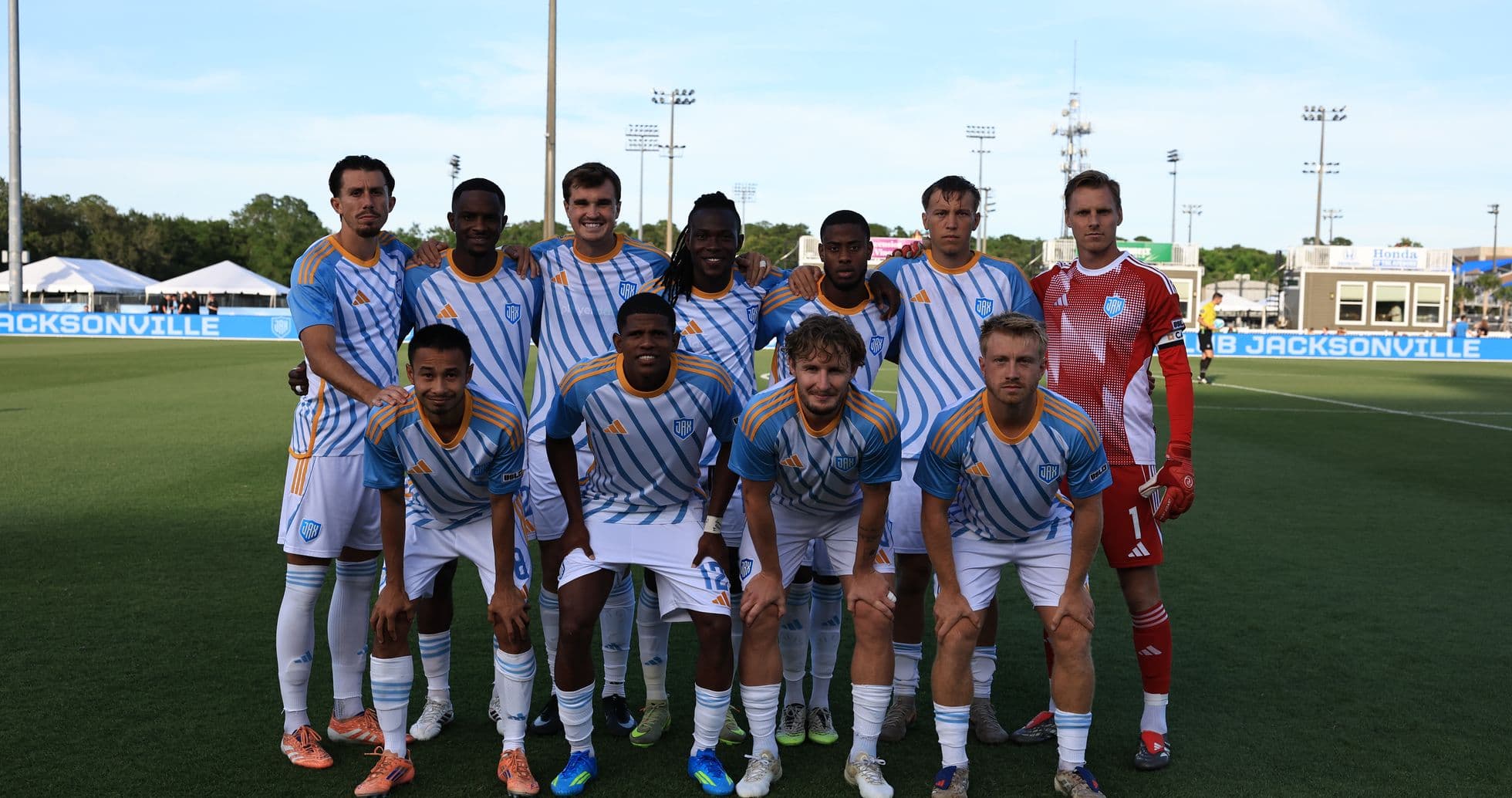
Tampa Bay Rowdies Dominate Sporting JAX in USL League One Cup
Under the lights at Hodges Stadium, the USL League One Cup group stage drew a sharp line between an emerging project and an established machine. Sporting JAX, still feeling their way through this inaugural campaign, walked into their home dressing room knowing they were already chasing the group’s benchmark side. Tampa Bay Rowdies, perfect in the group and ruthless in both boxes, arrived with the authority of a team that understands exactly who it is.
Following this result, the table tells a stark story. Tampa Bay sit top of Group 7 with 9 points from 3 matches, a flawless run built on 8 goals for and just 1 against. Sporting JAX, by contrast, occupy 3rd with 4 points from 4 games, their overall goal difference at -3, underlining the thin margins they have failed to control. At home, the numbers are even more unforgiving: 2 matches, 2 defeats, 0 goals scored and 3 conceded. Hodges Stadium, for now, has not become the fortress they imagined.
I. The Big Picture – contrasting identities
Sporting JAX’s seasonal DNA is that of a side still forming its core principles. Overall they have scored only 3 times in 4 group games, with an overall average of 0.8 goals per match. On their travels they have shown more incision, averaging 1.5 goals away, but at home the attack has simply not fired: 0 goals in 2 fixtures, with an average of 0.0. Defensively, they concede 1.3 goals per game overall, split between 1.5 at home and 1.0 away. This is a team whose structure holds better on the road, where the game state invites them to be compact and counter, but whose proactive home blueprint remains unfinished.
Tampa Bay are the inverse: a side whose structure is fully crystallised. They average 2.7 goals per game overall, driven by a devastating 3.0 goals per match on their travels. At the back, they concede just 0.3 goals per match overall, including only 0.5 away. That blend of high output and stinginess is the statistical profile of a contender, and it framed everything about how this match unfolded.
On paper, this was always a clash between a team learning to live with the ball and a team that knows exactly how to hurt you when you lose it.
II. Tactical Voids – where the squads fell short
Sporting JAX’s lineup underlined both their promise and their gaps. J. McGuire in goal was shielded by a back line including W. Ackwei, A. Gomez, E. Dudley and E. Rito. Ahead of them, the double pivot of W. Kuzain and B. Soumaoro was tasked with both building play and providing cover, while T. Rose and J. Evans flanked the creative hub of K. Sadlier, with E. Jaaskelainen leading the line.
The problem was structural more than individual. With no clear formation data, the eye test from the personnel suggests a system leaning on wide progression and a single central creator. That left Kuzain and Soumaoro stretched between screening Tampa’s transitions and supplying early passes into Jaaskelainen. In a home side that has already failed to score in 2 home fixtures and has “failed to score” in total twice this campaign, the lack of a secondary goal threat from midfield is a glaring void.
On the bench, Sporting JAX had options in C. Olivares, J. Rossiter, A. Reid, H. Neville, P. Elias, R. Pedder, L. Granitur and E. Underwood, but the broader issue was not fresh legs; it was patterns. Without a clear, rehearsed route to goal at home, substitutions could only tweak intensity, not identity.
Tampa Bay’s squad, by contrast, looked layered and balanced. J. Waite in goal anchored a defensive unit featuring A. Rodriguez, L. Wyke, B. Schaefer, N. Dossantos and C. Ostrem. In front of them, M. Schneider and L. Perez offered structure, with S. Cruz and M. Micaletto operating as the connective tissue between lines. M. Myers led the line, the focal point for a side that already averages 3.0 away goals.
Crucially, Tampa’s bench was stacked with change-of-pace weapons: R. Cicerone, E. Conway, Pedro Becker, Mattheus, G. Vivi Quesada, I. LeFlore, Y. Leerman, plus the security of A. Pack and J. Kachurak. This depth allowed Tampa to protect a lead or chase more goals without breaking their tactical shape.
Disciplinary patterns also shaped the risk profile. Sporting JAX’s yellow cards this campaign cluster heavily in the 46-60 minute window, where 55.56% of their cautions arrive, with a further 22.22% in the 76-90 period. That late-game surge of bookings hints at a side that chases games with increasing desperation. Tampa Bay’s yellows are more evenly spread, with 33.33% between 46-60 and another 33.33% from 76-90, but crucially without red cards for either team this campaign. Both sides can play on the edge without tipping over, but Sporting JAX do it more reactively, when the match is already slipping away.
III. Key Matchups – Hunter vs Shield, Engine Room vs Enforcer
The “Hunter vs Shield” narrative in this fixture was always going to be Tampa Bay’s attack against Sporting JAX’s fragile home defence. Sporting JAX concede 1.5 goals per game at home, while Tampa Bay score 3.0 per game on their travels. That 1.5-goal gap in the respective averages is not theoretical; it is the space where Tampa’s front line lives.
M. Myers, supported by S. Cruz and M. Micaletto, personifies the Rowdies’ travelling menace. Even without individual goal tallies from the data, the structural cues are clear: Tampa’s “biggest away win” is 1-4, and their away goals-for high is 4. They arrive with the confidence to flood the box, pull full-backs out of shape, and finish moves with numbers.
On the other side, Sporting JAX’s “Shield” at home has not held. They have yet to keep a clean sheet at Hodges Stadium in this competition, and overall they have just 1 clean sheet, earned away. McGuire, Ackwei, Gomez and Dudley have shown they can be disciplined in a lower block on their travels, but at home, with Rito and Rose likely pushed higher, the spaces behind the full-backs become prime hunting ground for Tampa’s wide runners and late-arriving midfielders.
In the “Engine Room”, the duel between Sporting’s Kuzain–Soumaoro axis and Tampa’s Schneider–Perez pairing defined the game’s rhythm. Sporting JAX need Kuzain to dictate tempo and Soumaoro to break lines with carries, yet both were repeatedly pulled into emergency defending against Tampa’s counters. Tampa Bay’s midfield, by contrast, could sit in their block, compress central spaces, and then release Cruz and Micaletto into the half-spaces. The Rowdies’ overall goals-against average of 0.3 per match is not just a goalkeeper’s statistic; it is the reflection of a midfield that rarely allows clean entries into Zone 14.
IV. Statistical Prognosis – what this tells us going forward
Following this result, the statistical trend lines harden rather than bend. Sporting JAX remain a side whose away profile (1.5 goals scored, 1.0 conceded on their travels) suggests they are more comfortable as underdogs, compressing space and breaking quickly. At home, with 0.0 goals scored per match and 1.5 conceded, their current blueprint is unsustainable. They need either an additional runner from midfield – someone like J. Evans or T. Rose given license to arrive in the box – or a structural shift that gives Jaaskelainen more consistent service.
Tampa Bay, meanwhile, look every inch a cup favourite. Their away average of 3.0 goals scored and 0.5 conceded is the foundation of a side that can not only progress from the group but control knockout ties. Even without explicit xG numbers, the combination of high goals-for, low goals-against and multiple clean sheets suggests that their Expected Goals for and against are trending in their favour: they generate volume and quality while suppressing opponents’ chances.
If we project this forward, Sporting JAX’s path out of the group requires a tactical recalibration at home – more verticality, more risk in central zones, and a reduction in those late yellow-card surges that signal games slipping away. Tampa Bay’s task is simpler: maintain the balance, rotate intelligently with the depth provided by R. Cicerone, E. Conway and Pedro Becker, and continue to lean on a defensive structure that has conceded just 1 goal in 3 matches overall.
In narrative terms, this match was less an upset and more a confirmation. Sporting JAX are still writing their first chapter; Tampa Bay Rowdies are already deep into a story of dominance, and the numbers suggest there are several more pages to come.