Sunderland vs Manchester United: A Tactical Stalemate
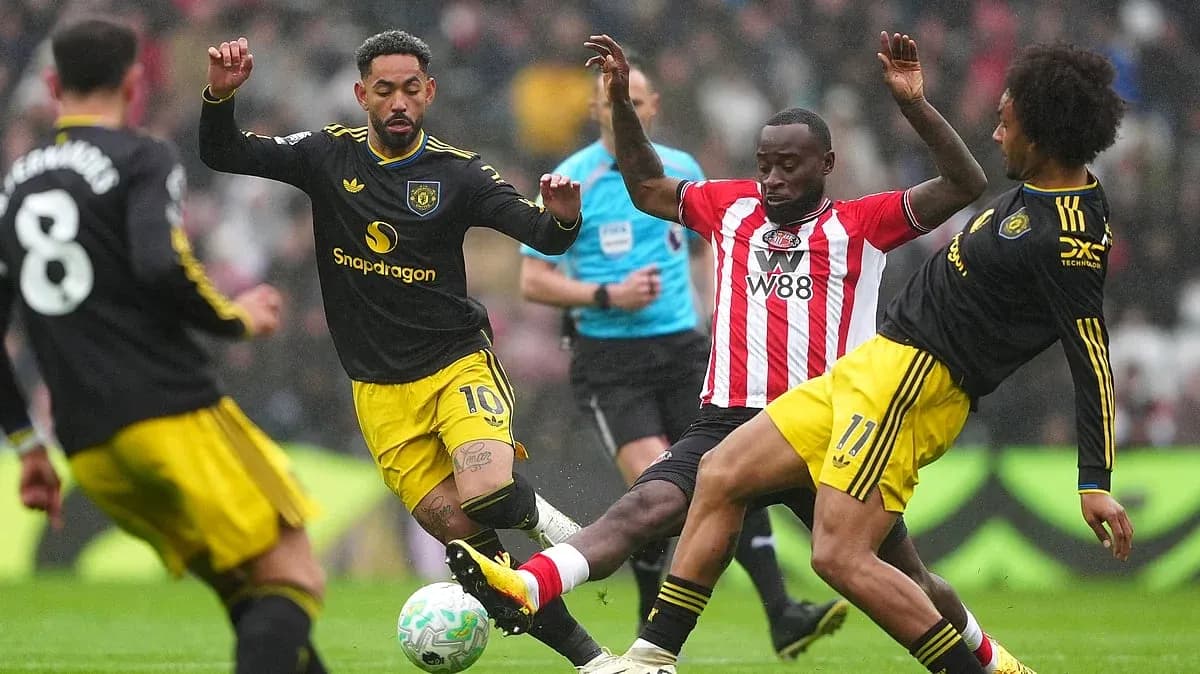
Sunderland and Manchester United played out a goalless but tactically rich 0–0 at the Stadium of Light in Round 36 of the Premier League, a match defined more by structure and control than by chaos. Sunderland shaded possession 51–49, generated the higher attacking volume and xG (1.25 to 0.62), and forced Senne Lammens into four saves, yet could not convert their territorial edge into a decisive moment. United, under Michael Carrick, accepted long spells without the ball, defended compactly, and relied on transitions through their attacking midfield line, but rarely broke Sunderland’s defensive shell or seriously tested Robin Roefs.
The disciplinary story belonged entirely to Manchester United. All three cards went to the visitors, and must be read as pressure points in a game where they were often second-best territorially.
Disciplinary Log
54' Mason Mount (Manchester United) — Foul
58' Joshua Zirkzee (Manchester United) — Foul
90+3' Matheus Cunha (Manchester United) — Simulation
Total cards: Sunderland: 0, Manchester United: 3, Total: 3.
Those bookings map neatly onto the game’s phases. Mount’s 54' yellow came just after half-time, at a stage when Sunderland’s midfield pairing of Granit Xhaka and Noah Sadiki were starting to pin United deeper, forcing Mount and Kobbie Mainoo into more emergency defending. Zirkzee’s 58' card, also for “Foul”, underlined how often United’s nominal striker had to defend from the front and disrupt Sunderland’s build-up, rather than stay high as a pure reference point. Cunha’s 90+3' yellow for “Simulation” capped a frustrated attacking display, United’s No.10 trying to manufacture a decisive moment in stoppage time rather than create it through collective structure.
Substitution Vector
Substitution vector, in strict event order, further explains the tactical adjustments:
- 65' Patrick Dorgu (IN) came on for Joshua Zirkzee (OUT)
- 75' Bryan Mbeumo (IN) came on for Amad Diallo (OUT)
- 79' Nilson Angulo (IN) came on for Chemsdine Talbi (OUT)
- 90' Eliezer Mayenda (IN) came on for Trai Hume (OUT)
Carrick’s first change at 65' — Dorgu (IN) for Zirkzee (OUT) — signalled a shift away from a classic centre-forward profile. Removing Zirkzee after his booking both reduced disciplinary risk and allowed United to re-balance their shape, likely pushing a midfielder higher or using Dorgu to stabilise the flank and protect Luke Shaw. Ten minutes later, at 75', Bryan Mbeumo (IN) for Amad Diallo (OUT) added a more direct, vertical threat on the break, an attempt to exploit space as Sunderland committed more numbers forward.
Regis Le Bris, by contrast, delayed his attacking tweaks. At 79', Nilson Angulo (IN) for Chemsdine Talbi (OUT) refreshed Sunderland’s left-sided attacking lane, trading Talbi’s midfield craft for more penetration between lines. The final change at 90' — Eliezer Mayenda (IN) for Trai Hume (OUT) — was a late, high-risk push: sacrificing a midfielder for another forward to chase a late winner, even if time was too short to reshape the underlying dynamics.
Tactical Analysis
Tactically, Sunderland’s plan was clear: controlled possession, structured build-up, and a multi-layered midfield. With Robin Roefs attempting to build from the back, the defensive line of Lutsharel Geertruida, Nordi Mukiele, Omar Alderete, and Reinildo Mandava provided width and progression. The passing data — 493 total passes at 84% accuracy — shows a side comfortable circulating the ball to move United’s block. Xhaka anchored the midfield, offering tempo and security, while Sadiki and Trai Hume provided energy and vertical runs. Enzo Le Fée and Chemsdine Talbi operated as advanced connectors, feeding Brian Brobbey, whose presence helped pin Maguire and Lisandro Martínez.
Sunderland’s 15 total shots (4 on goal, 6 off, 5 blocked) and 9 efforts inside the box demonstrate that the structure worked up to the final action. The xG of 1.25 reflects a steady accumulation of half-chances rather than one glaring miss. Yet Lammens’ four saves and United’s 5 blocked shots underline how Carrick’s side protected the central lane, forcing Sunderland into contested shooting zones rather than clean looks.
United’s approach was more conservative. With 478 passes at 82% accuracy and just 11 shots (1 on goal, 5 off, 5 blocked), they accepted a lower attacking volume in exchange for compactness. The back four of Noussair Mazraoui, Harry Maguire, Lisandro Martínez, and Luke Shaw sat relatively narrow, with Mainoo and Mount tasked with screening Sunderland’s No.10 spaces. Bruno Fernandes and Matheus Cunha floated between lines, but with Zirkzee often isolated, United struggled to sustain attacks in Sunderland’s half.
Defensively, though, they were efficient. The xG against of 1.25, combined with Lammens’ 4 saves and 5 blocks in front of him, indicates a unit that allowed territory but limited truly high-quality chances. Offensively, the 0.62 xG and only 1 shot on target show a lack of incision; Cunha’s late “Simulation” booking is emblematic of a side short on genuine solutions in the final third.
From a goalkeeper reality perspective, the contrast is stark: Roefs registered just 1 save, reflecting United’s limited threat, while Lammens had to intervene 4 times. Yet both ended with a clean sheet, supported by disciplined defensive lines and identical foul counts (12–12). The symmetry in fouls but asymmetry in cards (0 vs 3) suggests United’s infractions were more situationally risky — often in transition or under pressure — whereas Sunderland’s were more evenly distributed and less conspicuous.
Statistically, Sunderland’s 51% possession, superior shot volume, higher xG, and better passing accuracy point to a home side that controlled the match’s tempo and territory. United’s resilience, however, preserved a point. For Sunderland, this was a demonstration of a solid Overall Form and a robust Defensive Index, conceding just 0.62 xG and 1 shot on target. For United, the Defensive Index remains respectable — limiting a proactive opponent to 1.25 xG away from home — but the Overall Form in attack is a concern, with too little end product from a technically gifted midfield line.