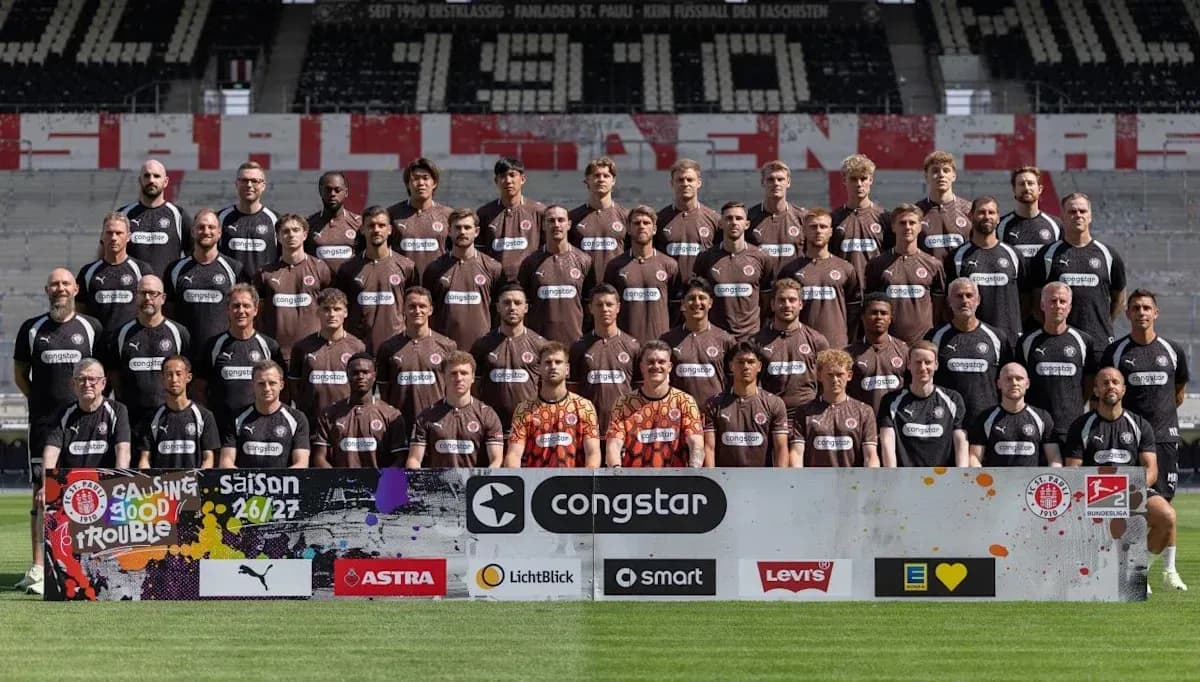
St. Pauli's Bold Reboot After Relegation
The party didn’t last long.
After the emotional high of 2024/25, when St. Pauli finally stayed in the Bundesliga for the first time since 1995/96, the crash was ruthless. Six wins, eight draws, twenty defeats. Bottom of the table in 2025/26. Relegated without argument.
The hangover has been just as heavy. Key players gone. The coach dismissed. A squad stripped of some of its heartbeat. Yet as the new season in the 2. Bundesliga looms, there’s a familiar feeling around the Millerntor: defiance. This club has been here before. It rarely stays quiet for long.
A captain leaves, a spine ripped out
Relegation always brings an exodus, but the scale of this summer’s departures in Hamburg cuts deep.
The headline loss is clear: Jackson Irvine.
153 appearances, 15 goals, 21 assists, promotion captain, community figure, cult hero. He didn’t just play for St. Pauli; he lived the club. His decision to request a move to Cerezo Osaka caught many off guard, not least because the transfer was announced less than a week before the opening fixture of the new season. One of the faces of the revival, gone in a flash.
The damage doesn’t stop there.
In goal, Nikola Vasilj has left for Al-Diriyah on a free after 167 appearances and 43 clean sheets. At the back, Karol Mets has joined Bochum, also on a free, after 91 games in brown and white. Manolis Saliakas has moved to Olympiacos for €1.3 million, while Hauke Wahl has been picked up by Wolfsburg for €2 million. Further up the pitch, Daniel Sinani has left for Sampdoria on a free after 70 appearances.
That’s not just turnover. That’s a core being torn out. A dressing room reset, forced by the drop.
The board’s first big response came on the touchline. Alexander Blessin, who couldn’t keep the club afloat last season, was dismissed in the weeks after relegation. In his place, St. Pauli have turned to a coach who knows how to drag an underdog upwards: Marcel Rapp.
Rapp’s arrival: a promotion coach for a promotion project
At 47, Marcel Rapp arrives from Holstein Kiel with something St. Pauli desperately need: recent proof that he can build a promotion side. In 2023/24, he led Kiel to the Bundesliga for the first time in their history. The same season St. Pauli won the league. Now those two storylines collide.
Rapp inherits a club that demands not just results but identity. He also inherits a squad that has lost its captain, its goalkeeper, and several of its defensive pillars. Yet the summer has not been about retreat. It’s been about targeted, pragmatic rebuilding.
Up front, St. Pauli have moved for a proven goalscorer: Branimir Hrgota.
Signed on a free from Fürth, the Bosnian forward is Fürth’s all-time leading scorer in the top two tiers of German football, with 69 goals and 41 assists in 238 appearances. He knows the league, knows the grind, and knows what it takes to lead a promotion push. His 16 goals and 7 assists in 2020/21 fired Fürth back to the Bundesliga for only the second time in their history.
This is not a speculative punt. It’s a calculated move to replace lost leadership and add teeth to the attack without a transfer fee.
At the back, Rapp has been handed Marcus Mathisen, a seasoned centre-back from Magdeburg, again on a free. With so much experience gone from the defensive line, Mathisen’s arrival is not a luxury; it’s a necessity.
New coach, new spine, new tone. The question is how quickly it all clicks.
Pre-season hints: goals, gaps, and a painful setback
If pre-season is a rehearsal, St. Pauli’s summer tour suggested one thing above all: this team will not be dull.
It started in familiar surroundings, a city derby of sorts against Altona 93. St. Pauli rolled through that one 2-6, a statement of attacking intent even if the opposition was modest. Next came a 1-3 win over Regionalliga Nord side Kickers Emden. Businesslike, if not spectacular.
The third outing brought something more emotional: a meeting with Babelsberg, a club whose fans share a long-standing friendship with those at the Millerntor. On the pitch, St. Pauli were ruthless, winning 1-4. Abdoulie Ceesay stole the show with a first-half hat-trick, a performance that hinted at a breakout campaign.
Then came the first real test against European opposition: Croatian side Gorica. St. Pauli edged it 2-1, with Louis Oppie and Ricky-Jade Jones on the scoresheet. But the victory came at a cost. Ceesay, fresh off his hat-trick, suffered a capsule-ligament injury in his right ankle. A sharp blow to Rapp’s attacking options before the season even begins.
The penultimate friendly raised the level again. Premier League and Europa League participants Bournemouth awaited in Austria, and this time St. Pauli were outgunned. Kaars gave them a 22nd-minute lead, but the side then unravelled, conceding four times in 27 minutes in a 4-1 defeat. It was a reminder of the gap to top-level pace and precision, and of the defensive work still to be done.
The final dress rehearsal came back home at the Millerntor against newly promoted LaLiga side Deportivo de La Coruña. Twice St. Pauli went ahead, first through Taichi Hara, then through Kaars. Twice they were pegged back, the second time in the 84th minute as the Spaniards forced a 2-2 draw. Encouraging in attack, frustrating in game management.
Pre-season rarely tells the whole truth. But it has at least revealed the outline of Rapp’s St. Pauli: brave going forward, still learning how to close the door.
Shape and selection: a three-man back line and a crowded attack
Tactically, Rapp is not expected to rip everything up. A three-at-the-back system looks set to remain, with adjustments rather than revolution.
With Eric Smith’s fitness still uncertain ahead of the opener against Fürth, the back three will likely see either Tomoya Ando or Adam Dzwigala slot in alongside Nemeth and the new man Mathisen. Stability there will be crucial after so much turnover.
In midfield, the plan seems clearer. Fujita is poised to anchor the centre, partnered by either Rasmussen or Metcalfe. On the flanks, Pyrka and Oppie are the likely starters, offering width and energy. Lars Ritzka and Erik Ahlstrand stand ready as reliable depth options in the middle, important in a league that punishes thin squads.
Up front, Rapp has options, even with Ceesay sidelined for now. Hrgota is expected to operate just off the main striker, paired with either Jones or Hara, while Kaars leads the line as the spearhead. Once Ceesay returns, that competition intensifies, giving St. Pauli multiple looks in the final third.
A likely starting shape? Something close to a 3-4-2-1:
Voll – Nemeth, Mathisen, Ando – Pyrka, Rasmussen, Fujita, Oppie – Hrgota, Jones – Kaars.
It’s not the most star-studded XI the club has fielded in recent years, but it has balance, experience, and just enough unpredictability to trouble opponents.
The stakes: history warns, the squad answers back
Relegation scars don’t fade quickly at the Millerntor. The last time St. Pauli dropped from the Bundesliga before this latest fall, back in 2010/11, it took 13 long years to return. The club’s quickest-ever bounce-backs to the top flight have taken four seasons, achieved twice in the 1990s and early 2000s.
That history hangs over this campaign. Another long exile is unthinkable for many supporters, but the 2. Bundesliga rarely respects sentiment.
Yet there are reasons to believe this time could be different.
Despite losing leaders and long-serving regulars, St. Pauli still boast one of the strongest cores in the division. The club’s squad is currently the second most valuable in the 2. Bundesliga, behind only VfL Wolfsburg – even if the gap to Wolfsburg is close to €200 million. That financial and sporting muscle matters over a 34-game slog.
Pre-season has shown they can still punch up, still impose themselves on better-funded sides for stretches. With Rapp’s track record, Hrgota’s goals, and a group of players who know the club and the league, this is not a typical relegated side forced into a full reset. It’s a damaged contender trying to reassemble itself on the fly.
Wolfsburg will start as clear favourites for the title. Behind them, the race for second and third is wide open. Hannover are circling. Heidenheim, also fresh from relegation, will have their own designs on an instant return. The margins will be thin.
Where does that leave St. Pauli?
On paper, they should not finish outside the top six. If the new arrivals bed in quickly, if Rapp’s structure tightens the defence without blunting the attack, a genuine shot at the top three is there.
The club has known long waits and sudden rises. Now comes the next test: is this the start of another slow climb, or the launchpad for an immediate return to the Bundesliga?