South Africa's Late Fight in Women's Africa Cup of Nations Draw
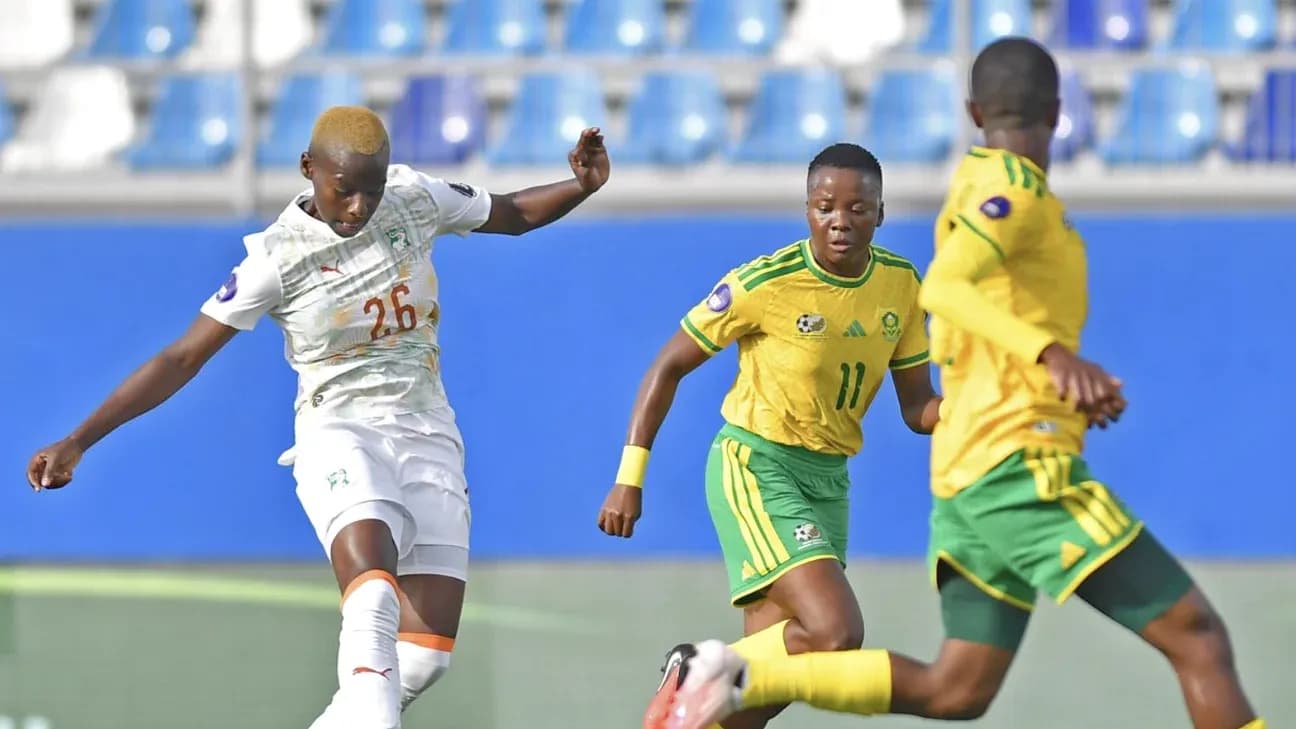
South Africa left Casablanca with their tournament life still flickering, not flourishing, after a wild 2-2 draw with Ivory Coast that mixed frailty, fight and a reminder of why Thembi Kgatlana still matters on the biggest African stage.
For 70 minutes, Banyana Banyana looked like a side drifting towards the exit door of the Women's Africa Cup of Nations. Two ruthless Ivorian counter-attacks had cut them open, their defensive shape torn apart and their star striker stranded up front, chasing shadows.
Then the game turned. Not suddenly, but with the slow, stubborn insistence of a team refusing to accept its fate.
Carved open, caught cold
Desiree Ellis’s side started flat and stayed that way for most of the first half. Ivory Coast, sharper and more direct, did not need a second invitation.
On 18 minutes, Banyana were sliced open on the break, and Grace Sery finished to punish them. Eighteen became 36, and the same pattern played out again: South Africa over-committed, the back line exposed, Sery striking once more. Two attacks, two goals, and Banyana’s campaign looked in serious trouble.
South Africa barely laid a glove on Ivory Coast before the interval. One move stood out: Linda Motlhalo threading a clever ball through for Kgatlana, forcing goalkeeper Aramatou Diakité to race off her line and smother. Aside from that, nothing. Kgatlana, so often the heartbeat of this team, drifted on the fringes of the contest, isolated and anonymous.
For those who had started to wonder whether her best days in Banyana colours were behind her, the first half felt like more evidence.
The second half tore that script up.
Kgatlana answers back
Kgatlana has always thrived when someone connects the dots around her. In the past, that link was Jermaine Seoposenwe, whose movement and intelligence created the lanes that Kgatlana devoured. Since Seoposenwe’s retirement last year, nobody has truly replaced her.
On Friday, Ronnel Donnelly stepped into the storm.
The Mamelodi Sundowns striker has absorbed more than her share of criticism, particularly given her limited club minutes. Yet Ellis keeps writing her name on the team sheet. In Casablanca, the reason became clear.
Donnelly does not mimic Seoposenwe. She imposes herself differently – by dragging centre-backs into places they do not want to go, by contesting everything in the air, by turning long, hopeful balls into something to fight for. She gives others space.
Shortly after coming on, she created some for herself, carving out a shooting chance in the box. When she failed to pull the trigger, the moment seemed to have gone. Instead, the ball was recycled, worked back to Kgatlana on the edge of the area.
This time, South Africa’s number one forward took charge.
Kgatlana cut inside, found her angle and drilled home with just under 20 minutes plus stoppage time to play. One swing of her boot, and the narrative around her tournament shifted. From doubt to defiance.
The goal jolted Banyana to life. The urgency they had lacked for an hour suddenly surged through the side. Every second ball mattered. Every run had purpose.
Donnelly’s moment, Magaia’s finish
Ivory Coast, who came into the game buoyant after a 4-1 demolition of Burkina Faso in their opener, had looked in control at 2-0 up. They now found themselves clinging on.
South Africa pushed higher. The passes became riskier, the duels fiercer. Donnelly kept fighting, backing into defenders, jumping for everything, making herself impossible to ignore.
Deep into stoppage time, the pressure finally told.
A hopeful ball forward became a weapon when Donnelly rose and flicked it on. The header did not need to be pretty; it only needed to be precise. It was. Hildah Magaia read it, burst through and lashed home the equaliser with conviction.
From 2-0 down and seemingly out of ideas, Banyana had dragged themselves level at the death. Not enough to secure qualification, but enough to keep the door open. Enough to remind the continent that this is still a team with teeth.
Group on a knife-edge
The draw leaves Group B finely poised.
Ivory Coast sit on four points from two games with a goal difference of +3, boosted by that 4-1 win over Burkina Faso. Tanzania, who beat South Africa 2-1 in their opener, went into their Friday night meeting with Burkina Faso on three points and a +1 goal difference.
South Africa now have a single point from two matches and sit at -1 on goal difference. Burkina Faso, beaten by Ivory Coast and yet to earn a point, remain bottom.
The arithmetic is brutal. Banyana Banyana must beat Burkina Faso on August 4 to have any chance of reaching the quarter-finals. A draw will not do. A narrow win might not either, with head-to-head records acting as the primary tiebreaker for teams level on points, ahead of goal difference.
In short: they need victory, and they may need it in style.
Ellis’s big call
That late surge against Ivory Coast has handed Ellis both a lifeline and a dilemma.
If she wants South Africa to start on the front foot, chasing goals rather than control, the evidence from Casablanca points in a clear direction. The combination of Donnelly, Kgatlana, Magaia and Lebogang Ramalepe as a front four unsettled a strong Ivorian side and finally gave Banyana the attacking edge they had lacked.
Donnelly’s physical presence, Kgatlana’s movement in behind, Magaia’s timing from deeper areas, Ramalepe’s energy – it worked. Not perfectly, not for long enough, but well enough to turn a lost cause into a salvage job.
With World Cup places on the horizon – the four WAFCON semi-finalists will qualify automatically for the 2027 FIFA Women’s World Cup in Brazil, and the two best losing quarter-finalists will get a second shot via African playoffs and the Inter-Confederation Playoff – South Africa cannot afford another slow start.
They are not out. They are not safe either.
What they showed in the final minutes against Ivory Coast was pride and resistance, the kind of edge that carried them to the continental title before. Against Burkina Faso, that spirit cannot be a late cameo.
It has to be the opening act.