Socceroos Draw with Paraguay: A National Event
Australia used to stop for a horse race. On Friday, it stopped for a stalemate.
For 90 tight, nervous minutes, the Socceroos inched their way to a 0-0 draw with Paraguay that felt far bigger than the scoreline. It was enough to send them into the World Cup knockout phase for a second straight tournament, and enough to freeze a working nation in its tracks in the middle of the afternoon.
A country clocks off
From early morning, pubs in Sydney, Melbourne and beyond were rammed with gold and green. Office workers arrived with laptops under one arm and pints in the other, half-typing, half-praying.
At the Golden Barley in Sydney’s inner west, brothers Jamie and Rick Hayman were among those who refused to let a day job get in the way. Rick, who runs a local construction company, sat with his staff, work admin open, eyes fixed on the screen.
He has followed the Socceroos “forever”, but he has rarely seen this.
“It unites the community,” he said. “That’s what you notice. Pubs get filled up, there’s all the talk around town, it’s really good to see.”
This was history: the first time a Socceroos World Cup match had kicked off entirely within Australian working hours. No alarms at 3am. No bleary-eyed commutes. Just a long lunch that turned into a national event.
In the front row of the Golden Barley, four old friends had taken up residence as soon as the doors opened. Nick, Guinness in hand, wore an original 1974 Socceroos jersey, a relic from the year Australia first made it to a World Cup. The shirt hung like a bridge between eras.
Nick and his partner Robyn, veterans of those brutal time zones, almost missed the ordeal.
“We were just saying this morning, we used to wake up in the middle of the night, it used to be really good,” he said, laughing. “It’s a unique experience. A family experience.”
This time, the family experience came with daylight.
Sardines in the rain
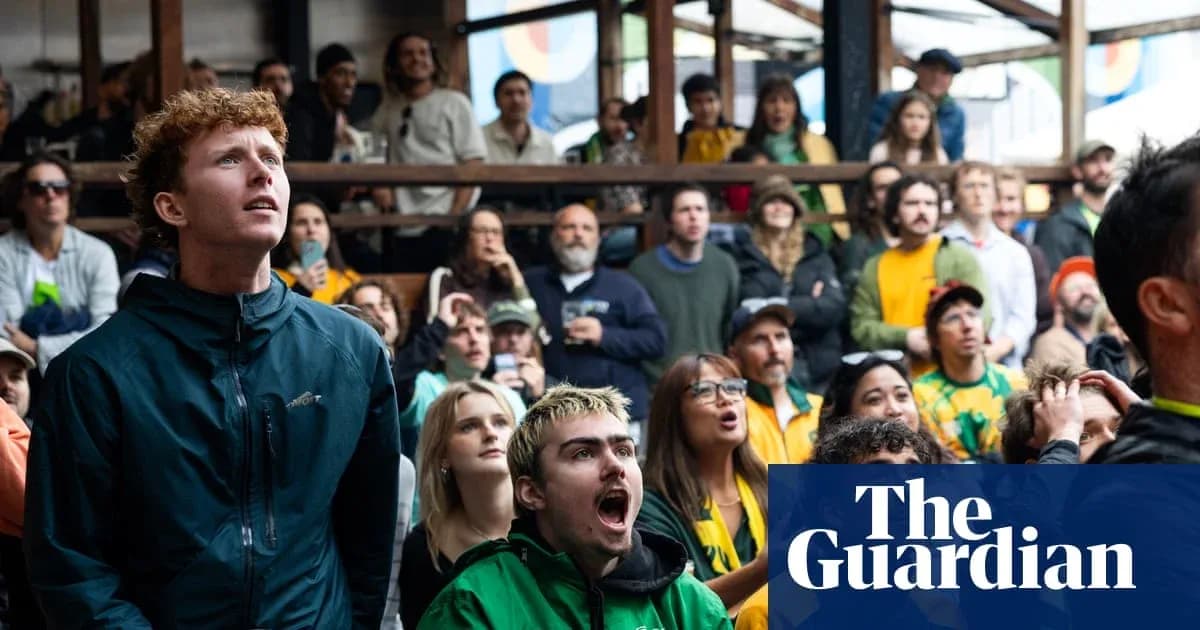
Down the road at the Vic on the Park, there was barely room to breathe. Hundreds of fans squeezed into the beer garden and bars, a restless mix of joy and dread.
When the rain swept in during the first half, jackets and scarves became makeshift umbrellas. Ponchos appeared from backpacks. Nobody moved. Nobody was giving up their view.
For 80 goalless minutes, the tension built. A few defiant “Aussie, Aussie, Aussie” chants cut through the drizzle, joined by the howl of a dog in the front bar that somehow matched the mood perfectly. As the clock crawled towards full-time, each clearance drew cheers, each attack a sharp intake of breath.
When the final whistle confirmed progression, relief burst into celebration. A bald man with a stick-on Australian flag tattooed to his head hugged his mates like they had just won the whole thing.
Some had planned their day around this. Others improvised. Sophie and her son Orson, in year 11, had also been at the Vic the previous weekend when Australia lost 2-0 to the USA in the early hours. This time, Orson skipped the last day of term. Sophie worked quietly from her phone, eyes flicking between emails and the big screen.
“This is of national importance,” she said. “I really want Oscar to hear a goal in the pub, just to hear us lift.”
Oscar, who dreams of becoming a football coach, watched the crowd as much as the game.
“Football’s growing,” he said. “It’s been brilliant, so cool to see so many people supposed to be working coming to support their country.”
Federation Square turns into a cauldron
In Melbourne, Federation Square turned into a sea of yellow. Victoria Police estimated 7,500 fans crammed into the famous plaza, most of them arriving hours before kick-off. By 10am, it was full.
Fans killed time with high-stakes games of bottle flip, each successful landing greeted with wild, almost tearful roars. Teenagers bragged loudly about wagging school or winning reluctant parental permission to skip class. When the national anthem rang out, seven flares lit the sky, prompting police to arrest a 16-year-old.
The crowd heaved and swayed. Every so often, a surge from some unseen pocket sent people stumbling. Once they steadied themselves, thousands turned as one, hunting for the culprit and unleashing a single, booming “wanker” in unison. Police later said three teenagers were issued penalty notices for riotous behaviour and moved on.
In the middle of it all stood former Socceroo Craig Foster, soaking it in. For him, this was more than just a nervy point.
“It was a near perfect game for Australia,” he said. “The squad depth has been demonstrated. They’ve done exactly what was required … Australia is managing well, learning very quickly, and it’s a beautiful day anytime the Socceroos get through to knockout rounds.
“We are here. We’re still in this tournament, and we’re fighting all the way. There’s nothing better in life.”
A few metres away, teenager Ali Abolhasani and his friend were having a far less composed afternoon. They described being crushed against the barricade, falling to the ground, losing their shoes, and never once thinking of leaving.
Asked how he felt, Abolhasani needed just one word: “Amazing.”
“I can’t wait to come back next week,” he said. “We did an all-nighter, we couldn’t sleep because we knew we’d make it … We’ll do it again.”
Capital fever
Even in Canberra, where the World Cup has sometimes felt distant, the fever finally took hold. More than 500 fans gathered at Garema Place, squinting at a modest two-screen setup that felt too small for the occasion but just big enough for a shared experience.
Among them was ACT senator David Pocock, who has watched the Socceroos from the stands and from parliament. He spoke of the crowd as a snapshot of modern Australia.
“The Socceroos, as it’s been talked about this week in parliament, represents what is so great about Australia,” he said. “We do have so many people from diverse backgrounds coming together, and you see the way that that resonates across the country.”
From a packed pub in Sydney to a jammed square in Melbourne and a chilly plaza in Canberra, the story was the same: a nation that once set its clock by a horse race now clears its calendar for a football team.
The scoreline read Paraguay 0, Australia 0. The impact felt far bigger. The Socceroos are through again. And next week, when they walk out for the knockout rounds, how many more will be willing to down tools, skip class and stop their day for 90 more minutes?