Shakira's Controversial World Cup Performance: Was It Really Her?
The World Cup had barely drawn its first breath when the first controversy arrived, and it had nothing to do with VAR, offside lines or added time.
On Thursday 11 June, Mexico City staged a lavish opening ceremony for the 2026 World Cup. Fireworks tore across the sky, a star-studded lineup rolled through the playlist – J Balvin, Maná, Lila Downs and, inevitably, Shakira, who by now has turned up at more World Cups than her former partner Gerard Piqué ever played in.
Yet it wasn’t the pyrotechnics or the setlist that hijacked the conversation. It was a theory.
Within hours of the final note, social media feeds filled with claims that the woman performing the tournament’s official anthem, ‘Dai Dai’, was not actually Shakira. The clips spread fast. Slowed-down videos, zoomed-in screenshots, side-by-side comparisons. One user on X wrote: “That’s not Shakira. Look how she misses the step when she sings ‘Dai Dai’. That’s a double. Shakira lied to everyone.”
The supposed smoking gun? Her appearance.
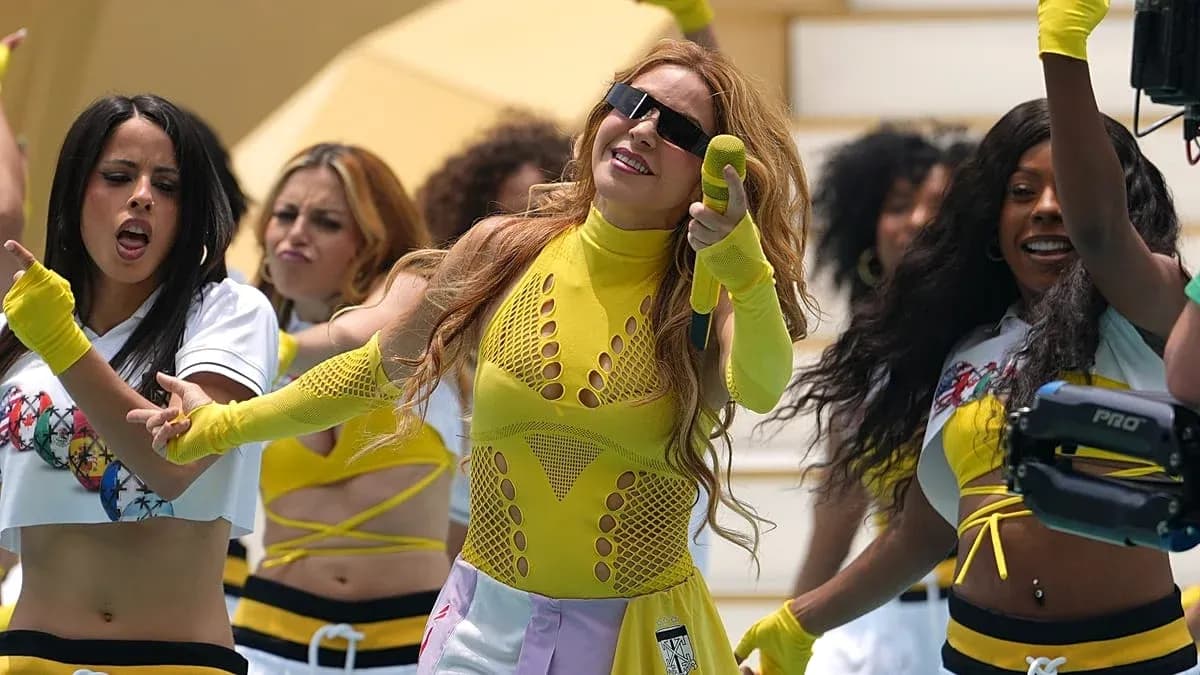
Shakira sprinted onto the pitch in a bright yellow top, white shorts, platform trainers and oversized dark sunglasses that swallowed half her face. Her hair, fans argued, looked a slightly different shade from the look they had grown used to over the years. With her eyes hidden and the colour tweaked, the conspiracy had its spark. X and TikTok did the rest.
Every gesture was dissected. Every turn of the head, every beat of the choreography, every second where the camera caught her at an awkward angle was seized on as “proof” that something was off. The World Cup curtain-raiser, designed to project spectacle and unity, suddenly had a side plot: was that really Shakira on the grass of Mexico City, or a meticulously drilled stand-in?
Her camp has stayed silent. No statement, no denial, no behind-the-scenes footage to swat away the rumours. That vacuum left plenty of room for imagination. Yet buried in the images from the night is one detail that cuts through the noise.
Shakira has a small scar on her forehead, a faint but distinct mark that has appeared in countless photographs over the years. It was visible in pictures from an event in New York in May 2026, distributed by the Associated Press, just as it has been in red-carpet shots and concert stills long before this World Cup.
Look closely at the high-definition photos from the opening ceremony. The same scar is there.
Could a body double have spent months studying her every move, memorising the choreography, matching her hair, her build, her stage swagger, and then gone one step further by reproducing a tiny facial scar to trick millions of viewers and dozens of ultra-sharp broadcast cameras?
In theory, anything is possible. In reality, the simpler explanation tends to win.
This looked like Shakira, moved like Shakira, sounded like Shakira and carried the same small scar Shakira has worn for years. The internet will keep arguing, of course. That’s what it does. But on the evidence in front of us, the performer who opened the 2026 World Cup was not a decoy, not a clone, not a carefully crafted impostor.
It was Shakira. And, as she once reminded the football world, those hips don’t lie.